Humphrey Lyttelton: The Life of a Jazz Legend and Broadcasting Icon
Humphrey Richard Adeane Lyttelton, known affectionately as Humph, was a towering figure in British cultural life. A virtuoso jazz musician, a distinguished broadcaster, and a master of deadpan comedy, Lyttelton bridged the gap between high art and popular entertainment for over six decades. From his early days as a self-taught trumpeter at Eton College to his tenure as the UK's oldest panel game host, his career was defined by a commitment to musical authenticity and a sharp, understated wit.
Key Facts
- Musical Legacy: A professional jazz musician and composer active from 1945 to 2008, specializing in trumpet and clarinet.
- Broadcasting Career: Hosted The Best of Jazz on BBC Radio 2 for 40 years and chaired the comedy hit I'm Sorry I Haven't a Clue.
- Military Service: Served as a second lieutenant in the Grenadier Guards during World War II, seeing action during Operation Avalanche in Italy.
- Chart Success: Achieved a UK Singles Chart hit in 1956 with "Bad Penny Blues".
- Artistic Pursuits: Worked as a cartoonist for the Daily Mail and was a passionate calligrapher.
Early Life and Military Service
Born on May 23, 1921, at Eton College in Buckinghamshire, Lyttelton was born into a family with deep aristocratic ties; his father, George William Lyttelton, was a house master at the school. It was during his time at Eton that Lyttelton discovered his passion for jazz, drawing inspiration from legends like Louis Armstrong and Nat Gonella. He taught himself the trumpet and formed his first quartet in 1936.
After a brief period working at the Port Talbot steel plate works in South Wales—an experience that shaped his "romantic socialist" views—Lyttelton was called to military service. Commissioned into the Grenadier Guards on November 29, 1941, he participated in the invasion of Salerno, Italy, during Operation Avalanche. In a moment of legendary eccentricity, he is noted to have come ashore with a pistol in one hand and his trumpet in the other.
His first broadcast performance occurred inadvertently on VE Day in May 1945, when he played the trumpet from a wheelbarrow during the celebrations. Following the war, he expanded his artistic horizons by attending Camberwell Art College.
A Distinguished Career in Jazz
Lyttelton's musical journey began in the postwar era, where he became a central figure in the British revival of traditional New Orleans jazz. In 1949, he famously defied the restrictive practices of the Musicians' Union—which forbade collaborating with American jazz musicians—to record with Sidney Bechet.
Throughout the 1950s, Lyttelton evolved his sound. While he initially focused on Dixieland (a early 20th-century style of New Orleans jazz), he gradually shifted toward a more mainstream approach. This transition was not without controversy; in 1953, fans of the traditional style protested the addition of saxophonists to his band, with some labeling the new sound as "bopper" music.
In 1956, he achieved commercial success with the Joe Meek-produced "Bad Penny Blues," which spent six weeks on the UK Singles Chart. Over the years, he collaborated with American greats such as Buck Clayton, Jimmy Rushing, and Big Joe Turner. In 1983, he founded Calligraph Records to manage his own recordings and those of his associates.
The Humphrey Lyttelton Band
For much of his career, Lyttelton led an eight-piece ensemble. The band was renowned for its rigorous touring schedule and high-profile collaborations. In the 1990s, they toured with Helen Shapiro, and later worked with singer Elkie Brooks. Notably, in 2001, the band contributed to the track "Life in a Glasshouse" on Radiohead's album Amnesiac.
The Voice of the BBC
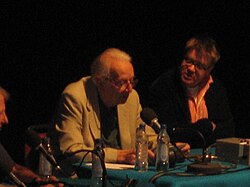
Lyttelton's influence extended far beyond the bandstand. From 1967 to 2007, he presented The Best of Jazz on BBC Radio 2, where he shared his vast knowledge of the genre with a wide audience. However, he perhaps became most beloved as the chairman of the BBC Radio 4 comedy panel game I'm Sorry I Haven't a Clue (ISIHAC), a role he held from 1972 until his death.
On ISIHAC, Lyttelton perfected a persona of the disgruntled, deadpan chairman. He was celebrated for his mastery of the double entendre and innuendo, creating a style of humor that was sophisticated yet daring. His association with the show's fictional game, "Mornington Crescent," became a cultural touchstone in the UK.
Personal Life and Final Years
Lyttelton was married twice: first to Patricia Mary Braithwaite (div. 1952) and later to Elizabeth Jill Richardson, who passed away in 2006. He was a man of strong convictions, twice refusing state honors, including a knighthood in 1995, as he felt such recognition was unnecessary.
In April 2008, Lyttelton was hospitalized to treat an aortic aneurysm. Despite his illness, he showed remarkable resilience, performing in nearly all of his scheduled tour dates before his surgery. He passed away on April 25, 2008, surrounded by his family.
His legacy continues through The Humph Trust, established by his son Stephen to support aspiring jazz musicians. Additionally, the Lyttelton Arms pub in Camden stands as a permanent tribute to his memory.
| Category | Details |
|---|---|
| Primary Instruments | Trumpet, Clarinet |
| Key Radio Shows | The Best of Jazz (Radio 2), I'm Sorry I Haven't a Clue (Radio 4) |
| Notable Hit | "Bad Penny Blues" (1956) |
| Military Unit | Grenadier Guards (WWII) |
| Record Label | Calligraph Records |
Frequently Asked Questions
What was Humphrey Lyttelton's role on I'm Sorry I Haven't a Clue?
He served as the chairman and host of the comedy panel game from 1972 until 2008, known for his deadpan delivery and use of sophisticated innuendo.
Which jazz instruments did Humphrey Lyttelton play?
He was primarily a trumpet player, having taught himself the instrument at Eton College, but he also played the clarinet.
Did Humphrey Lyttelton have any success in the pop charts?
Yes, in 1956 he had a hit single titled "Bad Penny Blues," produced by Joe Meek, which remained in the UK Singles Chart for six weeks.
Why did he refuse a knighthood?
Lyttelton twice declined state honors, including a knighthood in 1995, as he did not believe accepting such titles was the right path for him.
What is The Humph Trust?
Founded by his son Stephen Lyttelton, The Humph Trust is an organization dedicated to providing sponsorship and support for young, up-and-coming jazz musicians.