Humboldt Current: The Engine of South America's Marine Productivity
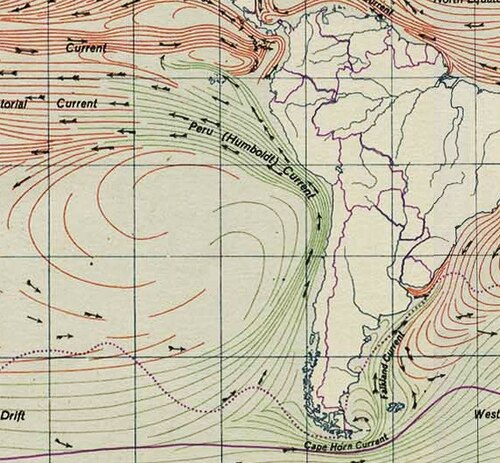
The Humboldt Current, also known as the Peru Current, is a cold, low-salinity ocean current that flows north along the western coast of South America. As an eastern boundary current moving toward the equator, it extends between 500 and 1,000 km (310–620 mi) offshore. While named after the German naturalist Alexander von Humboldt, who documented its measurements in his 1846 book Cosmos, the current was actually discovered by José de Acosta 250 years prior.
This massive system stretches from southern Chile (approximately the 45th parallel south) to northern Peru (approximately the 4th parallel south). At its northern limit, these cold waters meet warm tropical waters to create the Equatorial Front. In some areas, such as the 5th parallel south off the coast of Peru, sea surface temperatures can drop to 16 °C (61 °F)—strikingly lower than the typical tropical average of over 25 °C (77 °F).
Key Facts
- Global Impact: Accounts for roughly 18-20% of the total worldwide marine fish catch.
- Climate Influence: Responsible for the extreme aridity of the Atacama Desert and coastal regions of Peru and southern Ecuador.
- Biological Status: Classified as a Class I highly productive ecosystem (>300 gC/m/yr).
- Key Species: Primarily supports pelagic fish such as anchovies, sardines, and jack mackerel.
- Environmental Risk: Highly susceptible to disruptions caused by the El Niño-Southern Oscillation (ENSO).
Physical Oceanography and Dynamics
The circulation of the Humboldt Current is primarily driven by trade winds. However, several other factors influence its variability, including latitudinal shifts between the trade winds and the Intertropical Convergent Zone (the region where northern and southern hemisphere trade winds meet), as well as the movement of the Southern Westerlies and cyclonic storms.
The current carries fresh, cold Sub-Antarctic surface water northward. Around the 18th parallel south, these waters mix with warm, high-salinity Subtropical Surface waters, leading to partial subductions. In the depths, the equatorial undercurrent (EUC) flows eastward, feeding the Peru-Chile undercurrent (PCU) which moves poleward.
Off the coast of central Chile, a coastal transition zone (CTZ) exists, characterized by high eddy kinetic energy. This creates mesoscale eddies that extend 600–800 km (370–500 mi) offshore. Within this zone, high concentrations of chlorophyll-a (a pigment used to measure phytoplankton biomass) are found, typically within 50 km of the coast.
](/images/ae/60/ae600455c414241f3aa8512f1d086056b32c8721e66230db5fdcfb6013244004.png)
The Oxygen Minimum Zone (OMZ)
A defining feature of the system is the intense Oxygen Minimum Zone (OMZ), the fourth largest permanent hypoxic (low-oxygen) zone in the world's oceans. Covering approximately 2.18 ± 0.66 million km², the OMZ is caused by a lack of ventilation as the current veers offshore in southern Peru, combined with the sinking and decay of organic matter. The core of this zone is centered off Peru, reaching from 100 m to 600 m deep.
This hypoxic environment forces many organisms to remain near the surface. Interestingly, about 75% of the total zooplankton biomass move in and out of the OMZ, facilitating a significant exchange of carbon between the surface euphotic layer (the sunlit top layer of the ocean) and the depths.
Coastal Upwelling
The high biological productivity of the region is driven by upwelling—the process where deep, cold, nutrient-rich water rises to the surface. This occurs in three distinct patterns:
- Seasonal Upwelling: Occurs in Chile during spring and summer (January–March).
- Upwelling Shadow: A less productive region between 35°S and 15°S caused by the subtropical gyre.
- Year-round Upwelling: Highly productive and consistent along the coast of Peru.
![La Silla observatory is in the Southern outskirts of the Atacama Desert, one of the driest places on Earth, it may come as a surprise to see cloud formations result of the Humboldt Current.[6]](/images/d9/04/d904cd5fabb24511224db1fa8abebfe572768fdcf834c970fa5fcdf0fb2242e3.jpg)
Biological Productivity and Fisheries
The constant supply of nutrients from upwelling supports a massive food web starting with phytoplankton. This productivity attracts a diverse array of mollusks, crustaceans, fish, marine mammals (such as cetaceans and eared seals), and seabirds.
The Humboldt Current supports some of the world's most successful commercial fisheries. The primary catches include:
- Anchoveta: Found close to the coast in recently upwelled waters.
- Sardines: Typically found further offshore.
- Jack Mackerel (Jurel): A straddling species found both inside and outside the 200-mile economic exclusive zone.
- Others: Hake, squid, tuna, and swordfish.
Population shifts are common; for example, sardines and anchovies often replace each other as the dominant species based on environmental changes. While the jurel fishery grew in the 1970s to reduce pressure on anchoveta, it suffered from overfishing in the 1980s before recovering following 1998 restrictions.
| Feature | Details |
|---|---|
| Geographic Range | Southern Chile (~45°S) to Northern Peru (~4°S) |
| Primary Driver | Trade Winds |
| Key Biological Process | Coastal Upwelling |
| Major Commercial Species | Anchoveta, Sardines, Jack Mackerel |
| Climate Impact | Cools coastal South America; creates Atacama Desert aridity |
| Global Fish Catch Share | 18-20% |
Influence of El Niño
The El Niño-Southern Oscillation (ENSO) periodically disrupts the system. During an El Niño event, the thermocline (the layer where temperature changes rapidly with depth) and the upper OMZ deepen to over 600 m. This leads to a loss of nitrogen and a decrease in carbon export.
These events often cause fish stock crashes with severe social and economic consequences. A notable example occurred in 1972, when an El Niño event caused the Peruvian anchoveta population to collapse. This triggered a "regime shift," where sardine populations increased dramatically over the following 15–20 years, shifting the focus of the fishing industry.
Frequently Asked Questions
Why is the Humboldt Current important for the global fishing industry?
It is the most productive eastern boundary current system in the world, accounting for approximately 18-20% of the total global marine fish catch, particularly for species like anchoveta and jack mackerel.
How does the current affect the weather on land?
The current cools the marine air, which inhibits precipitation. This is the primary reason for the extreme aridity of the Atacama Desert in Chile and coastal areas of Peru and southern Ecuador.
What is the Oxygen Minimum Zone (OMZ)?
The OMZ is a massive subsurface region with very low oxygen levels. It is the fourth largest permanent hypoxic zone in the world's oceans and restricts the vertical migration of many zooplankton species.
What happens to the ecosystem during an El Niño event?
El Niño deepens the thermocline and the OMZ, reducing nutrient availability. This often leads to a collapse in anchoveta populations and can cause a shift in dominance to other species, such as sardines.
Who discovered the Humboldt Current?
Although named after Alexander von Humboldt, who published measurements of the current in 1846, it was actually discovered by José de Acosta 250 years earlier.