Human Lips: Anatomy, Function, and Clinical Significance
The lips, known scientifically as the labia oris, are a pair of soft, movable appendages attached to the jaws. As the most visible part of the mouth in humans and many other animals, they serve as a critical interface between the external environment and the internal oral cavity. Beyond their aesthetic role, the lips are complex organs essential for eating, speaking, and sensory perception.
In mammals, the lips are highly flexible, facilitating the ingestion of food through actions like suckling and gulping. In humans, they also function as a sophisticated somatosensory organ, providing high sensitivity to touch and temperature, and acting as an erogenous zone during intimacy.
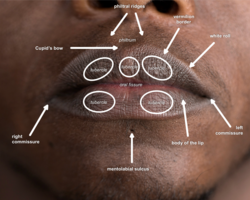
Key Facts
- Composition: The lips consist of the upper lip (labium superius oris) and lower lip (labium inferius oris).
- Unique Skin: Lip skin is significantly thinner than facial skin, lacking sweat glands and hair follicles.
- Coloration: The reddish hue of the vermilion zone is caused by blood vessels showing through thin skin with fewer melanocytes.
- Sensitivity: High concentrations of nerve endings make the lips highly sensitive to tactile stimuli.
- Motor Control: Lip movement is governed by muscles of facial expression supplied by the 7th cranial nerve (facial nerve).
Anatomical Structure
Surface Landmarks
The transition between the lips and the surrounding facial skin is marked by the vermilion border. The reddish area within this border is the vermilion zone. On the upper lip, the vermilion border forms a distinct shape known as the Cupid's bow.
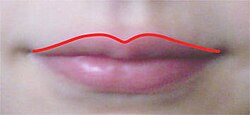
Other notable features include the procheilon (a fleshy tubercle in the center of the upper lip) and the philtrum, the vertical groove extending from the procheilon to the nasal septum.
Tissue and Microanatomy
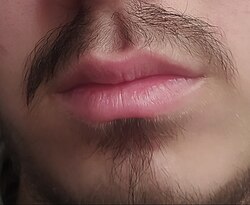
The skin of the lips is composed of stratified squamous epithelium. Unlike typical facial skin, which can have up to 16 cellular layers, lip skin only has three to five. Because the lips lack sweat glands and the protective layer of body oils found elsewhere on the face, they are prone to drying and chapping.
The lower lip is formed from the mandibular prominence of the first pharyngeal arch and covers the mandible. The upper lip covers the maxilla and is characterized by the philtrum and the distinct red tone of its lower half.
Internal Systems: Nerves, Blood, and Muscles
Nerve and Blood Supply
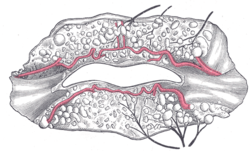
The lips are highly innervated to support their sensory functions. The infraorbital nerve (a branch of the maxillary nerve) supplies the upper lip, while the mental nerve (a branch of the mandibular nerve) supplies the lower lip and the anterior labial gingiva (gums).
Blood is supplied by the facial artery via the superior and inferior labial branches. These arteries bifurcate and connect (anastomose) with their counterparts from the opposite side of the face.
Muscular Control
The muscles acting on the lips are part of the muscles of facial expression, derived from the second pharyngeal arch. These muscles attach to the dermis, allowing them to wrinkle or dimple the skin to convey emotion.
| Function | Primary Muscles Involved |
|---|---|
| General Closure | Orbicularis oris, Buccinator |
| Elevation (Raising) | Levator labii superioris, Levator anguli oris, Zygomaticus major/minor |
| Depression (Lowering) | Depressor labii inferioris, Depressor anguli oris, Mentalis |
| Anchor Point | Modiolus |
Primary Functions
Food Intake and Articulation
The mobility of the lips allows humans to hold food, seal the mouth airtight to prevent leaks, and create a narrow funnel to increase suction. This suction is vital for infants during breastfeeding.

In speech, the lips are essential for creating labial, bilabial, and labiodental consonant sounds, as well as vowel rounding. They also enable the use of wind instruments and whistling. Furthermore, visual cues from the lips allow for lip reading, which is often used by individuals with hearing loss.
Sensory and Social Roles
Due to their dense nerve endings, the lips are a primary tactile organ used for exploring objects in early childhood and serve as an erogenous zone in adulthood. They are also central to facial expressions, such as smiling or frowning, which communicate emotional states.
Clinical Significance
The lips can manifest symptoms of various systemic and localized conditions:
- Cyanosis: A blue tint caused by low oxygen levels in the blood, often seen in cold weather or after death.
- Cheilitis: Inflammation of the lips, which includes chapped lips, angular cheilitis (corners of the mouth), and herpes labialis (cold sores).
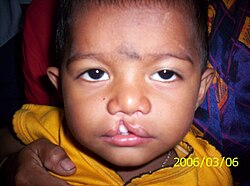
- Cleft Lip: A congenital birth defect that can be corrected through surgical intervention.
- Carcinoma: Malignant cancers caused primarily by tobacco use and UV exposure. Lower lip carcinomas are typically planocellular, while upper lip carcinomas can be basocellular.
Society, Culture, and Other Species
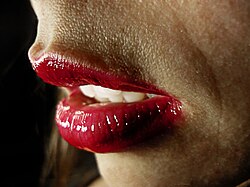
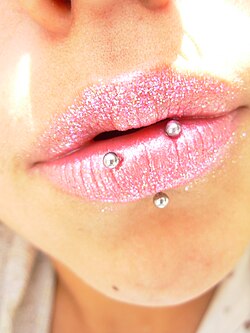
Culturally, lips are symbols of sensuality. This has led to various cosmetic practices, including the use of lipstick, lip gloss, and lip augmentation or piercings.
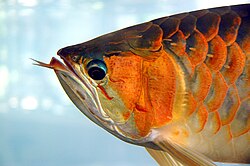
While most vertebrates have simple tissue folds, mammals have more prominent and mobile lips. In contrast, birds and turtles possess hard, keratinous lips that form a beak. Some fish have modified lips with sensitive barbels (whisker-like sensory organs).
Frequently Asked Questions
Why are lips redder than the rest of the face?
The skin on the lips is much thinner than facial skin and contains fewer melanocytes. This allows the underlying blood vessels to be more visible, creating the characteristic red color.
Why do lips chap more easily than other skin?
Lips lack sweat glands and sebaceous (oil) glands. Without the natural protective layer of oils and sweat, the skin loses moisture faster and is more susceptible to environmental damage.
What is the philtrum?
The philtrum is the vertical groove located in the center of the upper lip, extending from the nasal septum to the labial tubercle (procheilon).
What causes blue lips (cyanosis)?
Blue lips occur when the blood contains insufficient oxygen, causing it to turn a dark red or blue color. This is often triggered by extreme cold or underlying medical conditions.
Which nerve controls the movement of the lips?
The motor supply for the muscles of the lips is provided by the facial nerve, which is the 7th cranial nerve.