HMS Benbow: The Life and Service of an Iron Duke-class Battleship
The HMS Benbow was a formidable piece of naval engineering, representing the pinnacle of British dreadnought design during the early 20th century. As a member of the Iron Duke-class, she was built for power and endurance, serving through the most intense naval conflicts of the First World War and continuing her service into the geopolitical upheavals of the post-war era.
Her journey began on May 30, 1912, when her keel was laid at the William Beardmore and Company shipyard. Launched on November 12, 1913, she was completed by October 1914, entering service just as the First World War reshaped the global landscape. By December 1, 1914, she joined the 4th Battle Squadron, quickly becoming its flagship on December 10 after replacing the HMS Dreadnought.
Early War Operations and Training
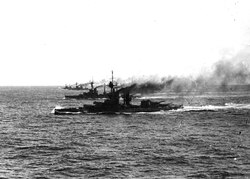
The early years of the war were characterized by rigorous preparation and strategic sweeps of the North Sea. To improve seaworthiness, the Royal Navy removed the rearmost 6-inch guns from the Iron Duke-class ships and sealed their casemates, as these openings were too low in the hull and allowed water to leak into the ship during rough seas.
Throughout 1915 and 1916, the Benbow participated in numerous gunnery drills and patrols. Key operations included:
- The Battle of Dogger Bank (1915): While the Grand Fleet sailed in support of Vice Admiral David Beatty's Battlecruiser Fleet, the main fleet did not engage in the primary action.
- Tondern Raid (1916): Benbow supported the raid on the German zeppelin base, though the fleet retired independently due to a severe gale.
- Horns Reef Demonstrations: The ship participated in maneuvers to distract German forces, allowing the Russian Navy to relay defensive minefields in the Baltic Sea.
The Battle of Jutland
The most significant engagement of the Benbow's career occurred during the Battle of Jutland, the largest naval battle of the First World War. On May 31, 1916, the British Grand Fleet sought to intercept the German High Seas Fleet, commanded by Vice Admiral Reinhard Scheer.
Under the command of Captain Henry Wise Parker and serving as the flagship for Vice Admiral Doveton Sturdee, the Benbow was positioned toward the center of the British line. The ship opened fire at 18:30, though poor visibility hampered the gunners. During the engagement, the Benbow utilized both her main 13.5-inch batteries and her secondary 6-inch batteries to repel German torpedo boats attempting to rescue the disabled light cruiser SMS Wiesbaden.
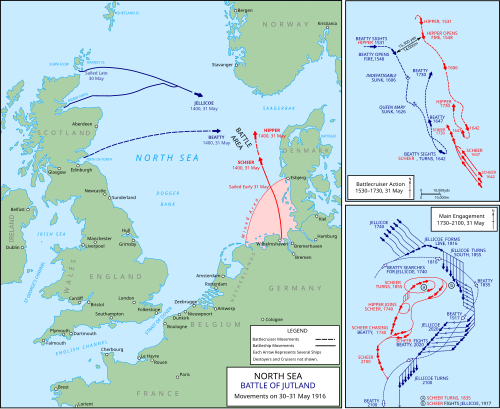
Despite claims of hitting the battlecruiser SMS Derfflinger, the engagement ended without a decisive victory for either side. By the time the Grand Fleet reorganized on June 1, the German fleet had withdrawn. In total, the Benbow fired forty 13.5-inch armor-piercing shells and sixty 6-inch rounds during the battle.
Later War Modifications and Convoy Duty
Following Jutland, the Benbow underwent several upgrades to adapt to evolving warfare. In July 1916, additional deck armor was installed over the ammunition magazines. Later modifications included larger searchlights for night combat and rangefinder baffles to confuse enemy gunners.
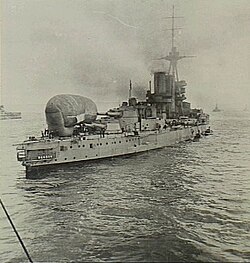
As the war progressed, the ship's role shifted toward protecting convoys to Norway against German destroyers and light cruisers. In 1918, flying-off ramps were added to the "B" and "Q" turrets, allowing the ship to launch aircraft for reconnaissance.
Postwar Service and the Mediterranean
After the dissolution of the Grand Fleet, the Benbow was assigned to the Mediterranean Fleet. Her post-war career was marked by intervention in the Russian Civil War and the Greco-Turkish War. Between April 1919 and June 1920, she supported White Russian forces in the Black Sea, including a mission to Novorossiysk where she rescued 150 Russian soldiers and a British adviser.
In July 1920, the Benbow helped secure the harbor at Gemlik to facilitate the arrival of Greek forces. She continued to operate in the Sea of Marmara and underwent a refit in Malta in 1922.
Decommissioning and Legacy
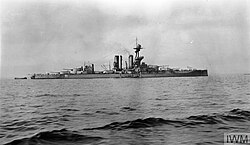
In the late 1920s, the Benbow returned to the Atlantic Fleet, serving as a squadron flagship starting in May 1928. However, the geopolitical landscape had changed. Under the Washington Naval Treaty—an international agreement designed to prevent a naval arms race by limiting the tonnage of capital ships—the Benbow and her sister ships were slated for replacement.
The ship was paid off in 1929 and sold for scrap in January 1931. She was broken up by Metal Industries at Rosyth in March 1931.
Key Facts
- Class: Iron Duke-class battleship.
- Laid Down: May 30, 1912, at William Beardmore and Company.
- Main Armament: 13.5-inch guns.
- Major Conflict: Battle of Jutland (May 31 – June 1, 1916).
- Post-War Role: Anti-communist operations in the Black Sea and support in the Greco-Turkish War.
- Fate: Sold for scrap in January 1931 per the Washington Naval Treaty.
| Period | Primary Assignment | Key Event/Operation |
|---|---|---|
| 1914–1916 | Grand Fleet (4th Battle Squadron) | North Sea Sweeps & Battle of Jutland |
| 1917–1918 | Grand Fleet | Norway Convoy Protection |
| 1919–1926 | Mediterranean Fleet | Russian Civil War & Greco-Turkish War |
| 1926–1930 | Atlantic Fleet | Fleet Training Exercises |
Frequently Asked Questions
Why were the 6-inch guns removed from the Iron Duke-class ships?
The rearmost 6-inch guns were removed because their casemates were located too low in the hull, which allowed water to continuously enter the ship during operations.
What was the Benbow's role during the Battle of Jutland?
The Benbow served as the flagship for Vice Admiral Doveton Sturdee and was positioned in the center of the British line, engaging German forces with both her main and secondary batteries.
How did the Washington Naval Treaty affect the HMS Benbow?
The treaty limited the number and size of capital ships to prevent an arms race, which led to the Benbow being slated for replacement and eventually sold for scrap in 1931.
What post-war conflicts did the Benbow participate in?
The ship was involved in anti-communist operations in the Black Sea supporting White Russians during the Russian Civil War and supported Greek forces during the Greco-Turkish War.
What technical modifications were made to the ship in 1917 and 1918?
Modifications included the installation of larger searchlights for night combat, rangefinder baffles to hinder enemy gunners, and flying-off ramps on the "B" and "Q" turrets for aircraft.