Highways: Global Infrastructure, Design, and Economic Impact
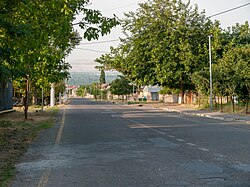
In its broadest sense, a highway is any public or private road or public way on land. While the term can encompass everything from minor public roads to rights of way, it is most commonly used in the United States to describe major roads. In casual conversation, it is often used interchangeably with freeway or expressway, referring specifically to controlled-access highways designed for high-speed traffic.
The term "high" in highway historically refers to the "main" road, with usage predating the 12th century. Depending on the region, the definition varies: in North America and Australia, highways are often categorized by the level of government that maintains them (state, provincial, or county). In British English, "highway" is primarily a legal term covering any route with a public right of access, including footpaths.
Key Facts
- Longest National Highway (Circuit): Australia's Highway 1, spanning over 14,500 kilometers.
- Largest Network: China possesses the world's largest highway network, followed by the United States.
- Highest Motorable Road: Located in India, passing through Umling La at 5,883 meters.
- Busiest Highway: Highway 401 in Ontario, Canada, with some sections exceeding 500,000 vehicles per day.
- Widest Highway: The Katy Freeway in Houston, Texas, reaches up to 26 lanes in certain sections.
The Evolution of Highway Systems
![The construction of Harbor Freeway, and its subsequent displacement of homes in Los Angeles, California.[citation needed]](/images/05/87/0587e05fadf38c61d9b1b915b2bcc1897067c49b2006f8a18c48fec3f4b25834.jpg)
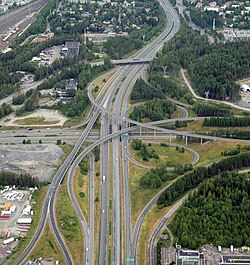
Historically, highways were designed for pedestrians and horse-drawn carriages. The advent of bicycles and motor cars necessitated advancements in road construction. By the 1920s and 1930s, nations began investing heavily in these systems to stimulate commerce and strengthen national defense.
Early Milestones in Europe and the US
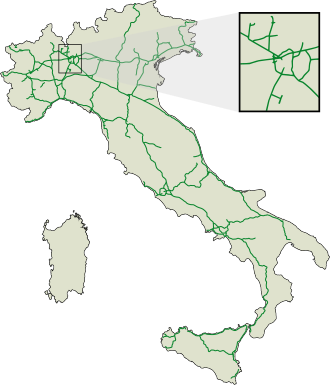
Germany led early innovation with the Bonn-Cologne Autobahn (opened 1932) and the first limited-access, high-speed network from Frankfurt am Main to Darmstadt in 1935. In Italy, the Autostrada dei Laghi became the first controlled-access highway ever built.
![The Italian Autostrada dei Laghi ("Lakes Highway" in the 1950s; now parts of the Autostrada A8 and the Autostrada A9), the first controlled-access highway ever built in the world[9][10]](/images/86/dd/86dd0c2bae99b2e9e79eacc50b111af604a9c21d83261e10f6eec2c15a0c46cc.jpg)
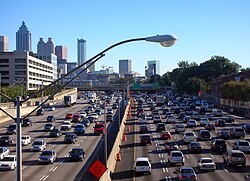
In the United States, the Federal Aid Highway Act of 1921 established funds for an extensive system, followed by the 1922 Pershing Map. The most significant expansion occurred via the Federal Aid Highway Act of 1956, which allocated $25 billion to construct the 66,000-kilometer Interstate Highway System over two decades.
The British Motorway System
The Special Roads Act 1949 in Great Britain allowed for roads restricted to specific vehicle classes, overturning the principle that all vehicular roads must be open to pedestrians and horses. The first motorway sections (M6 and M1) opened in 1958 and 1959, respectively.
Highway Design and Classification
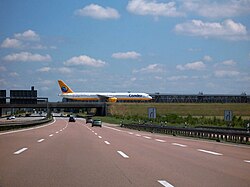
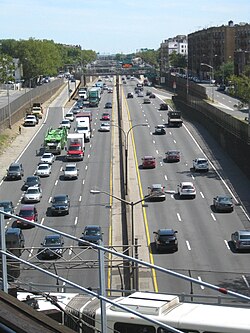
To manage traffic flow and maintenance, governments classify roads based on their function. The US Federal Highway Administration uses a hierarchy including Principal Arterials (freeways and expressways), Minor Arterials, Collectors, and Local roads.
Performance Metrics
Engineers measure highway efficiency using specific speed metrics. Running speed (or average running speed) refers to the average speed of a vehicle while in motion, which is typically 5–10 mph slower than the free-flow speed.
Economic and Environmental Impacts
Highways act as catalysts for economic growth. A 2016 study indicated that a 10% increase in a region's highway stock led to a 1.7% increase in regional patenting over five years. Additionally, new highway access has been linked to an increase in top-income taxpayers in those areas, though it also contributes to residential and job urban sprawl.
![The use of "Redlining" often would dictate where in cities highways would go through.[23]](/images/5b/08/5b0866bb60fe77cfe75658195bfe98a3fe7fc2c1b42e7ac055e95b76850e01dd.jpg)
Environmentally, highways present a complex trade-off. While they can help prevent the spread of steppe and forest fires, they often contribute to noise, light, and air pollution in surrounding areas.
Global Highway Statistics

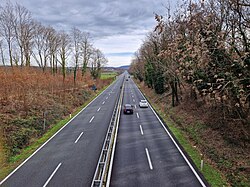
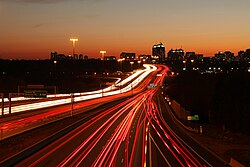
The scale of modern highway systems is immense. The United States maintains approximately 6.43 million kilometers of highway. China's network is similarly vast, with an expressway system that was the longest in the world by 2011, stretching some 85,000 kilometers.
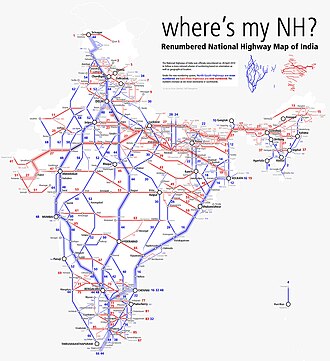
Notable Global Routes
- Pan-American Highway: Nearly 25,000 kilometers long, connecting many countries in the Americas, though it remains discontinuous due to a gap in southeastern Panama.
- Trans-Canada Highway: A system over 10,700 kilometers long, connecting major urban centers across Canada.
- Karakoram Highway: The highest international highway, reaching an altitude of 4,693 meters between Pakistan and China.
Specialized Infrastructure: Bus Lanes
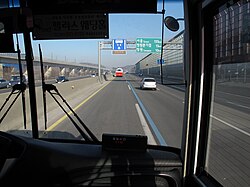
To alleviate congestion, many nations implement dedicated bus lanes. South Korea's Gyeongbu Expressway features a significant bus lane (137.4 km) between Seoul and Daejeon, with specific daily enforcement hours.
| Category | Highway/System | Metric | Location |
|---|---|---|---|
| Longest Circuit | Highway 1 | >14,500 km | Australia |
| Busiest | Highway 401 | >500,000 vehicles/day | Canada |
| Widest (Total) | Katy Freeway (I-10) | 26 Lanes | USA |
| Highest (International) | Karakoram Highway | 4,693 m | Pakistan/China |
| Highest (National) | National Highway 5 | ~4,900 m | India |
Frequently Asked Questions
What is the difference between a highway and a motorway?
While "highway" is a broad term for any public road, a "motorway" (common in the UK and Europe) is a specific type of controlled-access highway restricted to certain vehicle classes and designed for high-speed traffic.
Which country has the largest highway network?
China has the world's largest network of highways, followed closely by the United States.
What is the Pan-American Highway's biggest limitation?
The Pan-American Highway is discontinuous because of a significant gap in southeastern Panama, where extreme rainfall and unsuitable terrain make construction impossible.
How do highways affect regional economics?
Highways can spur innovation (increasing regional patenting) and attract higher-income taxpayers, though they are also linked to urban sprawl.
What is the highest motorable road in the world?
The highest motorable road passes through Umling La in India, reaching an altitude of 5,883 meters.