Hermann Duckek: The Master of Equestrian Sports Surfaces
In the world of elite equestrian sports, the difference between a gold medal and a disappointing finish often lies beneath the horse's hooves. Few individuals understood this better than Hermann Duckek (1936–2001). Known globally as the "Duke of Dirt" (or Bodenpapst in German), Duckek was the preeminent authority on riding arena surfaces, blending the skills of a riding master with the precision of an engineer to create the world's finest competition footings.
Key Facts
- Specialization: World-leading expert in the construction and maintenance of dressage and jumping arenas.
- Olympic Legacy: Responsible for surfaces at five Olympic Games (1976, 1988, 1992, 1996, and 2000).
- Innovation: Invented fibresand to solve drainage issues at the 1990 World Equestrian Championships in Stockholm.
- Professional Title: Certified riding-master since 1966.
- Global Impact: Designed surfaces for numerous World Championships, European Championships, and Volvo World Cup finals.
From Farming to Riding Mastery
Born on September 9, 1936, in Ulm, Germany, Hermann Duckek began his life on his parents' farms. At age 26, he transitioned from daily farm management to pursue his passion for riding. He underwent rigorous training in Flensburg, Germany, under the guidance of master Karl Diel, earning his riding-master title in 1966.
His expertise soon attracted international attention. After graduating, Duckek moved to Denmark to lead the Nordborg Riding Club. His career progressed through various roles in Southern Jutland before he took over the Holte Riding Club near Copenhagen in 1971. It was here that he established the successful "Holte Week" (Holte Ugerne) and trained legendary riders such as Lis Hartel and Ulla Håkansson.
The "Duke of Dirt": Revolutionizing Arena Footing
Duckek's reputation for maintaining pristine arenas led to his first major international assignment in 1974, maintaining the Dressage World Championship arena in Copenhagen. This success opened the door to the global stage, leading to his appointment for the 1976 Montréal Olympic Games in Bromont, Canada.
Duckek was more than a consultant; he assumed full responsibility for the materials, installation, and maintenance of every project. He was renowned for balancing the financial constraints of organizers with the strict performance requirements of world-class athletes. His innovative contributions include the use of rubber mats in Wiesbaden and Geotex-sand mixtures in Gothenburg.
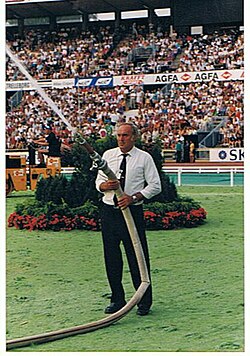
One of his most significant technical achievements occurred in 1990 at the Stockholms Olympiastadium. Because the stadium's drainage had collapsed due to previous heavy use by concert artists, Duckek invented fibresand—a specialized mixture that ensured a safe, stable footing. For this specific event, he even had the sand colored green.
Pioneering New Concepts
Beyond materials, Duckek introduced structural innovations to the sport. In 1991, while bringing the Volvo World Cup to Brøndby, Denmark, he pioneered the concept of 4-in-hand driving (a discipline involving four horses and a carriage) inside a hall, a format that has since been adopted by many event organizers worldwide.
A Legacy of Precision and Passion
Duckek's career was marked by a commitment to the sport's integrity. Whether it was spending hours searching through stadium sand to recover a lost Olympic gold medal for rider Gabriela Grillo in 1976 or managing the crisis of a flooded stadium at the 1986 World Championships in Cedar Valley, Canada, his dedication was absolute. The latter event led to the naming of "Hermann's Hill," a vantage point from which he monitored the drainage of the arena.
His influence extended to the community of trainers through the International Dressage Trainer Club, which he founded and presided over in 1986. Even in his final days, he remained active, preparing the footing for the 2000 Sydney Olympic Games. Hermann Duckek passed away on March 3, 2001, in Hoersholm, Denmark, at the age of 64.
Summary of Major Projects
| Competition Level | Notable Locations / Years | Key Contribution |
|---|---|---|
| Olympic Games | Montréal (1976), Seoul (1988), Barcelona (1992), Atlanta (1996), Sydney (2000) | Full construction and maintenance |
| World Championships | Copenhagen (1974), Stockholm (1990), Rome (1998), etc. | Material selection and installation |
| European Championships | Aachen (1983), Arnhem (1999), Verden (1997), etc. | Surface optimization |
| Volvo World Cup | Gothenburg, Paris-Bercy, Las Vegas, etc. | Innovation of indoor 4-in-hand driving |
Frequently Asked Questions
What is "fibresand" and why was it created?
Fibresand is a specialized arena surface invented by Hermann Duckek for the 1990 World Equestrian Championships in Stockholm. It was developed to provide a safe and stable footing in a stadium where the existing drainage system had collapsed.
Which Olympic Games did Hermann Duckek work on?
Duckek was responsible for the equestrian surfaces at the 1976 Montréal, 1988 Seoul, 1992 Barcelona, 1996 Atlanta, and 2000 Sydney Olympic Games.
What was the "Duke of Dirt"?
"Duke of Dirt" (or Bodenpapst in German) was the nickname given to Hermann Duckek due to his unrivaled global expertise in the construction and maintenance of riding arena surfaces.
How did Duckek contribute to the sport of 4-in-hand driving?
Duckek created the idea of hosting 4-in-hand driving competitions inside a hall during the 1991 Volvo World Cup in Brøndby, Denmark, a concept that has since been adopted by various other organizers.
What is the significance of "Hermann's Hill"?
Hermann's Hill was a location at the 1986 World Championships in Cedar Valley, Canada, where Duckek observed a drainage failure during heavy rain. The spot was later named in his honor with a plaque, which he eventually took home to Denmark.