Heineken Lager Beer: A History of Global Brewing and Branding
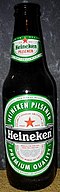
Heineken is one of the world's most recognizable beer brands, known globally for its signature green bottle and red star. Produced by the Dutch brewing company Heineken N.V., this pale lager has evolved from a local Amsterdam operation into a global powerhouse sold in 192 countries.
At its core, Heineken is a pale lager—a crisp, clear style of beer—with an alcohol by volume (ABV) of 5.0%. Its distinct profile is defined by a color of 7 EBC (European Brewery Convention) and a bitterness level of 23 IBU (International Bitterness Units).
Key Facts
- Origin: Netherlands, introduced in 1873.
- Style: Pale lager with 5.0% ABV.
- Global Reach: Distributed in 192 countries as of 2022.
- Key Innovation: Developed a specific yeast for Bavarian bottom fermentation.
- Non-Alcoholic Option: Heineken 0.0 launched in 2017.
The History of Heineken
The story began on February 15, 1864, when Gerard Adriaan Heineken purchased the De Hooiberg ("The Haystack") brewery in Amsterdam. While the brewery had existed since 1592, the modern Heineken brand was born in 1873. This was made possible after Heineken hired Dr. Elion, a student of the famous French chemist Louis Pasteur, to develop a yeast suitable for bottom fermentation, a process where yeast settles at the bottom of the tank during fermentation.
The brand gained rapid international acclaim, winning the Medaille D'Or at the 1875 International Maritime Exposition in Paris. This victory catalyzed the brand's export success, with sales eventually exceeding 6.4 million litres, making Heineken the largest beer exporter to France at the time.
Over the decades, the brand continued to collect accolades, including a Grand Prix at the 1889 Exposition Universelle in Paris. Two of these early awards, the Medaille d'Or and the Diplome d'Honneurs, remain featured on the label today. The original brewery has since been converted into the Heineken Experience museum.
Production and Product Evolution
Since 1975, the majority of Heineken beer has been brewed in Zoeterwoude, Netherlands. However, the company has expanded its local production globally to increase efficiency, including a significant presence in the United Kingdom following the acquisition of Scottish & Newcastle in 1996.
In 2011, the company produced 2.74 billion litres of Heineken-brand beer, while the total production across all Heineken Group brands reached 16.46 billion litres. The product line has also expanded to include variations such as Heineken Oud Bruin, Heineken Premium Light, and Heineken Tarwebok.
In 2017, the company introduced Heineken 0.0, a non-alcoholic version designed to mimic the taste of the original lager while offering fewer calories and less sugar than typical sodas.
Technical Specifications
| Attribute | Value |
|---|---|
| Alcohol by Volume (ABV) | 5.0% |
| Colour | 7 EBC |
| IBU Scale | 23 |
| Original Gravity | 1.044–1.048 |
| Style | Pale Lager |
Marketing and Global Partnerships
Heineken is renowned for its aggressive and creative marketing. In the UK, the brand became legendary for the slogan "Refreshes the Parts Other Beers Cannot Reach," a phrase coined by Terry Lovelock that entered everyday speech and was even referenced by Prince Charles in the 1990s.
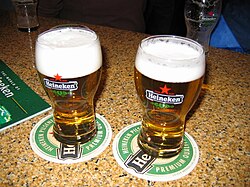
The brand has maintained a high-profile presence in sports and cinema. It has been a major sponsor of the UEFA Champions League, UEFA Euro, and the Rugby World Cup. More recently, Heineken 0.0 has sponsored the UEFA Europa League and UEFA Europa Conference League.
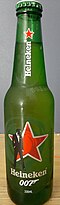
Heineken also has a deep relationship with the James Bond franchise, appearing in eight films since 1997's Tomorrow Never Dies. The brand reportedly spent €60 million for its inclusion in the 2012 film Skyfall, where James Bond himself is seen drinking the beer.
In the world of motorsports, Heineken became the Official Beer of the FIA Formula One World Championship in 2016, using the platform to promote its "When You Drink, Never Drive" campaign. In 2021, it also partnered with the W Series, the all-women single-seater racing series.
The Boring Phone
In a pivot toward promoting digital detoxing, Heineken collaborated with Bodega and Human Mobile Devices to release "The Boring Phone" in April 2024. Only 5,000 units of this transparent "dumbphone" were produced. It lacks the ability to download apps and features basic tools like a 0.3MP camera, FM radio, and simple games like Quick Snake.
The device is designed for simplicity, offering up to a week of standby time on a 1450mAh battery. For those without the physical phone, Heineken released "The Boring Mode" app to help users block distracting applications on their smartphones.
Operations in Russia
Following the start of the war in Ukraine, Heineken announced its intention to leave Russia in March 2022. However, investigative reports later indicated that the company continued to hire staff and launch new products in the region throughout 2022, including entering the non-alcoholic carbonated beverage market.
The withdrawal was finalized in August 2023 when Heineken sold its Russian operations to the Arnest Group for €1, along with a €100 million commitment to repay domestic debt. The company expected a total loss of €300 million from this exit.
Frequently Asked Questions
What makes Heineken different from other lagers?
Heineken is a pale lager characterized by its specific yeast developed for Bavarian bottom fermentation, resulting in a consistent taste and a 5.0% alcohol content.
Why are Heineken bottles green?
While the brand previously used brown bottles for the Dutch market, it transitioned entirely to green bottles in February 2013 to align with its global export image.
What is Heineken 0.0?
Launched in 2017, Heineken 0.0 is a non-alcoholic beer designed to provide a taste similar to the original lager but with lower sugar and calories than most sodas.
How did Heineken get involved with James Bond?
Heineken has a long-term brand investment with the Bond franchise, appearing in eight films. This includes significant product placement, such as in Skyfall and Spectre.
What is the purpose of "The Boring Phone"?
The Boring Phone is a limited-edition device created to encourage people to disconnect from smartphones and social media by providing only basic communication and utility functions.