Heibonsha Publishing: A Century of Japanese Knowledge and Literature
Founded in 1914, Heibonsha has evolved from a small venture selling pocket guides into one of Japan's most prestigious publishing houses. For over a century, the company has played a pivotal role in documenting the Japanese language, preserving history, and disseminating global knowledge through an ambitious array of encyclopedias and literary collections.
Key Facts
- Founded: 1914 by educator Shimonaka Yasaburō.
- Major Achievement: Published the Daijiten, the largest kokugo (national language) dictionary ever produced.
- Diverse Portfolio: Specializes in comprehensive encyclopedias, art surveys, and historical gazetteers.
- Innovation: Launched Sun, Japan's first monthly graphics magazine, in 1963.
- Centennial: Celebrated its 100th anniversary in 2014.
The Early Years and the Rise of the Encyclopedia
Heibonsha began as a vehicle for Shimonaka Yasaburō to sell his pocket encyclopedia, That is Convenient: Pocket Advisor. By 1923, the business transitioned into a public limited company. The aftermath of the 1923 Great Kantō earthquake served as a catalyst for the company to expand its publishing scale significantly.
In 1927, the house introduced the 60-volume Collection of Contemporary Popular Literature. These budget-friendly, small-format books became widely known as "one-yen books." This success paved the way for the first major Encyclopedia, a 28-volume set published between 1928 and 1934.
The Monumental Daijiten
Between 1934 and 1936, Heibonsha published the Daijiten (Great/Comprehensive Dictionary), edited by Shimonaka Yasaburō. This work remains the largest kokugo dictionary ever published. The original 26-volume edition featured over 700,000 headwords organized by pronunciation, covering an expansive range of Japanese vocabulary.
Post-War Expansion and Diversification
Although operations ceased during the 1940s, Heibonsha relaunched in 1945 by reprinting its 1934 Encyclopedia. The following decade marked a period of rapid growth, with the publication of specialized works including the Social Encyclopedia, Housekeeping, Complete Collection of World Art, Encyclopedia of World History, and the Children's Encyclopedia.
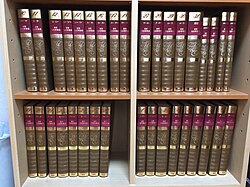
To mark its 40th anniversary from 1954 to 1959, the company issued a comprehensive 32-volume World Encyclopedia.
Modern Era and Specialized Series
The 1960s and 70s saw Heibonsha venture into new formats. In 1961, the National Encyclopedia was released during a period of high demand for encyclopedic knowledge. In 1963, the company innovated with Sun, the first monthly graphics magazine in Japan. They also established the Eastern Library Series to showcase Far East literature.
Collaboration became a key strategy in the 1970s. Heibonsha partnered with the U.S.-based publisher Weatherhill to produce The Heibonsha Survey of Japanese Art, featuring bilingual text in Japanese and English. Additionally, the company began the 50-volume Japanese Historical Place Names gazetteer in 1979, which has since transitioned to an online format featuring 200,000 detailed headings as of 2022.
Corporate Evolution and Recent History
In 1980, the internal Japanese Map Research Institute was spun off into the Heibonsha Map Publishing imprint. The company continued its commitment to massive reference works, completing a 35-volume World Encyclopedia in 1988. Later additions to their catalog include the Heibonsha Library (1993) and Corona Books (1994).
In recent years, Heibonsha launched the magazine Heart (2011) and relocated its offices to the historic publishing district of Kanda-Jimbochō in 2012, celebrating its centenary in 2014.
Heibonsha Publication Timeline
| Year/Period | Publication or Event | Significance |
|---|---|---|
| 1914 | Foundation | Established by Shimonaka Yasaburō |
| 1927 | Collection of Contemporary Popular Literature | Known as "one-yen books" |
| 1934–1936 | Daijiten | Largest kokugo dictionary ever published |
| 1954–1959 | World Encyclopedia (32 vols) | 40th anniversary commemorative work |
| 1963 | Sun (Taiyō) | Japan's first monthly graphics magazine |
| 1979–Present | Japanese Historical Place Names | Comprehensive gazetteer (now available online) |
| 1988 | World Encyclopedia (35 vols) | Completion of a massive global reference set |
Frequently Asked Questions
Who founded Heibonsha and why?
Heibonsha was founded in 1914 by the educator Shimonaka Yasaburō to sell his pocket encyclopedia, That is Convenient: Pocket Advisor, to the general public.
What is the significance of the Daijiten?
The Daijiten is significant for being the largest kokugo (national language) dictionary ever published, featuring over 700,000 headwords in its original 26-volume edition.
What was the "one-yen book" series?
The "one-yen books" refers to the 60-volume Collection of Contemporary Popular Literature published starting in 1927, which were produced as budget small-format books.
Did Heibonsha collaborate with international publishers?
Yes, in the early 1970s, Heibonsha jointly published The Heibonsha Survey of Japanese Art with the U.S.-based publisher Weatherhill, providing text in both English and Japanese.
Where is Heibonsha currently located?
In 2012, the company moved its offices to Kanda-Jimbochō in Tokyo.