Harmonica: History, Types, and Playing Techniques
The harmonica, often referred to as a mouth organ, blues harp, or French harp, is a versatile woodwind instrument classified as a free reed aerophone. Developed in Europe around the 1820s, it has evolved from a simple folk instrument into a sophisticated tool used in classical, jazz, and blues music. Its compact size and portability have made it a global phenomenon, spanning from the street corners of the American South to professional concert halls.
Key Facts
- Classification: Free reed aerophone (Hornbostel–Sachs 412.132).
- Origin: Developed in Europe c. 1820s, influenced by East Asian free-reed instruments like the sheng.
- Primary Types: Diatonic, Chromatic, Tremolo, and Chord harmonicas.
- Range: Varies by model, from 3 octaves (10-hole diatonic) to over 4 octaves (16-hole chromatic).
- Key Innovation: Richter tuning (1826) became the nearly universal standard for diatonic models.
Anatomy of a Harmonica
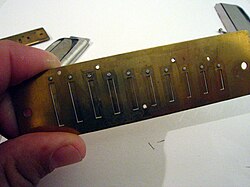
A standard harmonica consists of several critical components that work together to produce sound. The comb serves as the central body, holding the reed plates in place. The reed plates contain the actual reeds that vibrate when air is blown or drawn through the holes.
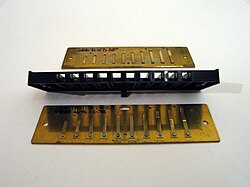
While most traditional designs use metal reed plates, some innovations, such as those by Finn Magnus in the 1950s, utilized all-plastic molded components for the reeds, plates, and comb.
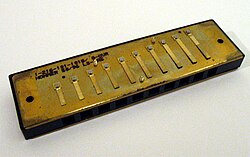
The cover plates protect the internal mechanisms and project the sound. These are typically made of metal, though plastic and wood are also used. Open designs are common for general use, while enclosed designs—such as the Hohner Meisterklasse—offer a louder tonal quality. Some historical models even featured bells on the covers that could be rung via a button.
Types of Harmonicas
Chromatic Harmonica
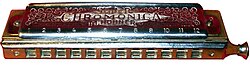
The chromatic harmonica allows the player to access all notes of the chromatic scale, including flats and sharps. This is achieved through a button-activated sliding bar that redirects airflow. Because they are tuned to equal temperament, 12-, 14-, and 16-hole models allow musicians to play in any key, making them suitable for jazz, classical, and Celtic music.
Diatonic Harmonica
The diatonic harmonica is typically tuned to a specific key. The most common is the 10-hole Richter-tuned model, which is a staple of blues and country music. While it is limited to one key, players use specialized techniques to expand its melodic range.
Specialized Models
- Tremolo Harmonica: Features multiple reeds per note to create a pulsing, vibrato effect.
- Chord Harmonica: Designed to play full chords; for example, the Suzuki SSCH-56 can produce 48 different chords.
- ChengGong: A unique design with a sliding mouthpiece that allows for various chord voicings and triads over three diatonic octaves.
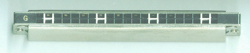
- Polyphonia: An orchestral melodic harmonica where all twelve chromatic notes are laid out on a single row.
Playing Techniques and Amplification
Beyond simply blowing and drawing air, advanced players use bending. This involves adjusting the embouchure (the shape of the mouth) to force the reed to resonate at a lower pitch, creating the soulful "wail" characteristic of the blues. In the 1970s, Howard Levy introduced over bending (overblowing and overdrawing), which enables a diatonic player to play a full chromatic scale.
Amplification and the "Mississippi Saxophone"
Since the 1950s, blues musicians have used microphones and tube amplifiers to increase volume and change the instrument's timbre. Innovators like Marion "Little Walter" Jacobs used "Bullet" microphones and cupped their hands around the harmonica to create a distorted, powerful sound similar to a saxophone.

For a cleaner, more natural sound, folk musicians often prefer standard vocal microphones like the Shure SM 58.
Historical Evolution
The harmonica's roots lie in the free-reed instruments of East Asia, which were introduced to Europe by the Jesuit Jean Joseph Marie Amiot. By 1821, Christian Friedrich Ludwig Buschmann is credited with inventing the harmonica, though Charles Wheatstone developed a similar "Aeolina" in 1829.
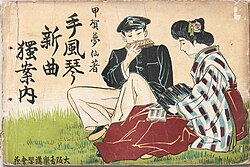
Mass production began in Germany, led by Matthias Hohner in 1857, who utilized machine-cut wooden combs to scale production. By the 20th century, the instrument spread globally. In Japan, Shōgo Kawaguchi developed a specific tremolo tuning in 1913 to better suit Japanese folk songs.

| Type | Tuning/Scale | Primary Use | Key Feature |
|---|---|---|---|
| Diatonic | Single Key (Richter) | Blues, Country, Folk | Capable of note bending |
| Chromatic | Full Chromatic Scale | Jazz, Classical | Slide button for sharps/flats |
| Tremolo | Varies (Richter or Asian) | Folk Music | Dual reeds for vibrato effect |
| Chord | Multiple Chords | Accompaniment | Plays full chords per hole |
Frequently Asked Questions
What is the difference between a diatonic and a chromatic harmonica?
A diatonic harmonica is tuned to a specific key and is primarily used for folk and blues; it requires "bending" to reach notes outside its key. A chromatic harmonica uses a slide button to provide all the sharps and flats of the chromatic scale, allowing it to play in any key.
What is "bending" in harmonica playing?
Bending is a technique where the player alters their mouth shape and air pressure to change the pitch of a note, typically lowering it. This creates the sliding, expressive sounds essential to blues and rock music.
Who is credited with the mass production of the harmonica?
Matthias Hohner, a clockmaker from Trossingen, Germany, began producing harmonicas in 1857 and became the first to mass-produce them using machine-cut wooden combs.
Is the glass harmonica related to the mouth organ?
No. Despite the similar name, the glass harmonica (invented by Benjamin Franklin) is a set of rotating glass cups played with wet fingers and is not a free-reed instrument.
What is a "Mississippi Saxophone"?
This term refers to a blues harmonica that is amplified through a tube amplifier and played with the hands cupped around a microphone to create a distorted, powerful tone reminiscent of a saxophone.