Haneda Airport: Tokyo's Premier Global Aviation Hub
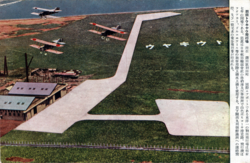
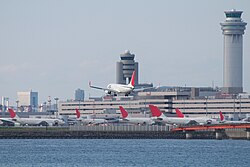
Located in Ōta, Tokyo, Haneda Airport (IATA: HND, ICAO: RJTT) serves as one of the world's most efficient and busiest aviation gateways. Since its opening on August 15, 1931, it has evolved from a regional airfield into a global powerhouse, consistently ranking among the top airports worldwide for its service and operational excellence.
As a primary hub for All Nippon Airways (ANA) and Japan Airlines (JAL), Haneda provides critical connectivity for both domestic travel within Japan and international routes across the globe. Its strategic location closer to central Tokyo compared to Narita Airport makes it a preferred choice for business travelers and tourists alike.
Key Facts
- World Ranking: Ranked 3rd globally in 2024 for passenger volume.
- Passenger Volume: Handled 85,906,170 passengers in 2024.
- Operational Excellence: Recognized as the most on-time international airport in 2022 with a 90.3% departure rate.
- Ownership: Operated by the Ministry of Land, Infrastructure, Transport and Tourism.
- Connectivity: Served by the Tokyo Monorail and the Keikyu Airport Line.
Airport Infrastructure and Facilities
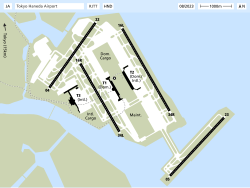
Haneda Airport is designed for high-capacity throughput, featuring four asphalt runways and three primary passenger terminals. The airport operates at an elevation of 6 meters (20 ft) above mean sea level (AMSL).
Runway Specifications
The airport utilizes a sophisticated runway system to manage its high volume of aircraft movements, which totaled 426,500 in 2024.
| Direction | Length (m) | Length (ft) | Surface |
|---|---|---|---|
| 16R/34L | 3,000 | 9,843 | Asphalt |
| 16L/34R | 3,360 | 11,024 | Asphalt |
| 04/22 | 2,500 | 8,202 | Asphalt |
| 05/23 | 2,500 | 8,202 | Asphalt |
Passenger Terminals
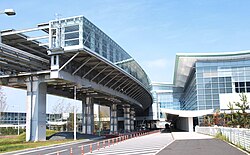
The airport features 71 gates equipped with jet bridges. The terminal structure is divided to optimize domestic and international flow:
- Terminal 1: Primarily domestic; open from 5:00 am to 12:00 am.
- Terminal 2: Handles both domestic and international flights (specifically ANA). Domestic areas operate from 5:00 am to 12:00 am, while international areas are open 24 hours.
- Terminal 3: The dedicated international terminal, operating 24 hours a day. It was renamed from "International Terminal" on March 14, 2020.
Terminals 1 and 2 are linked by an underground walkway, and a free landside shuttle bus connects all three terminals.
Historical Evolution
Haneda's history is marked by distinct eras that reflect Japan's political and economic shifts. Following its establishment in 1931, the airport transitioned through the Empire era and the subsequent Occupation era (1945–1952), during which it served as a U.S. Army Air Base.
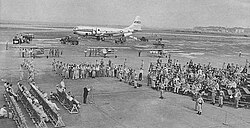
The airport entered its first international era in 1952, but later shifted focus toward domestic operations between 1978 and 2010. During this period, most international traffic was diverted to Narita. However, in June 2007, Haneda began reclaiming international rights for specific nighttime slots (departures 8:30 pm – 11:00 pm and arrivals 6:00 am – 8:30 am) to complement Narita's closure hours.

Since 2010, Haneda has entered its second international era, significantly expanding its global footprint and reclaiming its status as a primary international gateway for Tokyo.
Airlines and Global Connectivity
Haneda is an operating base for several carriers, including Air Do, Skymark Airlines, Solaseed Air, and StarFlyer. It hosts a vast array of international carriers including Delta Air Lines, United Airlines, British Airways, Emirates, and Qatar Airways.
In 2024, the busiest domestic routes from Haneda were to Sapporo–Chitose (9,007,372 passengers) and Fukuoka (8,647,386 passengers), highlighting the airport's role as the central artery for Japanese domestic travel.
Ground Transportation
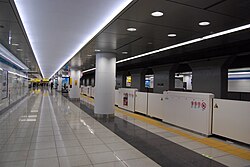
Access to the airport is streamlined through two primary rail systems, ensuring rapid transit to the heart of Tokyo.
- Tokyo Monorail: Provides service to Terminals 1, 2, and 3.
- Keikyu Airport Line: Offers access via the Terminal 1·2 Station and the Terminal 3 Station.
Frequently Asked Questions
Which terminals at Haneda Airport are open 24 hours?
Terminal 3 and the international flight area of Terminal 2 are open 24 hours a day. Terminal 1 and the domestic areas of Terminal 2 operate from 5:00 am to 12:00 am.
How do I travel between the different terminals?
Terminals 1 and 2 are connected by an underground walkway. For travel between all three terminals, a free inter-terminal shuttle bus is available on the landside.
What is the on-time performance of Haneda Airport?
Haneda is renowned for its punctuality; in 2022, it was the most on-time international airport globally, with a 90.3% on-time departure rate.
Which airlines use Haneda as a primary hub?
All Nippon Airways (ANA) and Japan Airlines (JAL) are the primary hub carriers at Haneda Airport.
How does Haneda differ from Narita Airport in terms of international flights?
While Narita remains a major hub, Haneda has expanded its international services since 2010 and handles specific nighttime slots that Narita does not, providing more flexibility for city-to-city business travel.