Handheld Gaming History: From LED Dots to LCD Classics
Long before the era of smartphones and high-resolution consoles, the world of portable entertainment began with simple electronic circuits and glowing lights. The evolution of handheld gaming is a story of rapid innovation, moving from basic light-emitting diodes (LEDs) to complex liquid crystal displays (LCDs) that paved the way for the modern gaming industry.
The Era of LED and Early Electronic Games
The earliest handheld games relied on simple mechanisms to interact with players. In the mid-1970s, devices like Mattel Auto Race (1976) and Mattel Electronic Football (1977) utilized red LED displays. In these games, gameplay was minimalist: players pressed buttons to move a bright dot—representing a car or a quarterback—to avoid obstacles represented by dimmer dots.
By 1978, the market expanded with the introduction of Simon by the Milton Bradley Company. Unlike its predecessors, Simon lacked a dedicated screen, instead using four colored, lighted buttons for a sound-and-color matching challenge. That same year, Parker Brothers released Merlin, a more advanced device featuring 11 buttons with integrated LEDs capable of running six different games.
This initial success triggered a wave of similar devices throughout the early 1980s, including popular "head-to-head" two-player games from Coleco and various miniaturized versions of arcade hits.
The Nintendo Revolution and the Birth of the D-Pad
A pivotal moment in gaming history occurred in 1979 when Nintendo designer Gunpei Yokoi observed a businessman playing with an LCD calculator on a bullet train. This inspired Yokoi to create a "game watch"—a device that combined a clock with a miniature game to kill time.
Starting in 1980, Nintendo released the Game & Watch series. These devices utilized the same LCD technology found in credit-card-sized calculators, incorporating a digital time display in the corner of the screen. As the games became more complex, Yokoi invented the directional pad (or "D-pad"), a cross-shaped controller for moving on-screen characters. This innovation was later integrated into the Famicom console and eventually became the global industry standard, replacing the joystick for many applications.
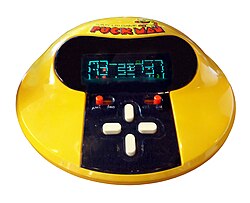
The Transition to LCD Technology
During the 1980s, LCDs became more affordable and largely replaced LED displays. While LCDs and Vacuum Fluorescent Displays (VFDs) allowed for custom images and greater detail, they introduced new technical constraints. Because graphics were fixed in place, every possible position of a game object had to be preset. Movement was an illusion created by sequentially flashing these preset objects.
Because backgrounds were static drawings layered behind transparent "moving" graphics, the gameplay was often cruder than earlier LED games. Despite this, the LCD era produced iconic titles from Nintendo and Tiger Electronics, as well as numerous arcade conversions.
Innovation in Power and Dimension: Bandai and Tomy
In 1982, Bandai introduced the LCD Solarpower series, marking the first time gaming devices were powered by solar energy. To overcome the limitations of single-panel LCDs, some titles, such as the horror game Terror House, utilized two stacked LCD panels to create an early 3D effect and allow for multiple game stages.
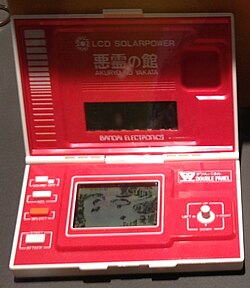
Shortly after, in 1983, Takara Tomy released the Tomytronic 3D series. These devices simulated 3D depth using two LED panels lit by external light through a top window, making it the first dedicated home video 3D hardware.
Key Facts
- First LED Games: Mattel Auto Race (1976) and Electronic Football (1977) used bright dots to represent players.
- The D-Pad: Invented by Gunpei Yokoi for Nintendo's Game & Watch series, it replaced joysticks as the industry standard.
- LCD Limitations: Early LCD games used fixed, preset positions for objects, creating movement through sequential flashing.
- Solar Power: Bandai's LCD Solarpower (1982) was the first solar-powered gaming line.
- Early 3D: Bandai used double-stacked panels, while Tomytronic 3D used external light and dual LED panels to simulate depth.
Summary of Early Handheld Series
| Company | Series/Game | Key Technology | Notable Feature |
|---|---|---|---|
| Mattel | Auto Race / Football | LED | Simple dot-based movement |
| Nintendo | Game & Watch | LCD | Introduction of the D-pad |
| Bandai | LCD Solarpower | Solar LCD | Double panels for 3D effects |
| Takara Tomy | Tomytronic 3D | LED | First dedicated home 3D hardware |
Bandai LCD Solarpower Catalog
The Bandai series was divided into two primary phases:
- First Series: Included titles such as Invaders of the Mummy's Tomb, Escape from the Devil's Doom, Sub Attack, Break Out, Shark Island, and the Japan-exclusive Nazo No Chinbotsusen.
- Second Series (Double Panel): Focused on 3D effects with titles like Amazone, Terror House, Frankenstein, and Airport Panic.
Frequently Asked Questions
What is a D-pad and who invented it?
The D-pad, or directional pad, is a cross-shaped controller used to move characters on a screen. It was invented by Gunpei Yokoi for Nintendo's Game & Watch series and later became a standard feature for game console controllers.
How did early LCD games create the illusion of movement?
Since LCD graphics were fixed in place, developers preset every possible location for a game object. The game would then flash these objects in sequence, creating the appearance of movement across a static background.
Which was the first solar-powered gaming device?
The Bandai LCD Solarpower series, released in 1982, were the first gaming devices to utilize solar power.
How did early handhelds achieve 3D effects?
Bandai achieved an early 3D effect by stacking two LCD panels on top of each other. Takara Tomy's Tomytronic 3D series used two LED panels lit by external light through a window to simulate depth.
What were the main differences between LED and LCD handhelds?
LED games used simple, bright dots for graphics. LCD games allowed for custom, detailed images but were limited by fixed object positions, meaning they could not have overlapping graphics or fluid movement.