Handball: The Fast-Paced Evolution of a Global Team Sport
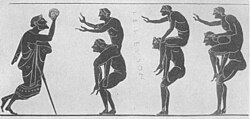
Handball is a high-energy, high-scoring team sport that combines speed, strength, and tactical precision. While its roots can be traced back to ancient ball games, the modern version of the sport has evolved into a professional powerhouse, particularly across Europe. Characterized by rapid transitions and physical contact, handball offers a thrilling spectacle for both players and spectators alike.
Key Facts
- Governing Body: International Handball Federation (IHF).
- First Official Match: 2 December 1917, in Berlin, Germany.
- Team Structure: 7 players per side, including one goalkeeper.
- Court Size: 40 by 20 metres.
- Olympic Status: Part of the Summer Olympic programme since 1972 (men) and 1976 (women).
- Global Reach: Over 27 million registered players as of 2016.
The History and Origins of Modern Handball
The modern game was codified in Northern Europe, primarily within Denmark, Germany, Norway, and Sweden. The first written rules were published in 1906 by Danish gym teacher Holger Nielsen. However, the sport's official "date of birth" is recognized as 29 October 1917, when Max Heiser, Karl Schelenz, and Erich Konigh published the modern set of rules in Berlin.
Following the first official match in December 1917, the sport grew through international competition. Men's international matches began in 1925 between Germany and Belgium, followed by women's international matches in 1930 between Germany and Austria. While field handball was featured in the 1936 Berlin Olympics, the indoor version eventually became the dominant format, re-emerging in the 1972 Munich Olympics.
Understanding the Playing Court and Equipment
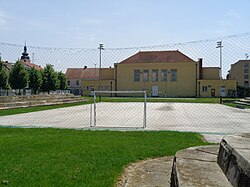
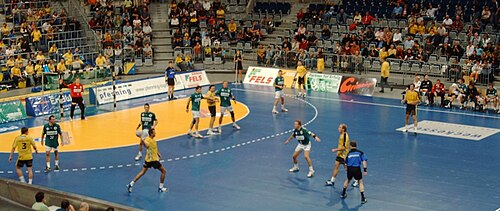
Handball is typically played on an indoor court measuring 40 by 20 metres. At each end sits a goal, which is surrounded by a crease (or zone)—a near-semicircular area 6 metres from the goal. Only the defending goalkeeper is permitted to stand inside this zone.
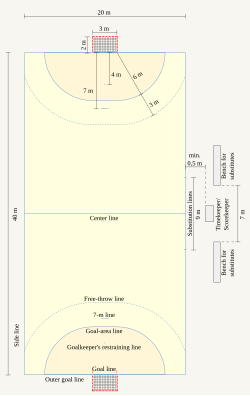
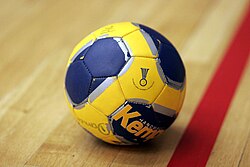
A dashed line located 9 metres from the goal marks the free-throw line. For gameplay, players use a specialized ball, the size of which depends on the age and gender of the participants. Professional men use a Size III ball, while women and younger men typically use a Size II ball.
Ball Specifications
| Class | Target Group | Circumference (cm) | Weight (g) |
|---|---|---|---|
| III | Men over 16 | 58–60 | 425–475 |
| II | Women over 14, Men over 12 | 54–56 | 325–375 |
| I | Juniors over 8 | 50–52 | 290–330 |
Gameplay, Rules, and Tactics
A standard match consists of two 30-minute halves. Since 2012, teams are permitted to call up to three team timeouts per game (a maximum of two per half), which last one minute each. The game is fast-paced, with professional teams often scoring between 20 and 35 goals per match.
Player Roles and Substitutions
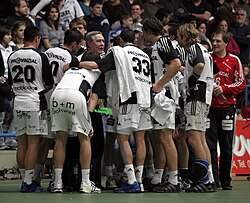
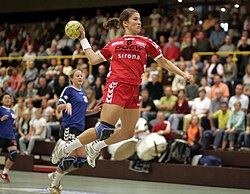
Each team consists of court players and one goalkeeper. A significant rule change in 2015 allows any court player to substitute for the goalkeeper without needing to wear a specific colored bib, a tactic often used to create an extra attacker. This has led to an increase in "empty net" goals.
Defensive Formations
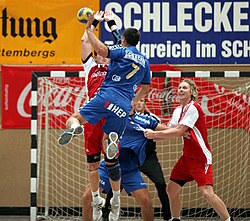
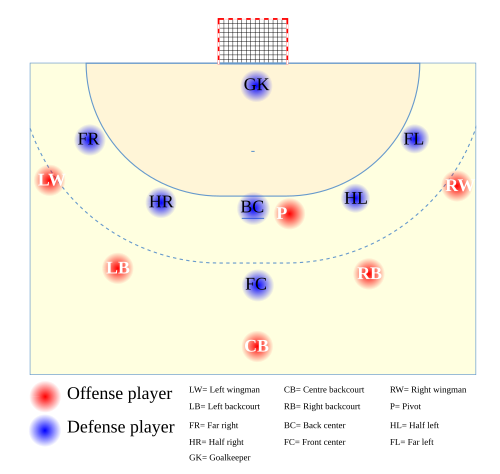
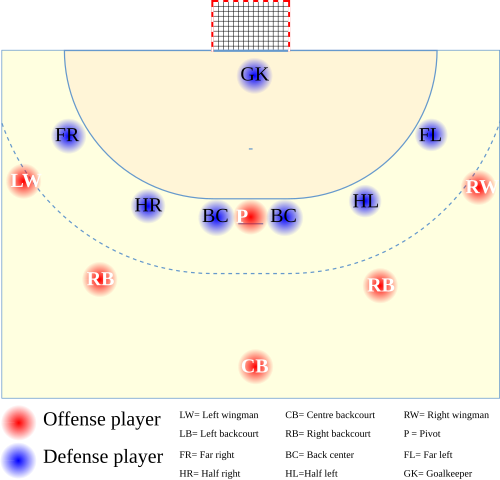
Defenders use various strategies to protect the goal. Common formations include:
- 6–0 Defense: A "flat defense" where all players line up between the 6-metre and 9-metre lines.
- 5–1 Defense: An "offensive defense" where one player moves outside the 9-metre perimeter to pressure opponents.
- 4–2 Defense: A formation featuring two players positioned further out in front.
Officiating and Penalties
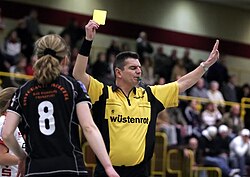
Referees manage the flow of the game and ensure rules are followed. They use various signals and can issue penalties, such as a seven-metre throw for significant fouls, or yellow cards for misconduct.
Frequently Asked Questions
How many players are on a handball team?
Each team has 7 players on the court at one time, which includes six court players and one goalkeeper.
Can players enter the 6-metre goal area?
Only the goalkeeper is allowed to move freely within the 6-metre zone. Court players may jump into the zone to shoot, but they must release the ball before landing.
What is the difference between indoor and beach handball?
While indoor handball is played on a 40x20m court, beach handball is a variant played on sand. Beach handball has been part of the World Games since 2001.
Who governs international handball?
The International Handball Federation (IHF) is the highest governing body for the sport, responsible for organizing world championships and managing international regulations.
How long does a handball match last?
A standard professional match consists of two 30-minute halves, typically separated by a 10 to 15-minute halftime intermission.