Ham Curing Methods: From Traditional Dry-Curing to Modern Brining
Ham is produced by curing raw pork, a preservation process that transforms raw meat into a stable, flavorful product. This is primarily achieved through two distinct methods: salting (known as dry curing) or brining (known as wet curing). Depending on the desired final product, producers may also employ smoking and various seasonings to enhance taste and longevity.
Dry-Cured Ham
Traditional dry curing is a patient process. While some rare versions use only salt, most involve cleaning the raw meat and covering it in salt. The meat is gradually pressed to expel fluids, and herbs or spices may be added for flavor. Once the initial salt cure is complete, the hams are washed and hung in dark, temperature-regulated environments to dry, followed by a period of air-hanging.
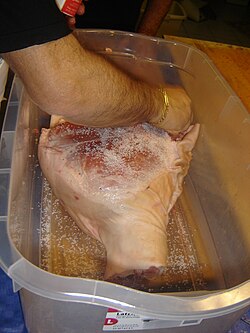
The time required for dry curing varies significantly depending on the variety of ham. For instance, Jinhua ham typically takes 8 to 10 months, while jamón serrano requires 9 to 12 months. Prosciutto di Parma takes over a year, and Iberian ham can take up to two years to develop its characteristic flavor. Many of these varieties, such as prosciutto, are consumed without cooking.
The Role of Nitrites
Modern dry-cured hams generally include nitrites (sodium nitrite or potassium nitrite) alongside salt. Nitrites serve two primary purposes: they inhibit bacterial growth and react with myoglobin (the protein responsible for meat color) to create a desirable dark red hue. However, because nitrites can be toxic, some regions regulate the maximum allowable content. Furthermore, during cooking, nitrites can react with amino acid degradation products to form nitrosamines, which are known carcinogens.
The Science of Proteolysis and Lipolysis
Dry curing triggers complex enzymatic reactions. Proteinases (including cathepsins B, D, H, and L, as well as calpains) and exopeptidases (peptidase and aminopeptidase) drive proteolysis—the breakdown of muscle tissue into small peptides and free amino acids. Simultaneously, adipose (fat) tissue undergoes lipolysis to create free fatty acids. These reactions are influenced by the animal's age, weight, and breed, as well as environmental factors like temperature, water content, redox potential, and salt levels. Notably, salt and phosphates act as inhibitors to proteolytic activity.
Because salt does not distribute perfectly evenly, salt content varies throughout the meat. This can be measured through sampling or non-invasively using CT scanning.
Wet-Cured Ham
Wet curing involves brining, where meat is immersed in a salt-water solution, often supplemented with sugar for flavor. This process typically lasts between 3 and 14 days and increases the final volume and weight of the product by approximately 4%.
An alternative, faster method involves pumping the curing solution directly into the meat. This ensures a more even distribution of salt and can increase the product's weight more than simple immersion, often completing the process in just a few days.
Unlike many dry-cured varieties, wet-cured hams are usually cooked. A prime example is Italian prosciutto cotto, which is brined, cooked in a container, and surface pasteurized. Under Italian regulations, this product may contain a variety of additives, including dextrose, fructose, lactose, maltodextrin, milk or soy proteins, modified starches, gelatine, and various flavorings.
Smoking and Flavor Development
Smoking is an additional preservation step where meat is placed in a smokehouse. The distinct flavor of smoked ham comes from the combustion of lignin, a primary component of wood. This process produces specific flavor compounds, including guaiacol (and its 4-, 5-, and 6-methyl derivatives) and 2,6-dimethylphenol.
Key Facts
- Dry curing involves salt application and air-drying; wet curing involves immersion in brine.
- Curing times for dry hams range from 8 months (Jinhua) up to 2 years (Iberian).
- Nitrites are used to prevent bacteria and maintain a dark red color via myoglobin reaction.
- Proteolysis breaks down muscle tissue into peptides and amino acids during dry curing.
- Wet curing typically increases the meat's weight and volume by about 4%.
- Smoked flavors are derived from the combustion of lignin in wood.
| Feature | Dry-Cured | Wet-Cured |
|---|---|---|
| Primary Method | Salting and air-drying | Brining (immersion or pumping) |
| Duration | 8 months to 2 years | 3 to 14 days (or fewer if pumped) |
| Typical Consumption | Often eaten raw (e.g., Prosciutto) | Usually cooked (e.g., Prosciutto cotto) |
| Weight Change | Shrinkage (depending on salt/nitrites) | Increase (approx. 4% or more) |
Frequently Asked Questions
What is the difference between dry-curing and wet-curing?
Dry-curing involves covering the meat in salt and allowing it to air-dry over many months, whereas wet-curing involves immersing the meat in a brine solution for a much shorter period, typically a few days to two weeks.
Why are nitrites added to cured hams?
Nitrites are added to inhibit the growth of harmful bacteria and to react with myoglobin in the meat, which preserves the characteristic dark red color of the ham.
Are all dry-cured hams cooked before eating?
No. Many dry-cured hams, such as prosciutto, are designed to be eaten without being cooked.
What causes the specific flavor of smoked ham?
The flavor is produced by the combustion of lignin in the wood used in the smokehouse, which creates compounds such as guaiacol and 2,6-dimethylphenol.
How does wet curing affect the weight of the ham?
Wet curing generally increases the volume and weight of the finished product, typically by about 4%, though pumping the solution into the meat can increase the weight even further.