Gyeonggi Province: The Economic and Cultural Heart of South Korea
Located in the western central region of the Korean Peninsula, Gyeonggi Province serves as the vital surrounding area of Seoul, the capital of the Republic of Korea. As a central hub of the Seoul Metropolitan Area, it blends rapid modernization and urban expansion with deep-rooted historical traditions. From its sprawling industrial cities to its serene natural landscapes, Gyeonggi is the most populous province in the country and a primary driver of South Korea's national economy.
The province is strategically positioned between east longitude 126 and 127 and north latitude 36 and 38. It covers approximately 10,199 square kilometers, representing about 10% of South Korea's total territory. Its geography is diverse, featuring 413 kilometers of coastline to the west and a border with the cease-fire line to the north.

Key Facts
- Capital: Suwon
- Population: 13,511,676 (2020 Census), ranking 1st in South Korea.
- Economy: Nominal GDP of KRW 594 trillion (US$ 475 billion) as of 2023.
- Administrative Structure: Comprised of 28 cities and 3 counties.
- Life Expectancy: 83.9 years (2023 data for Gyeonggi Province).
Geography and Administration
Gyeonggi Province surrounds Seoul on all sides, creating a massive integrated metropolitan zone. While the provincial government is headquartered in Suwon, additional government buildings are located in Uijeongbu to better serve the northern region of the province.
The province shares borders with Gangwon Province to the east, and North and South Chungcheong Provinces to the south. Its administrative history includes significant shifts, such as the transfer of the provincial seat from Seoul to Suwon in 1967 and the separation of Incheon in 1981.
Demographics and Urban Growth
Gyeonggi has experienced explosive population growth due to the urbanization of South Korea. In 1960, the population stood at 2,748,765; by 2020, it had surged to over 13.5 million. This growth is reflected in the rise of several "Special Cities" with populations exceeding one million.
As of 2024, the most populous cities include Suwon (1,195,000), Yongin (1,085,000), and Goyang (1,071,000). Conversely, the least populated areas are found in the counties, such as Yeoncheon, Gapyeong, and Yangpyeong.
![Percentage surviving to certatin ages in Gyeonggi Province in 2023. Life expectancy for the province in 2023 was 83.9 years.[6]](/images/a9/30/a930ab9ab281b0347ccef4939ea8eb19d1b98ecd8d43e6943b3aba57046eb17b.png)
Economy and Infrastructure
With a nominal GDP of US$ 475 billion and a per capita GDP of US$ 39,969, Gyeonggi is an economic powerhouse. This prosperity is supported by a sophisticated transportation network, including major expressways such as the Gyeongbu Expressway (Seoul–Busan) and the Seoul Ring Expressway, which facilitate the movement of goods and people across the peninsula.
Education and Culture
The province is a center for higher learning, hosting numerous national and private universities. Notable institutions include Ajou University, Kyung Hee University, and Sungkyunkwan University (Natural Science Campus) in Suwon, as well as Dankook University and Hankuk University of Foreign Studies in Yongin.
Culturally, the province is diverse. According to 2015 census data, 32% of the population identifies as Christian (23% Protestant, 9% Catholic), while 10.7% follow Buddhism. A majority (57.3%) are non-religious or follow indigenous beliefs.
Sports and Tourism
Gyeonggi is a major hub for professional sports, hosting numerous clubs across football, baseball, basketball, and volleyball. The province is home to the KT Wiz (KBO Baseball) and various K League football teams.
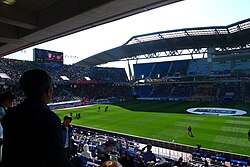

For tourists, the province offers a mix of modern entertainment and traditional heritage. Popular destinations include the Everland theme park and the Korean Folk Village in Yongin, as well as the Icheon Hot Springs. The region is also famous for its seasonal festivals, such as the Hwaseong Cultural Festival in Suwon and the Yeoju Ceramics Exposition.
| Category | Detail |
|---|---|
| Total Area | 10,199 km² |
| Population (2020) | 13,511,676 |
| Nominal GDP (2023) | US$ 475 Billion |
| Administrative Center | Suwon |
| Key Industries | Urbanization, Education, Technology |
Frequently Asked Questions
What is the capital of Gyeonggi Province?
The capital and administrative center of Gyeonggi Province is Suwon.
How does Gyeonggi Province compare in population to other regions?
Gyeonggi is the most populous province in South Korea, with a population of 13,511,676 as of the 2020 census.
What are some of the top tourist attractions in Gyeonggi?
Key attractions include Everland theme park, the Korean Folk Village in Yongin, and the various cultural festivals held in Suwon and Yeoju.
Which cities in Gyeonggi have the highest populations?
As of 2024, the most populous cities are Suwon, Yongin, and Goyang, all of which have populations exceeding one million people.
What is the economic status of the province?
Gyeonggi is a major economic driver for South Korea, with a 2023 nominal GDP of KRW 594 trillion (approximately US$ 475 billion).