Gulf South Conference: A Comprehensive History of Membership and Evolution
The Gulf South Conference (GSC) stands as a prominent fixture in collegiate athletics, characterized by a dynamic history of expansion, realignment, and institutional transitions. From its humble beginnings as a football-only league to becoming one of the largest conferences in the NCAA at its peak, the GSC has mirrored the shifting landscape of American college sports.
The conference was established in the summer of 1970 under the name Mid-South Athletic Conference (MSAC). Its founding members included Delta State, Florence State (now North Alabama), Jacksonville State, Livingston (now West Alabama), Tennessee–Martin, and Troy State (now Troy). Due to scheduling constraints during the 1970–71 academic year, the league focused exclusively on football, with Jacksonville State claiming the inaugural title.
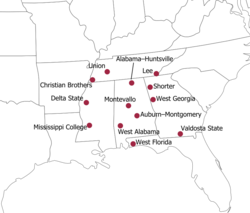
The Formative Years and Early Expansion
By 1971, the league underwent a significant transformation. It rebranded as the Gulf South Conference, established an administrative office in Hammond, Louisiana, and expanded its scope to include championships in all men's sports. This era saw the addition of Southeastern Louisiana (SLU) and Nicholls State, bringing the membership to eight schools.
The 1970s and 80s were marked by a cycle of arrivals and departures. While Mississippi College and Northwestern Louisiana joined in 1972, several members eventually left to pursue Division I status—the highest level of NCAA competition—including Northwestern State, Nicholls State, and Southeastern Louisiana. Stability returned briefly in the 1980s with the addition of Valdosta State in 1981 and West Georgia in 1983.
Growth and the Peak of Membership
The 1990s triggered a period of aggressive growth. Following the departure of Tennessee–Martin and Troy State to Division I in 1991, the GSC embarked on a massive expansion. Between 1992 and 1996, ten new members joined, including Lincoln Memorial, Alabama–Huntsville, Henderson State, Central Arkansas, Mississippi University for Women (MUW), West Florida, Arkansas-Monticello, Arkansas Tech, Montevallo, and Southern Arkansas.
This expansion culminated in July 2000, when the addition of Harding University and Ouachita Baptist University made the GSC the largest NCAA conference at any level, boasting 18 member schools. However, this peak was short-lived; MUW discontinued its athletics program in 2003, and other institutions like Central Arkansas and Lincoln Memorial departed shortly thereafter.
Modern Realignment and the 2010s
The 2011–12 academic year marked a pivotal shift in the conference's structure. Six Arkansas-based members—Arkansas Tech, Arkansas–Monticello, Harding, Henderson State, Ouachita Baptist, and Southern Arkansas—broke away to form the Great American Conference. This exodus led the GSC to move away from divisional play after the 2010-11 season.
To rebuild, the GSC supported the Division II applications of several institutions. Union University and Shorter University joined in 2014-15, followed by Lee University in 2015-16. The conference also began utilizing associate members—schools that participate in specific sports rather than all conference activities—starting with Florida Tech for football in 2013.
Key Facts
- Founded: 1970 as the Mid-South Athletic Conference.
- Peak Size: 18 member schools in 2000.
- Administrative Hub: Moved to Birmingham in 1979 under Commissioner Jim McCullough.
- Major Realignment: Six members left in 2011 to form the Great American Conference.
- Recent Transitions: North Alabama (2018) and West Georgia (2024) transitioned to Division I.
Conference Membership Summary
| Period | Key Additions | Key Departures | Reason for Change |
|---|---|---|---|
| 1970-1971 | Charter Members | N/A | Conference Formation |
| 1992-1996 | 10 New Members | Jacksonville State | Aggressive Expansion |
| 2000 | Harding, Ouachita Baptist | N/A | Reached 18-school peak |
| 2011 | Shorter, Union | 6 Arkansas Schools | Formation of Great American Conf. |
| 2018-2027 | Loyola New Orleans (2027) | North Alabama, West Florida | Transition to Division I |
Frequently Asked Questions
What was the original name of the Gulf South Conference?
The conference was originally founded in 1970 as the Mid-South Athletic Conference (MSAC) and operated as a football-only league for its first year.
Why did the GSC stop using divisional play?
The GSC moved away from divisional play after the 2010-11 season following the departure of six Arkansas-based members who left to form the Great American Conference.
What is an associate member in the GSC?
An associate member is an institution that joins the conference for a specific sport rather than all athletic programs. An example is Florida Tech, which joined as an affiliate for football in 2013.
Which schools have recently transitioned from the GSC to Division I?
Recent transitions to Division I include the University of North Alabama (2018), the University of West Georgia (2024), and the University of West Florida (scheduled for 2026).
Who is the current leadership of the conference?
Matt Wilson was selected as the seventh commissioner of the GSC in May 2014, succeeding Nate Salant.