Guiyang: The Forest City and Big Data Hub of Guizhou
Known as the Forest City, the Summer Capital of China, and the Second Spring City, Guiyang is the capital of Guizhou province. Centrally located on the eastern part of the Yunnan–Guizhou Plateau, this prefecture-level city sits on the north bank of the Nanming River. With its high elevation and lush surroundings, Guiyang offers a unique blend of ancient heritage and cutting-edge technological advancement.
Despite being the provincial capital, Guiyang is not the largest city in Guizhou—that title belongs to Zunyi. However, it serves as the region's primary political, cultural, and scientific center, recently ranking among the top 150 science cities globally according to the Nature Index.
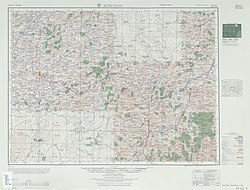
Key Facts
- Elevation: Approximately 1,100 to 1,275 meters (3,600 to 4,183 ft).
- Population: 5,987,018 (2020 Census).
- Economy: A global hub for big data and computing, hosting giants like Apple, Huawei, and Alibaba.
- Climate: Humid subtropical, characterized by cool winters and moderate summers.
- Education: Home to Guizhou University, a Project 211 national research university.
History and Evolution
The valley of Guiyang has been inhabited since the Spring and Autumn period. Its strategic importance grew in the 7th century as a military outpost under the Sui and Tang dynasties, then known as Juzhou. During the Mongolian Yuan dynasty, it evolved into a city called Shunyuan. By 1413, when Guizhou became a full province, Guiyang was established as its capital.
The city experienced significant growth following the Japanese invasion of China during World War II and saw another surge in development during the 1990s following the reform and opening-up policies initiated by Deng Xiaoping.
Geography and Climate
Guiyang is defined by its mountainous terrain and a monsoon-influenced humid subtropical climate (Köppen: Cwa). Because of its high elevation and low latitude, the city avoids the extreme heat found in other parts of China, earning it the nickname "Summer Capital."
The city is one of China's least sunny major cities, receiving only 1,150 hours of sunshine annually, with relative humidity consistently above 75%. Precipitation is heavy, totaling roughly 1,149 millimeters (45.2 inches) per year, with the majority falling between May and July.
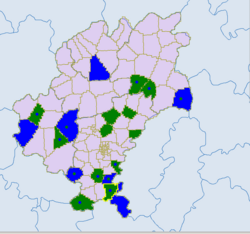
Administrative Structure and Demographics
Guiyang is divided into six urban districts—Nanming, Yunyan, Huaxi, Wudang, Baiyun, and Guanshanhu—along with three counties (Kaiyang, Xifeng, and Xiuwen) and the city of Qingzhen. The municipal seat is located in the Guanshanhu District.
According to the 2020 census, the city's permanent population was 5,987,018. There has been a significant shift toward urbanization, with 80.07% of the population now residing in cities and towns.
| Category | Detail |
|---|---|
| Total Area | 8,034 km² |
| Urban Population | 4,506,134 |
| GDP (Prefecture-level) | CN¥ 431.2 billion (US$ 62.5 billion) |
| Per Capita GDP | CN¥ 72,246 (US$ 10,474) |
| Time Zone | UTC+08:00 |
Economy and Innovation
Guiyang has transformed into a powerhouse of the digital economy. In 2016, the Milken Institute named it the Best-Performing City in China due to rapid growth in jobs, wages, and GDP. This success is largely driven by massive investments in big data and computing infrastructure.
Attracted by state support and tax incentives, multinational corporations including Microsoft, Huawei, Tencent, Qualcomm, and Alibaba have established a presence in the city, turning Guiyang into a critical node for cloud computing in Asia.
Culture and Tourism
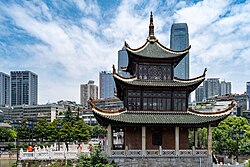
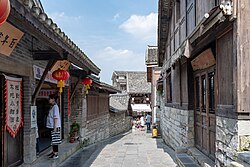
Guiyang blends traditional Chinese architecture with a modern urban lifestyle. Visitors often frequent the Jiaxiu Pavilion, a symbol of the city, or explore the historic streets of Qingyan Ancient Town.
The city's culinary scene is equally diverse. Local specialties include Huangba (a sweet steamed or fried rice wrap) and Bingfen (ice jelly with sesame and peanuts), a popular summer treat. Interestingly, Guiyang has developed one of the highest densities of coffee shops in China, with over 3,000 cafes as of 2025.
Transportation Infrastructure
Guiyang serves as a vital transport hub for Southwest China. The Guiyang Longdongbao International Airport (KWE) handles millions of passengers annually, connecting the city to global destinations.
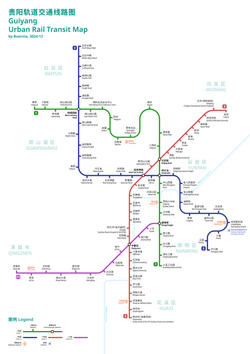
The city's internal transit has expanded rapidly with the Guiyang Metro, which now operates three lines (Line 1 opened in 2017, Line 2 in 2021, and Line 3 in 2023).
For long-distance travel, Guiyang is a major railway junction. The development of high-speed rail has drastically reduced travel times to China's first-tier cities, with Chongqing now reachable in approximately 2 hours and Guangzhou in 4.5 hours. Additionally, the city is a junction for four major national expressway segments, linking it to Kunming, Zunyi, and beyond.
Frequently Asked Questions
What is Guiyang's nickname and why?
Guiyang is known as the "Forest City" and the "Summer Capital of China" because of its lush greenery and moderate summer temperatures, which provide a refuge from the heat of other Chinese cities.
Why is Guiyang important for technology?
Guiyang has invested heavily in big data and computing infrastructure, attracting major global tech firms like Huawei, Microsoft, and Alibaba through tax incentives and government support.
What are the must-visit tourist spots in Guiyang?
Key attractions include the historic Qingyan Ancient Town, the scenic Jiaxiu Pavilion, and the natural wonder of Zhijin Cave.
How accessible is Guiyang by train?
Guiyang is a major high-speed rail hub. It offers rapid connections to major cities, including Chongqing (approx. 2 hours), Chengdu (4 hours), and Guangzhou (4.5 hours).
What is the local food like in Guiyang?
Local favorites include Huangba, a sweet rice wrap, and Bingfen, a refreshing ice jelly. The city is also famous for having an exceptionally high density of coffee shops.