Gudrun Ensslin: The Intellectual Force Behind the Red Army Faction
Gudrun Ensslin was a pivotal figure in the history of West German political violence. As a co-founder of the Red Army Faction (RAF)—also widely known as the Baader-Meinhof Gang—Ensslin transitioned from a privileged academic background to become a leading far-left militant. Often regarded as the intellectual head of the organization, she played a critical role in shaping the group's ideology and directing its violent campaign against the West German state.
Key Facts
- Role: Co-founder and intellectual leader of the Red Army Faction (RAF).
- Education: Studied education, English, and German at the University of Tübingen.
- Criminal Activity: Involved in five bomb attacks resulting in four deaths.
- Death: Died on October 18, 1977, during the "Death Night" at Stammheim Prison.
- Key Associates: Andreas Baader and Ulrike Meinhof.
Early Life and Academic Foundations
Born on August 15, 1940, in Bartholomä, Germany, Ensslin grew up in Bad Cannstatt, Stuttgart. The daughter of Helmut Ensslin, a pastor in the Evangelical Church, she was raised in an environment where social injustices were frequently discussed. In her youth, she was a high-achieving student and active in the Protestant Girl Scouts and parish Bible studies.
At eighteen, Ensslin spent a year in the United States attending high school in Warren, Pennsylvania, where she graduated with honors in 1959. Upon returning to Germany, she continued her education at the University of Tübingen on a scholarship from the German National Academic Foundation. She majored in education, English studies, and German studies, demonstrating a strong intellectual aptitude.
During her time in Tübingen, Ensslin and her partner, Bernward Vesper, founded Studio neue Literatur, a small publishing venture. Their first project was an anthology of poems protesting atomic weapons, signaling her early engagement with political activism.
The Path to Radicalization
By 1964, Ensslin had moved to West Berlin to work on her thesis. She and Vesper were active in the democratic left-wing and held positions with the Social Democratic Party of Germany. They participated in protests against the Vietnam War and restrictive security laws. In May 1967, Ensslin gave birth to her son, Felix.
A turning point occurred in June 1967 during protests against the Shah of Iran's visit to Germany. During a demonstration at the Deutsche Oper Berlin, an unarmed protester, Benno Ohnesorg, was shot and killed by a police officer. Ensslin viewed this event as evidence that West Germany was a fascist police state. This conviction, coupled with the subsequent acquittal of the officer involved, pushed her toward more extreme measures.
In 1967, Ensslin met Andreas Baader, beginning a relationship that would redefine her life. She eventually left Vesper and her son to join Baader and Thorwald Proll in an escalation of their fight against the system.
Leadership in the Red Army Faction
The transition to violent militancy began on April 2, 1968, when Ensslin, Baader, Proll, and Horst Söhnlein firebombed department stores in Frankfurt. This act of arson led to their arrest and subsequent three-year prison sentences. However, after being released pending appeal in 1969, Ensslin and her comrades fled to Italy and France.
The RAF officially emerged as a violent entity on May 14, 1970, when Ensslin, Ulrike Meinhof, and two other women liberated Andreas Baader from custody. Following this event, Ensslin became one of the most wanted individuals in Germany, coordinating urban guerrilla warfare against the state.
Her period of active militancy ended on June 7, 1972, when she was arrested in a Hamburg boutique. The arrest occurred after a shop assistant discovered a revolver in a coat Ensslin had left outside a fitting room.
The "Death Night" and Legacy
While Ensslin was imprisoned, the second generation of the RAF attempted to secure her release through high-profile kidnappings and hijackings, most notably the abduction of Hanns-Martin Schleyer and the hijacking of Lufthansa Flight 181 in October 1977.
These efforts culminated in the "Death Night" of Stammheim Prison on October 18, 1977. Ensslin was found dead in her cell by hanging. Simultaneously, Andreas Baader and Jan-Carl Raspe were found shot. While some survivors and critics claimed these were extrajudicial killings by the government, official investigations and subsequent studies, such as those by Stefan Aust, concluded the deaths were suicides.
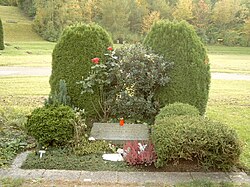
Ensslin was buried on October 27, 1977, in a common grave with Baader and Raspe at the Dornhalden Cemetery in Stuttgart.
Summary of Gudrun Ensslin's Life
| Category | Details |
|---|---|
| Lifespan | August 15, 1940 – October 18, 1977 |
| Education | University of Tübingen (Education, English, German) |
| Primary Affiliation | Red Army Faction (RAF) |
| Key Actions | Frankfurt department store arson (1968); Baader's liberation (1970) |
| Place of Death | Stammheim Prison, Stuttgart |
Frequently Asked Questions
What was Gudrun Ensslin's role in the Red Army Faction?
Ensslin was a co-founder and is widely considered the intellectual leader of the RAF. She was instrumental in developing the group's political beliefs and planning its violent operations.
What event triggered Ensslin's shift toward violent militancy?
The killing of unarmed protester Benno Ohnesorg by a police officer in June 1967, and the subsequent acquittal of the officer, deeply enraged Ensslin and led her to view the West German state as fascist.
How was Gudrun Ensslin captured?
She was arrested on June 7, 1972, in a Hamburg boutique after a shop assistant found a revolver in a coat she had left outside a fitting room.
What happened during the "Death Night" at Stammheim Prison?
On October 18, 1977, Ensslin, Andreas Baader, and Jan-Carl Raspe were found dead in their high-security cells. Ensslin died by hanging, while Baader and Raspe were shot.
Was the death of Gudrun Ensslin a suicide?
The official state ruling and exhaustive studies by authors like Stefan Aust conclude that the deaths were suicides, although some former RAF members have alleged they were extrajudicial killings.