Guaraná: The High-Caffeine Powerhouse of the Amazon
Deep within the Amazon basin, particularly in Brazil, grows a remarkable climbing plant known as guaraná (Paullinia cupana). A member of the Sapindaceae family, this plant is distinguished by its large leaves and clusters of flowers, but it is most famous for its seeds. These seeds, similar in size to coffee beans, serve as a potent natural source of energy for millions of people across South America and the rest of the world.
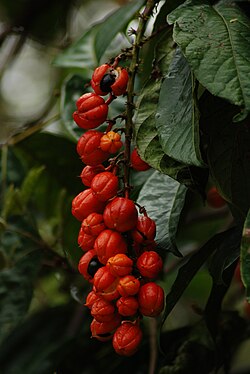
The fruit of the guaraná plant is visually striking, ranging in color from brown to red. When the fruit splits open, it reveals black seeds partially covered by white arils (fleshy seed coverings). This specific color contrast creates a striking resemblance to human eyeballs, a feature that has inspired local folklore and given the plant its distinctive identity.
Key Facts
- Scientific Name: Paullinia cupana.
- Origin: Native to the Amazon basin, especially common in Brazil.
- Caffeine Content: Seeds can contain up to 6% caffeine, significantly higher than green coffee beans (1–3%).
- Primary Use: Used as a stimulant in energy drinks and traditional soft drinks in Brazil and Paraguay.
- Biological Purpose: High caffeine levels act as a defensive toxin to repel insects.
![Ripe guaraná fruits resemble human eyes.[6]](/images/c3/d1/c3d17a1b20a54c2ed6b114e6e4e82f24908e89a406154740f45a0b8ca9d1badf.jpg)
History and Cultural Significance
The name "guaraná" is derived from warana, the word used by the Sateré-Mawé people. For the Tupi and Guarani cultures, the plant is deeply intertwined with mythology. According to a Sateré-Mawé legend, the plant originated from the eyes of a beloved village child killed by a deity. A benevolent god planted the child's left eye in the forest to create the wild variety of guaraná and the right eye in the village to create the domesticated version.
Traditional preparation methods vary. The Guaranis produce a herbal tea called cupana. This process involves shelling, washing, and drying the seeds, which are then pounded into a fine powder. This powder is kneaded into a dough and shaped into cylinders, creating what is known as "guaraná bread." To consume it, the bread is grated and steeped in hot water with sugar.
European colonizers first encountered the plant in the 16th century through the accounts of Spanish chroniclers such as Felip Betendorf, Oviedo, Hernández, and Cobo. Since then, it has been refined and commercialized globally by food scientists and marketers.
Chemical Composition
Guaraná is prized for its concentration of xanthine alkaloids—a group of stimulants that includes caffeine, theophylline, and theobromine. It also contains polyphenols, specifically (+)-catechin and (-)-epicatechin, which can form insoluble complexes with caffeine.
The seeds contain a complex mixture of chemical components that contribute to its properties as a stimulant and its nutritional profile.
| Chemical Component | Concentration (Parts per million) |
|---|---|
| Caffeine (Guaranine) | 9,100–76,000 |
| Tannin | 50,000–120,000 |
| Starch | 50,000–60,000 |
| Protein | < 98,600 |
| Resin | < 70,000 |
| Fat | < 30,000 |
| Ash | < 14,200 |
| Theophylline | 0–2,500 |
| Theobromine | 200–400 |
Modern Uses and Safety
Soft Drinks and Energy Beverages
Brazil is one of the world's largest consumers of soft drinks, and many of its local brands utilize guaraná extract. In Brazil, Peru, and Paraguay, the term "guaraná" is often used generically to refer to soft drinks containing the extract. Additionally, a traditional fermented beverage is made using guaraná seeds, water, and cassava.
Due to its high caffeine content, guaraná has become a popular additive in energy drinks worldwide, providing a concentrated stimulant effect.
Regulatory Status
In the United States, the Food and Drug Administration (FDA) has not granted guaraná fruit powder or seed extract the status of "generally recognized as safe" (GRAS). Instead, they are approved specifically as food additives for flavor purposes.
Frequently Asked Questions
How does guaraná compare to coffee in terms of caffeine?
Guaraná seeds are significantly more potent, containing up to 6% caffeine, whereas green coffee beans typically contain between 1% and 3% caffeine.
Why does the guaraná plant produce so much caffeine?
The high concentration of caffeine serves as a natural defensive toxin, which the plant uses to repel insects from its berries and seeds.
What is "guaraná bread"?
Guaraná bread is a traditional preparation by the Guaranis where dried, powdered seeds are kneaded into a dough and shaped into cylinders. This bread is later grated and mixed with hot water and sugar to make tea.
Is guaraná considered safe by the FDA?
Guaraná seed extract and fruit powder are not classified as "generally recognized as safe" (GRAS) by the FDA, but they are approved for use as flavor additives in food.
What is the origin of the guaraná myth?
According to the Sateré-Mawé people, the plant grew from the eyes of a child killed by a deity; the left eye produced the wild variety and the right eye produced the domesticated variety.