Ground Segment Infrastructure for Spacecraft Operations
The success of any space mission depends not only on the vehicle in orbit but also on the complex infrastructure on Earth that supports it. This ground segment acts as the vital link between mission operators and the spacecraft, providing the necessary interfaces for communication, monitoring, and control.
Ground Stations: The Radio Interface
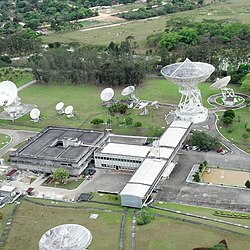
Ground stations serve as the primary radio interfaces between the space and ground segments. Their core purpose is to facilitate Telemetry, Tracking, and Command (TT&C), as well as the transmission and reception of payload data. To manage multiple spacecraft, tracking networks—such as NASA's Near Earth Network and Space Network—utilize time-sharing protocols.
To ensure mission continuity, ground station equipment is often monitored remotely. Continuity of Operations plans typically include backup stations to maintain radio contact if a primary site is disabled by a natural disaster or technical failure.
Transmission and Reception Processes
The process of sending data to a spacecraft, known as uplinking, involves several technical steps. Ground network packets are extracted, encoded to baseband, and modulated onto an intermediate frequency (IF) carrier. This signal is then up-converted to the assigned radio frequency (RF) band, amplified to high power, and transmitted via a waveguide to the antenna. In cold climates, heaters or blowers are used to prevent ice and snow from accumulating on the parabolic dishes.
Conversely, downlinked signals are captured by the antenna and passed through a low-noise amplifier—often integrated into a low-noise block downconverter in the antenna hub to minimize signal loss. The signal is down-converted to IF, demodulated, and decoded through bit and frame synchronization. Any errors caused by signal degradation are identified and corrected. This data is then packetized for ground networks or stored temporarily for later playback if bandwidth is limited. Some stations also support delay-tolerant networking to handle intermittent connectivity.
Depending on the bandwidth requirements, a single spacecraft may utilize multiple RF bands for different data streams.
Passes, Tracking, and Ranging
A pass occurs when a ground station has a direct line of sight to the spacecraft. The timing of these passes is dictated by the station's location and the spacecraft's trajectory. To extend these opportunities, the Space Network employs geostationary relay satellites.
Precise tracking is essential for antenna pointing and for correcting Doppler shifting—the change in RF frequency caused by the spacecraft's motion. Ground stations also perform automated ranging by multiplexing ranging tones with command and telemetry signals. This data is sent to the control center to assist in orbit determination, which further refines antenna pointing.
Mission Control Centers (MCC)
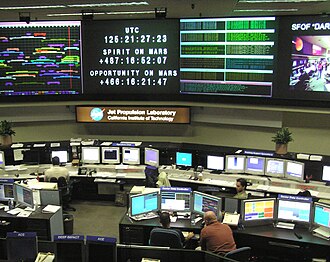
While ground stations handle the physics of radio communication, the Mission Control Center processes the information. The MCC analyzes telemetry, issues commands, and manages software updates. For crewed missions, the MCC also manages voice and video communications. Like ground stations, MCCs maintain backup facilities for operational continuity.
Telemetry Processing
Telemetry allows operators to monitor the health and status of the spacecraft. Data is often organized into virtual channels for housekeeping, diagnostics, and science. Flight control software processes this data through several stages:
- Separation of virtual channels.
- Time-ordering and gap-checking of frames (with retransmission requests if gaps exist).
- Decommutation: Associating raw parameter values with specific names called mnemonics.
- Conversion of raw data into calibrated engineering values.
- Limit and constraint checking to trigger alerts.
- Generation of visual displays, such as plots, tables, or synoptic mimics (flow diagrams).
This process relies on a spacecraft database provided by the manufacturer, which contains frame formatting, calibrations, and limits. This database is updated throughout the mission to account for hardware degradation or software upgrades.
Commanding and Analysis
Commands are formatted and validated against the spacecraft database before transmission. They can be issued in real-time or as part of automated procedures. To ensure synchronization, the spacecraft acknowledges received commands via telemetry, and both sides maintain a command counter. For security, commands and telemetry are often encrypted.
Before being sent to the actual vehicle, procedures are tested against a spacecraft simulator. Additionally, MCCs use offline subsystems for complex analytical tasks, including:
- Maneuver planning and orbit determination.
- Collision avoidance and conjunction assessment.
- Mission scheduling and on-board memory management.
- Path planning for planetary rovers.
Staffing and Support Infrastructure
MCCs are staffed by flight controllers, with peak staffing during early mission phases or critical events, such as spacecraft eclipses. Some uncrewed missions now use "lights-out" (automated) operations to reduce costs, relying on software notifications to alert operators when intervention is needed.
Remote Terminals and User Segments
Remote terminals allow payload controllers, science teams, and system administrators to access data outside the main MCC. These may be receive-only or bidirectional. The user segment refers to end-user terminals, such as satellite phones or TV systems; some communicate directly with the spacecraft, while others rely on the ground segment for processing.
Integration, Launch, and Networking
Before launch, vehicles are tested at Integration and Test (I&T) facilities to ensure the spacecraft and ground segment communicate correctly. During the launch phase, launch facilities relay telemetry via the ground network. The launch vehicle itself is sometimes categorized as a transfer segment.
The ground network connects all these elements using a mix of LAN and WAN technologies, often via leased lines or VPNs. Because reliability is critical, these networks emphasize redundancy to maximize uptime and minimize recovery time. Security is maintained through firewalls, encryption, antivirus software, and intrusion detection systems.
Key Facts
- TT&C stands for Telemetry, Tracking, and Command.
- Doppler shifting must be accounted for due to the high velocity of spacecraft.
- Mnemonics are the names assigned to specific telemetry parameters.
- Passes are limited by the line-of-sight between the station and the spacecraft.
- Redundancy is the primary method for ensuring ground network reliability.
| Component | Primary Function | Key Technical Process |
|---|---|---|
| Ground Station | Radio Interface | Modulation, Up/Down-conversion |
| Mission Control Center | Data Analysis & Command | Decommutation, Calibration |
| Ground Network | Data Transport | VPNs, Encryption, Redundancy |
| I&T Facility | Pre-launch Validation | End-to-end Communication Testing |
Frequently Asked Questions
What is the difference between the ground segment and the user segment?
The ground segment consists of the professional infrastructure (stations, MCCs) used to operate the spacecraft. The user segment consists of the end-user terminals, such as satellite phones or TV receivers, that consume the services provided by the spacecraft.
How do ground stations handle signal loss or interference?
Ground stations use low-noise amplifiers to boost weak signals and employ error identification and correction techniques to fix data corrupted by signal degradation.
What is a "lights-out" operation in mission control?
A "lights-out" operation is an automated control center setup for uncrewed spacecraft, where software monitors the mission and only notifies human operators when specific intervention is required, reducing staffing costs.
Why is a spacecraft database necessary for commanding?
The database ensures that commands are formatted correctly and validated against the spacecraft's current capabilities and software version before they are transmitted, preventing errors.
How are communication gaps handled during a pass?
Flight control software performs gap-checking on received frames; if data is missing, the system can command the spacecraft to retransmit the missing information.