Grendel in Cinema: Evolution of a Legendary Monster
The monstrous Grendel, a central antagonist in the epic poem Beowulf, has served as a versatile canvas for filmmakers for decades. From terrifying beasts and primitive humans to misunderstood outcasts, the cinematic portrayal of Grendel reflects shifting cultural perspectives on monstrosity, nature, and morality.
Major Cinematic Adaptations
The Post-Apocalyptic Vision (1999)
In Graham Baker's 1999 film Beowulf, the setting is shifted to a post-apocalyptic future. Vincent Hammond portrays Grendel as an armored creature equipped with clawed hands, feet, and jagged fangs. This version introduces significant narrative changes: Grendel is the son of Hrothgar and possesses the ability to become partially invisible, similar to the creature in the film Predator.
The climax of Grendel's arc also deviates from the original poem. While Beowulf still tears off Grendel's arm during their initial encounter, the monster survives the injury. Beowulf eventually secures the kill by stabbing Grendel's stump.
The Realistic Approach (2005)
The 2005 film Beowulf & Grendel attempts a more grounded, realistic interpretation of the legend. Played by Ingvar Eggert Sigurðsson, Grendel is depicted as a primitive, Neanderthal-like man. While King Hrothgar and his men perceive him as a "troll," he is essentially a prehistoric human. In contrast, his mother—credited as a "sea hag"—is portrayed with a more inhuman appearance.
The Digital Tragedy (2007)
Robert Zemeckis's 2007 Beowulf presents Grendel as a diseased and deformed creature, portrayed by Crispin Glover. This version establishes a familial link between Grendel's mother and Hrothgar, making Grendel the product of their relationship. He is also the older half-brother of the dragon, who was fathered by Beowulf.
Grendel is characterized as the "embodiment of pain," born with an oversized external eardrum that makes the singing in Heorot physically agonizing. This physiological weakness is eventually exploited by Beowulf. The film portrays Grendel as a timid, childlike figure who speaks Old English with his mother and shrinks in size when frightened. He ultimately bleeds to death after his arm is severed.
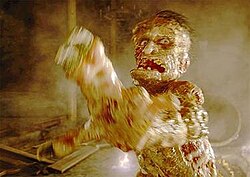
Philosophy professor Stephen T. Asma noted that Zemeckis's version humanizes the monster, suggesting that Grendel is a victim of pride and prejudice. In this interpretation, Grendel is not inherently evil but becomes "bad" because he is an outcast, shifting the moral blame toward the humans who rejected him.
Other Notable Portrayals and Influences
Beyond the major feature films, Grendel has appeared in various formats and inspired other creatures:
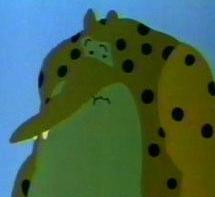
- Grendel Grendel Grendel (1981): An animated film based on John Gardner's 1971 novel, featuring Peter Ustinov as Grendel and told from the monster's own perspective.
- Grendel (2007): A television movie produced for the Sci Fi Channel.
- Beowulf: Prince of the Geats (2008): Features Christian Boeving as the monster.
- The 13th Warrior (1999): Features the Wendol, a fictional enemy race.
- How to Train Your Dragon (2010): The character Tuffnut refers to the Red Death as the "bride of Grendel."
- Outlander: The Moorwen is based on Grendel; as the last of its kind, it seeks revenge on humans before being killed by a fall from a cliff.
- Siegfried & Roy: Masters of the Impossible: Grendel is depicted as a "gentle giant" troll with eyes on its back who helps the son of King Midas.
Key Facts
- Diverse Forms: Grendel has been portrayed as an armored alien-like creature, a Neanderthal, a deformed humanoid, and a gentle giant.
- Family Ties: Both the 1999 and 2007 films imagine Grendel as the son of Hrothgar.
- Physical Weakness: In the 2007 film, Grendel's sensitivity to sound (due to a large eardrum) is his primary vulnerability.
- Narrative Shift: Modern adaptations often shift Grendel from a purely evil monster to a misunderstood outcast.
| Film (Year) | Actor | Depiction | Key Characteristic |
|---|---|---|---|
| Beowulf (1999) | Vincent Hammond | Armored Creature | Partial invisibility |
| Beowulf & Grendel (2005) | Ingvar Eggert Sigurðsson | Neanderthal Man | Realistic/Primitive |
| Beowulf (2007) | Crispin Glover | Deformed Humanoid | Sensitivity to sound |
| Grendel Grendel Grendel (1981) | Peter Ustinov | Animated | First-person perspective |
Frequently Asked Questions
How does the 2007 Beowulf film change Grendel's origin?
The 2007 film introduces a relationship between Grendel's mother and King Hrothgar, making Grendel their son and the half-brother of the dragon.
What is Grendel's specific weakness in the Zemeckis film?
Grendel has a large external eardrum that causes him intense pain when he hears the echoing songs from the hall of Heorot.
Which film portrays Grendel as a prehistoric human?
The 2005 film Beowulf & Grendel depicts him as a Neanderthal-looking primitive man, though the characters in the film believe him to be a troll.
How does the 1999 Baker adaptation handle Grendel's death?
Unlike the original poem, Grendel survives having his arm torn off; Beowulf eventually kills him by stabbing the remaining stump.
What is the philosophical interpretation of Grendel in the 2007 movie?
According to professor Stephen T. Asma, the film suggests Grendel is a misunderstood outcast rather than an inherently evil being, implying that the humans who cast him out are the true monsters.