Great Northern, Piccadilly and Brompton Railway: The Origins of a London Icon
The development of London's deep-level tube network was not a single coordinated effort, but rather a complex puzzle of competing private bills, financial struggles, and strategic mergers. At the heart of this evolution was the Great Northern, Piccadilly and Brompton Railway (GNP&BR), a line born from the convergence of three distinct railway projects in the late 19th century.
The Three Founding Visions
Between 1896 and 1899, three separate companies sought parliamentary approval to carve tunnels beneath the streets of London. Each had a specific goal: relieving congestion or connecting key districts.
Brompton and Piccadilly Circus Railway (B&PCR)
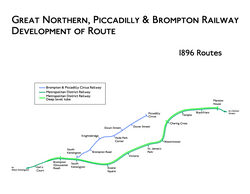
Proposed in November 1896, the B&PCR was designed to run entirely underground from Air Street near Piccadilly Circus to the south end of Exhibition Road in South Kensington. The route planned stations at Dover Street, Down Street, Hyde Park Corner, Knightsbridge, and Brompton Road. To power its electric trains, the company planned a generating station at Lots Road, West Brompton. The project received royal assent on 6 August 1897.
District Railway (DR) Deep-Level Tube
Simultaneously, the District Railway—which operated a steam-powered sub-surface line—sought to build an express deep-level tube between Gloucester Road and Mansion House. This express line was intended to bypass congestion, featuring only one intermediate stop at Charing Cross (now Embankment). Like the B&PCR, the DR required electricity and planned a power station near Walham Green (now Fulham Broadway). This act also received assent on 6 August 1897.
Great Northern and Strand Railway (GN&SR)
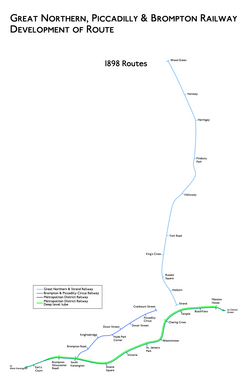
In 1898, the GN&SR was announced, backed by the Great Northern Railway (GNR) to relieve pressure on the King's Cross route. The line was planned to run from Wood Green to Stanhope Street, north of the Strand. Due to the construction of Kingsway and Aldwych, the southern terminus was eventually moved to the junction of those two roads. The bill was enacted on 1 August 1899.
Key Facts
- Founding Companies: The GNP&BR was formed by the merger of the B&PCR, the GN&SR, and parts of the District Railway's deep-level plans.
- Financial Backing: American financier Charles Yerkes provided the necessary capital via the Underground Electric Railways Company of London (UERL).
- Architectural Style: Stations were designed by Leslie Green, featuring signature oxblood red glazed terracotta.
- Power Source: The Lots Road generating station was a critical piece of infrastructure for the line's electrification.
- Timeline: Construction began in July 1902, and the railway opened in December 1906.
The Yerkes Era and Financial Rescue
Despite having parliamentary approval, these companies struggled to find the capital required for construction. The deadlock was broken in 1901 by Charles Yerkes, an American financier experienced in developing Chicago's tramways. Yerkes and his consortium purchased a majority of the District Railway shares in March 1901, followed by the B&PCR and GN&SR in September 1901.
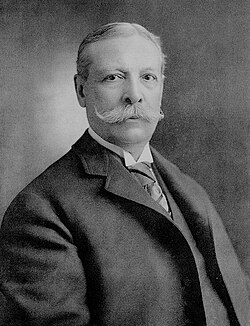
To manage these assets, Yerkes established the Underground Electric Railways Company of London (UERL). This holding company raised an initial £5 million, eventually totaling £18 million by 1903, primarily from overseas investors. This massive injection of capital allowed the separate projects to be integrated into a single cohesive network.
Route Evolution and Mergers (1898–1905)
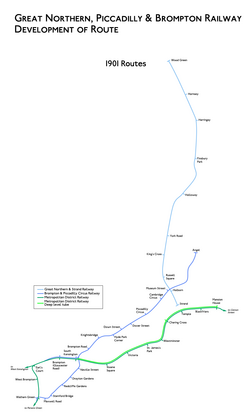
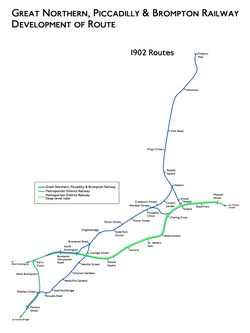
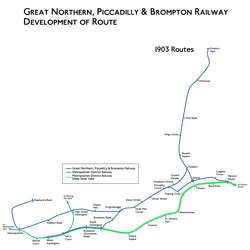
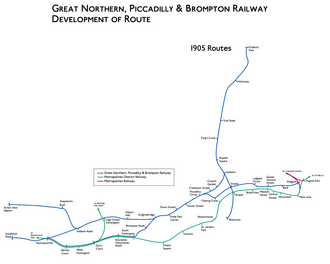
The path to the final route was marked by strategic shifts. In 1898, the DR purchased the B&PCR to block a competing proposal from the City & West End Railway. Over the next few years, several extensions were proposed and debated:
- Eastern Extensions: The B&PCR sought to extend from Piccadilly Circus toward Angel, Islington, though some sections were delayed due to concerns over vibrations.
- Western Connections: Plans were made to connect the B&PCR to the DR's line south of Walham Green.
- The GN&SR Merger: By 1902, the GN&SR transferred its powers and obligations to the B&PCR, effectively merging the two into the GNP&BR.
Construction and Design
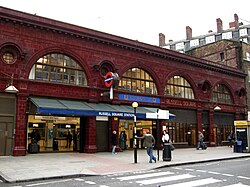
Construction officially began in July 1902 at Knightsbridge. The main contractor, Walker, Price & Reeves, worked rapidly; by October 1904, 80% of the tunnels were complete. A defining feature of the line was the architecture of the surface buildings. Architect Leslie Green created a standardized "house-style" for the UERL, utilizing steel-framed buildings faced with dark oxblood red glazed terracotta blocks and large semi-circular upper windows.
Most stations were equipped with two to four lifts and an emergency spiral staircase. The line finally opened in December 1906, following a period of test running. Interestingly, because the District Railway's existing tracks were electrified and resignalled in 1905, the planned deep-level tunnels east of South Kensington became unnecessary and were abandoned.
| Railway Company | Original Route Focus | Key Termini/Points | Act Date |
|---|---|---|---|
| B&PCR | Piccadilly to South Kensington | Air Street, Exhibition Road | 1897 |
| District Railway (Deep) | Express line beneath sub-surface | Gloucester Road, Mansion House | 1897 |
| GN&SR | Wood Green to the Strand | Wood Green, Holborn, Strand | 1899 |
Frequently Asked Questions
Who was Charles Yerkes?
Charles Yerkes was an American financier who had previously developed Chicago's tramway system. He provided the critical funding and organizational structure (via the UERL) to merge and build the GNP&BR and electrify the District Railway.
What is the "Leslie Green" style?
Leslie Green was the architect who designed the UERL's stations. His signature style featured two-storey steel-framed buildings clad in oxblood red glazed terracotta with distinctive semi-circular windows.
Why were some of the original deep-level tunnels not built?
The electrification and resignalling of the District Railway's existing surface and sub-surface tracks in 1905 increased capacity enough that the planned deep-level tunnels east of South Kensington were no longer needed.
How was the railway powered?
The railway relied on electric trains, with power provided by a generating station built at Lots Road, West Brompton, on the north bank of the River Thames.
What happened to the GN&SR's southern terminus?
Originally planned for Stanhope Street, the terminus was relocated to the junction of Kingsway and Aldwych because Stanhope Street was scheduled for demolition by the London County Council.