Great Glen Fault: Scotland's Massive Strike-Slip System
The Great Glen Fault is a prominent strike-slip fault—a fracture in the Earth's crust where two blocks of land slide past each other horizontally—that carves a dramatic path through the landscape of Scotland. Known for its striking linearity, this geological feature is not merely a local curiosity but a remnant of ancient continental collisions that shaped the North Atlantic region.
From the depths of Loch Ness to the rugged coastlines of Ireland and Canada, the fault tells a story of tectonic upheaval spanning hundreds of millions of years.
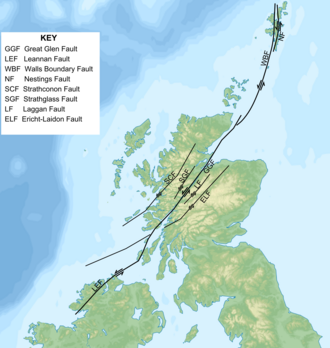
Key Facts
- Type: Strike-slip fault.
- Estimated Displacement: 64 miles (104 km).
- Origin: Formed during the Caledonian orogeny (approx. 430–390 Ma).
- Global Reach: Historically connected to the Cabot Fault in Newfoundland, Canada.
- Landscape Impact: Quaternary glaciation along the fault zone created Loch Ness.
Geography and Global Extent
Aligned from the northeast to the southwest, the Great Glen Fault runs through the Great Glen in Scotland. Its path extends southwest through Loch Linnhe and the Firth of Lorne, continuing into northwestern Ireland as the Leannan Fault, where it passes through Clew Bay, Donegal Bay, and Lough Swilly.
To the northeast, the system connects with the Melby and Walls Boundary faults before becoming obscured by Mesozoic rifting north of Shetland. Interestingly, the fault once spanned the Atlantic. When the Mid-Atlantic Ridge formed 200 million years ago, the contiguous fault was broken. The North American segment now exists as the Cabot Fault (also known as the Long Range Fault) in northwestern Newfoundland, Canada, extending into the Gulf of St. Lawrence for at least 300 miles (480 kilometers).
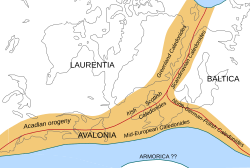
Geological History and Evolution
The Great Glen Fault evolved through several distinct phases of movement, beginning with the Caledonian orogeny—a mountain-building event caused by the collision of the Laurentia and Baltic tectonic plates. This occurred between the end of the Silurian and the Early Devonian periods (roughly 430 to 390 million years ago).
Phases of Movement
- Sinistral Phase: Initial movement was sinistral (left-lateral). This phase was mirrored by sub-parallel faults, including the Strathglass and Strathconon faults to the northwest, and the Tyndrum, Laggan, and Ericht-Laidon faults to the southeast.
- Dextral Phase: A second major movement phase occurred during the Carboniferous period, shifting to a dextral (right-lateral) sense.
- Final Phase: The last significant movements took place during the Late Cretaceous to Early Tertiary periods.
Evidence of this timeline is found in Devonian folds that are cut by dyke swarms from the Late Carboniferous to Early Permian. Much later, during the Quaternary glaciation, erosion along this weakened fault zone carved out the basin that now holds Loch Ness.
Seismic Activity and Modern Impact
Whether the Great Glen Fault is currently "active"—meaning it is actively accumulating seismic slip—remains a subject of scientific debate. Some researchers argue it is a reactivated strike-slip fault within the continental crust that continues to accumulate tectonic strain. Others, including geologist Roger Musson, suggest there are no signs of present activity, attributing the 1901 Inverness earthquake to a secondary fault rather than the main Great Glen line.
Despite the debate, moderate tremors have been recorded over the last 150 years. This seismic risk was taken into account during the construction of the Kessock Bridge on the A9 road out of Inverness, which incorporates specialized seismic buffers.
In more recent human history, the fault's natural valley provided the ideal route for the Caledonian Canal, a boat canal dug in the 19th century that remains in use today.
| Feature | Details |
|---|---|
| Primary Movement Type | Strike-slip (Sinistral then Dextral) |
| Formation Period | Caledonian orogeny (430–390 Ma) |
| Total Displacement | ~64 miles (104 km) |
| Associated Water Bodies | Loch Ness, Loch Linnhe, Gulf of St. Lawrence |
| North American Equivalent | Cabot Fault (Long Range Fault) |
Frequently Asked Questions
What is a strike-slip fault?
A strike-slip fault is a geological fracture where two blocks of the Earth's crust slide past each other horizontally, rather than moving vertically.
How did Loch Ness form?
Loch Ness was formed during the Quaternary glaciation, when glaciers eroded the land along the pre-existing weakness of the Great Glen Fault zone.
Is the Great Glen Fault still active?
There is no scientific consensus. Some experts believe it is accumulating tectonic strain, while others argue that recent seismic activity does not support the theory of re-activation.
How is the fault connected to Canada?
Before the Mid-Atlantic Ridge formed 200 million years ago, the Great Glen Fault was part of a contiguous system that included the Cabot Fault in Newfoundland, Canada.
What was the Caledonian orogeny?
The Caledonian orogeny was a major mountain-building event caused by the collision of the Laurentia and Baltic tectonic plates at the end of the Silurian and into the Early Devonian periods.