Governorates of Syria: Administrative Structure and History
Syria is organized as a unitary state, meaning the central government holds primary authority. To manage its territory effectively, the country is divided into fourteen primary administrative divisions known as governorates (Arabic: muḥāfaẓāt). These entities, often referred to as provinces or counties in English, serve as the backbone of local governance and public service delivery.
The administrative hierarchy descends from the governorate level down to the smallest local units. Each governorate is subdivided into districts (manāṭiq), which are further split into subdistricts (nawāḥī). The subdistricts, in turn, encompass various villages, which represent the most granular level of administrative organization.
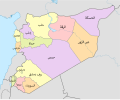
Key Facts
- Total Governorates: 14
- Administrative Hierarchy: Governorate → District → Subdistrict → Village
- Largest Governorate by Area: Homs (42,223 km²)
- Most Populous Governorate: Aleppo (approx. 4.8 million)
- Smallest Governorate by Area: Damascus (106 km²)
- Governance: Led by a presidentially appointed governor and a popularly elected provincial council.
Governance and Administration
Each governorate is managed by a governor who is appointed by the president, subject to approval by the cabinet. The governor holds extensive responsibility for the region's operational success, overseeing sectors such as health, education, social services, transportation, agriculture, industry, and the maintenance of law and order.
To ensure coordinated growth, the governor works closely with the relevant minister of local administration to supervise development projects. The governor is supported by a provincial council, whose members are elected by the public for four-year terms. This council elects an executive bureau from its membership to handle day-to-day administrative tasks between formal sessions.
At the lower levels, districts and subdistricts are managed by officials appointed by the governor. These officials act as vital intermediaries, connecting the central government with traditional local leadership, including clan leaders, village chiefs, and councils of elders.
Evolution of Syria's Administrative Divisions
The current map of Syria is the result of several decades of reorganization following the end of the French Mandate on April 17, 1946. Initially, Syria retained a framework of nine top-level districts: Aleppo, Damascus, Euphrates (Al-Furat), Hama, Hauran, Homs, Jabal al-Druze, Al Jazira, and Latakia.
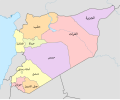
During the 1950s, the government standardized several names to better reflect local identities. Hauran became Daraa, Jabal al-Druze was renamed Sweida, and Al-Jazira became Al-Hasakah.
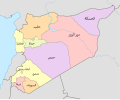
The 1960s saw significant territorial shifts. The Euphrates Governorate was split into Al-Rashid and Deir ez-Zor, and Idlib was established as a separate governorate from Aleppo. In 1962, the capital region was reorganized into the Damascus Governorate and the City of Damascus.
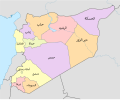
Further refinements occurred in the following decades. In 1964, Quneitra was created from parts of Damascus. By 1970, Al-Rashid was renamed Raqqa. The 1970s also saw the separation of Tartus from Latakia.
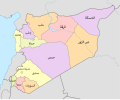
The final major structural change occurred in 1987, when the City of Damascus became an independent governorate, and the surrounding rural areas were reorganized into the Rif Dimashq Governorate.
Governorate Data Summary
| Governorate | Area (km²) | Population | Districts |
|---|---|---|---|
| Aleppo | 18,482 | 4,600,166 | 8 |
| Rif Dimashq | 18,032 | 2,831,738 | 9 |
| Damascus | 106 | 2,211,042 | 1 |
| Homs | 42,223 | 1,762,500 | 6 |
| Hama | 8,883 | 1,593,000 | 5 |
| Idlib | 6,097 | 1,464,000 | 5 |
| Hasakah | 23,334 | 1,272,702 | 4 |
| Latakia | 2,297 | 1,278,486 | 4 |
| Deir ez-Zor | 33,060 | 1,200,500 | 3 |
| Raqqa | 19,616 | 919,000 | 3 |
| Daraa | 3,730 | 998,000 | 3 |
| Tartus | 1,892 | 785,000 | 5 |
| Suwayda | 5,550 | 500,000 | 3 |
| Quneitra | 1,861 | 87,000 | 2 |
Frequently Asked Questions
How many governorates are there in Syria?
Syria is divided into 14 governorates.
Who appoints the governor of a province?
The governor is appointed by the president, subject to the approval of the cabinet.
What is the difference between Damascus and Rif Dimashq?
Damascus Governorate refers to the city itself, while Rif Dimashq (Rural Damascus) is the governorate that encompasses the rural areas surrounding the capital.
What are the smallest administrative units in Syria?
The smallest administrative units are the villages, which are located within subdistricts (nawāḥī).
Which governorate is the largest by land area?
Homs is the largest governorate, covering 42,223 square kilometers.