Governor Mike Parson: A Comprehensive Review of His Missouri Administration
Mike Parson assumed the role of Governor of Missouri on June 1, 2018, following the resignation of Eric Greitens. Since taking office, Parson has navigated a complex landscape of public health crises, legal battles over state authority, and significant policy shifts regarding social issues and criminal justice.
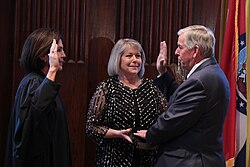
Parson's transition to the governorship began abruptly when Greitens announced his resignation effective at 5:00 pm on June 1, 2018; Parson was sworn in just thirty minutes later.
Key Facts
- Ascension: Became Governor in June 2018 after Eric Greitens resigned.
- Election: Won his first full term in November 2020, defeating Democratic nominee Nicole Galloway.
- COVID-19: Managed the state's pandemic response, including a brief statewide stay-at-home order in April 2020.
- Legal Battles: Faced court challenges over the appointment of the lieutenant governor and the legality of state gun laws.
- Clemency: Granted more pardons (over 760) between 2020 and 2024 than any Missouri governor since the 1940s.
Political Career and Elections
After serving as acting governor, Parson sought his first full term in the 2020 gubernatorial election. Despite rumors that former Governor Greitens might run again, Parson's team expressed doubt regarding a Greitens campaign. Parson secured the Republican nomination on August 4, 2020, defeating Jim Neely and Saundra McDowell, before winning the general election against State Auditor Nicole Galloway on November 3.
Legislative Actions and Policy Decisions
Abortion and Reproductive Rights
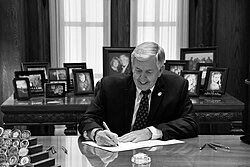
On May 24, 2019, Governor Parson signed HB 126, also known as the Missouri Stands for the Unborn Act. This legislation criminalized abortions after eight weeks of pregnancy, establishing a Class B felony punishable by five to 15 years in prison for providers. While the law included exceptions for medical emergencies, it provided no exceptions for rape or incest. A federal judge blocked the law shortly before its effective date, though the "reason ban"—which prohibits abortions based on race, sex, or Down Syndrome diagnosis—remained in effect.
Gun Rights and Federal Law
In June 2021, Parson signed a bill prohibiting local police departments from enforcing federal gun legislation, introducing fines of up to $50,000 for those who did. This move sparked a legal conflict with the U.S. Department of Justice, which argued the law violated the Supremacy Clause (the constitutional principle that federal law takes precedence over state law). In March 2023, a Federal District Court judge ruled the law unconstitutional.
Medicaid Expansion
Parson initially opposed a 2020 ballot referendum to expand Medicaid, citing concerns over the lack of a funding mechanism. Although Missouri voters approved the expansion in August 2020, Parson attempted to block its implementation in May 2021. The Missouri Supreme Court eventually ruled that the referendum did not violate state law, allowing the expansion to proceed.
COVID-19 Pandemic Management
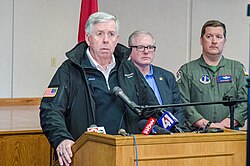
The COVID-19 pandemic defined much of Parson's early full term. In March 2020, he announced the first two cases in Missouri and declared a state of emergency, freeing $7 million in funding. While he initially delegated school closures to local districts, he eventually issued a statewide stay-at-home order on April 3, 2020.
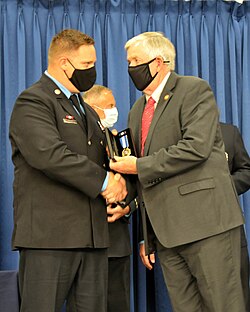
As the pandemic progressed, Parson became a vocal opponent of mask mandates and "COVID-19 passports," signing a law in June 2021 that limited the duration of local public health orders to 30 days. He also launched a Vaccine Incentive Program in July 2021, offering prizes of up to $10,000 to encourage vaccination.
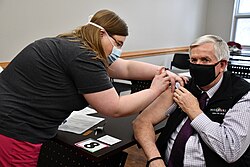
Parson and his wife, Teresa, both contracted the virus in September 2020, reporting mild symptoms and fully recovering by October. In February 2021, Parson received his own vaccination during a period when Missouri was ranked last in the nation for vaccine distribution.
Criminal Justice and Clemency
Governor Parson's record on clemency is marked by a high volume of pardons but a strict stance on the death penalty. He has never granted clemency in a death penalty case, notably denying requests for Brian Dorsey and Marcellus Williams, both of whom were executed.
Conversely, Parson has issued a record number of pardons for other offenses. Notable cases include the pardon of Mark and Patricia McCloskey following their guilty pleas for assault and harassment, and the conversion of Britt Reid's prison sentence to house arrest in 2024.
Border Security and State Budget
In early 2024, Parson supported Operation Lone Star, a Texas border security initiative. He deployed 200 National Guard members and 22 Highway Patrol troopers to the southern border via Executive Order 24-03. However, by June 2024, he vetoed a portion of the funds for the operation, reducing the allocation to $2 million.
Regarding the state's finances, Parson exercised significant authority over the 2024 operating budget, issuing hundreds of vetoes that cut $555.3 million from state spending.
Administrative Controversies
Parson's administration faced scrutiny over the appointment of Mike Kehoe as lieutenant governor in 2018, though the Missouri Supreme Court eventually upheld the legality of the move. Additionally, in 2021, Parson threatened to prosecute St. Louis Post-Dispatch reporter Josh Renaud after the journalist uncovered a security flaw on a state website that exposed the Social Security numbers of over 100,000 employees. A subsequent state investigation cleared Renaud of any wrongdoing, finding that the vulnerability had existed since 2011.
| Issue | Action/Position | Outcome/Status |
|---|---|---|
| Abortion | Signed HB 126 (8-week ban) | Blocked by federal judge |
| Medicaid | Opposed expansion referendum | Implemented via Supreme Court ruling |
| Gun Laws | Banned enforcement of federal gun laws | Ruled unconstitutional |
| COVID-19 | Opposed mandates; launched incentive program | Mixed distribution results |
| Death Penalty | Denied all clemency requests | Executions proceeded |
| Border Security | Deployed National Guard to Texas | Funding later reduced via veto |
Frequently Asked Questions
How did Mike Parson become Governor of Missouri?
Mike Parson became governor on June 1, 2018, immediately following the resignation of Governor Eric Greitens.
What was Parson's stance on Medicaid expansion?
Governor Parson opposed the expansion due to funding concerns, but after a public referendum and a Missouri Supreme Court ruling, the expansion was implemented on July 1, 2021.
Did Governor Parson ever grant clemency to death row inmates?
No, Governor Parson has never granted clemency in a death penalty case during his tenure.
What happened with the St. Louis Post-Dispatch reporter investigation?
After Governor Parson threatened to prosecute reporter Josh Renaud for uncovering a state website security flaw, a 158-page Highway Patrol report concluded that Renaud had committed no wrongdoing and had only accessed public information.
What is the "Missouri Stands for the Unborn Act"?
It is a law signed by Parson in 2019 that criminalized abortions after eight weeks of pregnancy, though it was largely blocked by a federal judge.