Goldsborough Railway Station: A History of the Flaxby Stop
Tucked away in North Yorkshire, the site of the former Goldsborough railway station tells a story of shifting demographics, wartime necessity, and modern urban planning. Though geographically closer to the village of Flaxby, the station served as a vital link for the local community and the residents of the nearby stately Goldsborough Hall for over a century.
The Origins and Naming of the Station
The station was officially opened in February 1850 by the East and West Yorkshire Junction Railway. However, the site had already seen activity prior to its official opening, with passenger trains stopping there on market days as early as October 1848. The station was strategically located near the A59 bridge over the railway.
Interestingly, the station's name varied in historical records, appearing as Gouldsborough, Goldsboro', or G'boro. While it was situated closer to Flaxby, it was named Goldsborough primarily because the users of Goldsborough Hall utilized the facility. Some historians suggest this naming convention was also intended to prevent confusion with Flaxton station on the York to Scarborough line.
Station Layout and Operations
Located 2.75 miles (4.4 km) east of Knaresborough and 13 miles (21 km) west of York, the station featured a staggered platform design. These platforms were positioned on opposite sides of the former Flaxby Road level crossing (the original route of the A59 before the bypass was constructed). The "down" platform, serving trains toward Knaresborough, sat to the east, while the "up" platform, serving trains toward York, was located to the west.
Freight and Local Economy
Beyond passenger travel, the station was a hub for local trade. By 1922, the North Eastern Railway reported a local population of 374 people, with 4,405 tickets sold that year. The station's goods facilities, including a coal depot and a small timber warehouse, were located west of the up platform. Freight traffic primarily consisted of livestock and barley, with 251 tonnes (277 tons) of barley handled in 1922.
Wartime Infrastructure
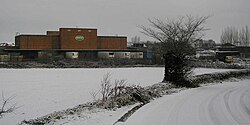
The onset of World War II brought a significant architectural change to the site. A massive brick building was constructed northwest of the station to serve as a refrigerated cold store for the Ministry of Food, designed to house emergency meat supplies. This "brick monolith" was supported by two loop reception sidings and two private sidings running on either side of the structure. This facility remained a landmark until its demolition in 2016.
The Decline and Closure of Services
The frequency of service at Goldsborough fluctuated over the decades. In 1877, the Bradshaws Timetable listed seven trains in both directions. By 1906, this had decreased to six return workings. By 1946, the station saw six services to York but only five to Harrogate.
The decline accelerated in the summer of 1958, when services were slashed to just one train in each direction. Consequently, the station closed to passengers on September 15, 1958, and ceased all goods traffic on May 3, 1965. In 1973, as freight demand continued to drop, the track through the station site was singled.
Future Prospects: Flaxby Parkway
In recent years, interest in the site has been revived. In December 2017, a proposal emerged to reopen the station as Flaxby Parkway to serve a new nearby development. In 2019, a development company purchased the site with the goal of reopening the station to support a proposed new village and to alleviate traffic congestion on the A59. Given its proximity to the A1(M), the site is viewed as having significant potential as a modern parkway station.
Key Facts
- Opened: February 1850 (Market day stops began October 1848).
- Location: Between Knaresborough (2.75 miles east) and York (13 miles west).
- Passenger Closure: September 15, 1958.
- Goods Closure: May 3, 1965.
- Wartime Use: Site of a Ministry of Food emergency meat cold store (demolished 2016).
- Modern Proposal: Potential reopening as Flaxby Parkway.
| Category | Detail |
|---|---|
| Original Operator | East and West Yorkshire Junction Railway |
| Primary Goods | Livestock and Barley |
| 1922 Ticket Sales | 4,405 |
| Track Status (1973) | Singled |
| Proposed New Name | Flaxby Parkway |
Frequently Asked Questions
Why was the station called Goldsborough instead of Flaxby?
The station was named Goldsborough because it was used by the residents of Goldsborough Hall. Additionally, using this name helped avoid confusion with Flaxton station on the York to Scarborough line.
What was the purpose of the large brick building constructed during WWII?
The building was a refrigerated cold store operated by the Ministry of Food to store emergency meat supplies during the war.
When did the station stop serving passengers?
Passenger services officially ended on September 15, 1958.
What is the current plan for the station site?
A development company purchased the site in 2019 with the intention of reopening it as Flaxby Parkway to serve a new village and reduce traffic on the A59.
How did the station's layout accommodate trains?
The station used staggered platforms on either side of the Flaxby Road level crossing, with the down platform (to Knaresborough) on the east and the up platform (to York) on the west.