Goldcrest: Europe's Smallest Bird
The goldcrest (Regulus regulus) holds the distinction of being the smallest bird in Europe. A tiny, energetic songbird, it is often overlooked due to its size, yet it possesses a striking appearance and a complex social life centered around the coniferous forests it calls home.
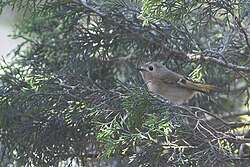
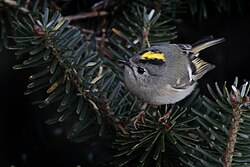
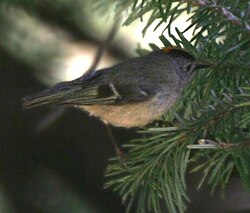
With a length of only 8.5–9.5 cm and a weight ranging from 4.5 to 7.0 g, the goldcrest is a master of the canopy. Its olive-green upper-parts and buff-white underparts provide excellent camouflage among pine needles, while its most defining feature—a bright, colorful crest—serves as a vital signal during social displays.
Key Facts
- Size: Smallest European bird (8.5–9.5 cm long).
- Habitat: Primarily mature lowland and mountain coniferous woodlands.
- Diet: Primarily insectivorous, with springtails being a major food source.
- Conservation Status: Least Concern (IUCN 3.1).
- Defining Feature: A bright yellow crest with an orange center in males.
Physical Description and Identification
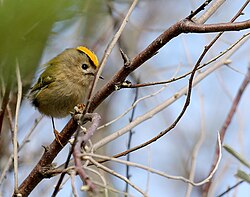
The goldcrest resembles a small warbler, characterized by two white wing bars and a plain face with conspicuous black irises. Its bill is small, thin, and black, while its legs are a dark flesh-brown color.
The crown is the most reliable way to identify the species. It features black sides and a narrow black front, topped with a bright crest. In males, this crest is yellow with a vivid orange center; in females, the crest is entirely yellow. When the bird is displaying, it erects the crest, making the male's orange stripe highly visible.
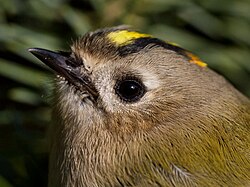
Juvenile goldcrests differ from adults in that their heads do not yet show the colored crown, and their beaks appear brighter.
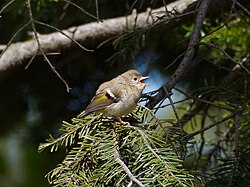
Across its range, several subspecies exist, including R. r. himalayensis in India, R. r. japonensis in Japan, and the recently discovered R. r. ellenthalerae found in the laurisilva forests of the Canary Islands.

Taxonomy and Evolution
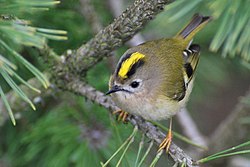
Goldcrests belong to the family Regulidae (kinglets). While they were once grouped with Old World warblers due to their similar appearance, phylogenetic research has revealed they are remotely related. The name Regulus is derived from the Latin word for "little king," a nod to their colorful crowns.
The species was first described by Carl Linnaeus in 1758. Fossil records from the Pleistocene epoch suggest a long history in Europe, including an extinct ancestor, Regulus bulgaricus, found in Bulgaria. The modern goldcrest lineage diverged from the ancestor of the common firecrest during the Middle Pleistocene.
Habitat and Distribution
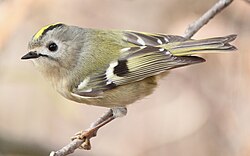
Goldcrests are specialists of coniferous woodlands, breeding in spruce, larch, Scots pine, silver fir, and mountain pine. They are also found in man-made plantations of douglas fir. While they primarily inhabit lowland areas, they can be found in mountains up to 3,000 meters, and occasionally as high as 4,800 meters.
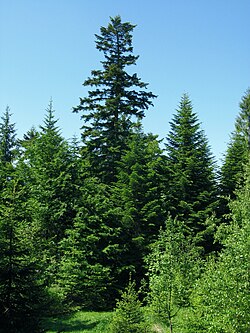
They are rarely found in broad-leaved woods unless some conifers are present. In some regions, such as Ireland, breeding densities can be remarkably high, reaching up to 591 pairs per square kilometer in Norway spruce forests.
Behavior and Breeding
The goldcrest builds a sophisticated, three-layered cup-shaped nest. The outer layer consists of moss, twigs, lichen, and cobwebs—the latter used to anchor the nest to thin branches. The middle layer is moss, and the inner lining is made of feathers and hair.
Both sexes participate in construction, though the female performs the majority of the work. Nests are typically suspended from hanging branches, though they have been recorded at heights ranging from 1 to 22 meters.
Laying typically occurs from late April to early May. A typical European clutch consists of nine to 11 whitish eggs. Interestingly, the female keeps the eggs warm not only with a brood patch but also by placing her warm legs into the center of the egg pile. Second clutches are common; the male often builds the second nest and feeds the first brood while the female incubates the second.
Diet and Ecological Competition
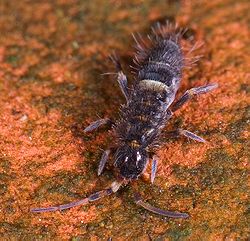
The goldcrest is an insectivore, and springtails are a primary component of its diet.
There is an interesting ecological relationship between the goldcrest and the common chiffchaff. Both share similar habitats, but goldcrests tend to breed deeper within the woodland, whereas chiffchaffs stay closer to the forest edge. In some areas, such as Finland, the expansion of spruce woodlands has led to an increase in goldcrest populations, potentially out-competing the chiffchaff for food resources.
Cultural History and Folklore
![On foggy or overcast nights, goldcrests and other disorientated migrants can be attracted to lighthouses in large numbers.[5]](/images/92/30/92305ef13d8b8cf584c26906431054aa6dfb10214a742e630dcf7b1c2f25b44c.jpg)
The goldcrest's tiny size and bright crown have made it a subject of ancient legend. Aristotle and Pliny both recorded a myth about a contest to see which bird could fly the highest. While the eagle initially led, a tiny bird hidden in the eagle's feathers eventually flew higher, claiming the title of "king of the birds." While this title is often associated with the wren in folklore, the fiery crown of the goldcrest suggests it may have been the original inspiration for the legend.
In English folklore, the bird was historically known as the "gold-crested wren," and fishermen in Suffolk referred to it as the "herring spink."

Summary Table: Goldcrest Specifications
| Feature | Detail |
|---|---|
| Length | 8.5–9.5 cm |
| Wingspan | 13.5–15.5 cm |
| Weight | 4.5–7.0 g |
| Primary Habitat | Coniferous forests (Spruce, Fir, Pine) |
| Clutch Size | Typically 9–11 eggs |
| Conservation Status | Least Concern |
Frequently Asked Questions
How can I tell a male goldcrest from a female?
The primary difference is the color of the crest. Males have a bright yellow crest with a distinct orange center, while females have a crest that is entirely yellow.
What do goldcrests eat?
Goldcrests are insectivores that feed on small invertebrates, with springtails serving as a major dietary item.
Where do goldcrests typically build their nests?
They build cup-shaped nests made of moss, lichen, and cobwebs, usually suspended from thin, hanging branches in coniferous trees.
Is the goldcrest related to the wren?
Despite historical names like "gold-crested wren" and shared folklore, they are not closely related. Goldcrests belong to the family Regulidae, while wrens belong to a different family.
Why are goldcrests found mostly in coniferous forests?
They are highly specialized for these environments, utilizing trees like spruce and fir for both nesting and foraging for the specific insects found in these woodlands.