Gleaning: How Birds and Bats Hunt Invertebrate Prey
In the natural world, survival depends on the efficiency with which an animal can locate and capture food. One of the most precise feeding strategies employed by birds and bats is gleaning. Unlike hawking—where a predator catches insects mid-air—or chasing moving prey like ants, gleaning involves plucking invertebrate prey, primarily arthropods, directly from a surface.
These surfaces can vary wildly depending on the species. Some birds glean from foliage or the ground, while others target crevices in rock faces, the eaves of houses, or even the hides of living animals. It is important to note that in ornithology, gleaning specifically refers to the capture of invertebrates and does not include the foraging of seeds or fruit.
Key Facts
- Definition: Gleaning is the act of plucking prey from surfaces rather than catching it in flight.
- Common Practitioners: Tits, chickadees, nuthatches, wrens, warblers, and certain hummingbirds.
- Physical Adaptations: Gleaners typically possess small, compact bodies and sharply pointed bills.
- Diverse Niches: Species specialize in different forest strata, from the forest floor to the upper canopy.
- Social Behavior: Many gleaners form mixed-species flocks to increase safety from predators.
Techniques and Adaptations
Foliage Gleaning
Foliage gleaning occurs across the leaves and branches of shrubs and trees. The approach varies by species: some, like the common chiffchaff and Wilson's warbler, are energetic and active. Others utilize hover-gleaning, where the bird hovers momentarily to pluck a prey item. In contrast, birds like the bay-breasted warbler and various vireos are more methodical, perching deliberately to pick over leaves.
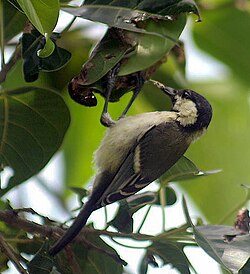
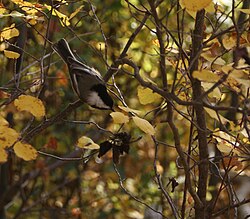
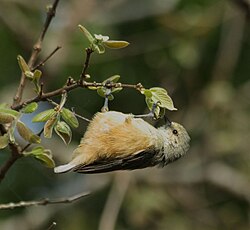
Some species have evolved the ability to hang upside-down from branch tips to access the undersides of leaves, a behavior frequently seen in black-capped chickadees.
Bark and Crevice Gleaning
Specialized birds like nuthatches, woodcreepers, and treecreepers focus on the bark of trees. While most bark-gleaners move upward, nuthatches are unique in their ability to move head-first down a trunk, a feat supported by strong legs and feet. In contrast, upward-facing gleaners often rely on stiff tail feathers for stability.
In arid or rocky environments, crevice-gleaning is the dominant niche. The canyon wren, for example, possesses a long bill and specific skeletal adaptations that allow it to probe deep into rocky cliff crevices or the sides of buildings. Similarly, the Louisiana waterthrush and Asian forktails glean aquatic insects from stream-side rocks and roots.
Morphological Specialization
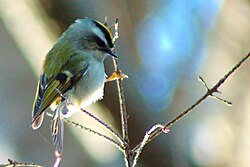
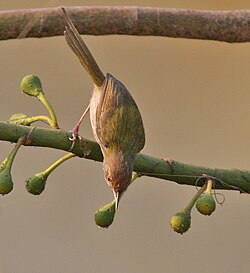
Physical traits are closely tied to the specific niche a bird occupies. Tiny, lightweight birds like the goldcrest and golden-crowned kinglet can perch on the thinnest twigs. Birds with very small bills, such as the blue tit, are optimized for taking tiny prey from broad leaves. Conversely, species like the ashy tailorbird use longer bills to glean within tangled vines.
Even within families, adaptations vary. In the Tyrannidae family (flycatchers), those adapted for gleaning have bills resembling those of warblers, whereas their hawking relatives have larger bills. Similarly, piculets—small members of the woodpecker family—have compact bodies and sharp bills suited for gleaning rather than the heavy-duty bills used for deep drilling.
Diverse Foraging Strategies
Ground Gleaning
Foraging on the forest floor often involves manipulating leaf litter. Some birds, such as leaftossers and the North American ovenbird, use their bills to flick or flip dead leaves to reveal hidden spiders and worms. Others, like buttonquails, rake their feet through the litter, while the green-tailed towhee performs a "double-scratch" with both legs simultaneously.
Sally-Gleaning and Specialized Hunting
Sally-gleaning is a hybrid technique where a bird flies from a perch to pluck prey off foliage. The pygmy tyrants and Caribbean todies utilize this method; todies specifically scan the undersides of leaves from a perch before performing an arcing flight to capture prey.
One of the most unusual strategies is practiced by African oxpeckers. These birds glean parasites, such as ticks and lice, from the hides of buffalo, giraffes, and cattle. On animals with bare skin, like rhinoceroses, they may consume blood and pus from open wounds.
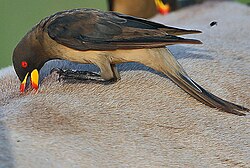
Other opportunistic behaviors include dippers foraging underwater, common grackles following plows to find grubs in fresh soil, and the Bornean ground-cuckoo following wild pigs to catch displaced insects.
Behavioral and Ecological Implications
Because gleaning is a highly visual activity, it is restricted to daylight hours. Furthermore, the intense focus required to find small prey makes birds vulnerable to predators. To mitigate this risk, many gleaners join mixed-species foraging flocks, allowing individuals to spend more time feeding and less time scanning for danger.
To avoid competition, species often exhibit niche segregation. This means they divide the habitat by vegetation type (e.g., conifers vs. broadleaf) or by height, with smaller species occupying the higher, thinner branches and larger species staying lower down.
| Strategy | Primary Target Surface | Key Adaptation/Behavior | Example Species |
|---|---|---|---|
| Foliage Gleaning | Leaves and twigs | Hovering or hanging upside-down | Black-capped Chickadee |
| Bark Gleaning | Tree trunks | Strong feet or stiff tail feathers | Nuthatch |
| Crevice Gleaning | Rocks and walls | Long, probing bills | Canyon Wren |
| Ground Gleaning | Leaf litter | Flicking or scratching | Ovenbird |
| Animal Gleaning | Living hides | Scissors-like bill motion | Yellow-billed Oxpecker |
Frequently Asked Questions
What is the difference between gleaning and hawking?
Gleaning is the act of plucking prey from a surface (like a leaf or rock), whereas hawking involves capturing insects while they are flying in the air.
Do all gleaning birds travel in flocks?
No. While many join mixed-species flocks for protection against predators, some foliage-gleaners, such as the leafbirds of Asia, are often found alone or in pairs.
How do nuthatches differ from other bark-gleaners?
Most bark-gleaners move upward on a trunk and use stiff tail feathers for support. Nuthatches have strong legs and feet that allow them to move head-first down a tree trunk.
What is sally-gleaning?
Sally-gleaning is a foraging technique where a bird scans from a perch and then makes a short, targeted flight (a sally) to pluck an insect off a leaf or branch before returning to a perch.
Why do some gleaning birds have different bill shapes?
Bill shape is an adaptation to the specific prey and surface. Small, sharp bills are ideal for broad leaves, while longer bills are necessary for probing deep into crevices or dead leaf clusters.