Glasses and Eyewear: A Comprehensive Overview of Types and Functions
Eyewear serves a vast array of purposes, ranging from the essential correction of vision to the protection of the eyes in hazardous environments. While many people associate glasses primarily with prescriptions, the technology behind lenses has evolved to include specialized tools for digital health, cinematic experiences, and medical assistance.
Whether used to treat a refractive error—a condition where the eye cannot focus light correctly on the retina—or to shield the eyes from ultraviolet radiation, the right pair of glasses can significantly enhance a person's quality of life and safety.
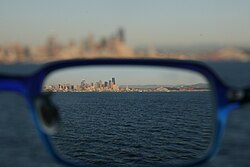
Key Facts
- Corrective lenses treat conditions like myopia (nearsightedness), hypermetropia (farsightedness), and astigmatism.
- Presbyopia is the age-related loss of lens elasticity, typically affecting people over 40.
- UV-400 blockers are the standard for comprehensive protection against harmful ultraviolet light.
- Safety glasses often feature break-proof plastic and side shields to protect against debris and chemicals.
- Prism glasses allow users to view screens or read while lying flat on their backs.
Corrective Eyewear
Corrective lenses function by bending light entering the eye to ensure the image focuses precisely on the retina. These are prescribed by optometrists or ophthalmologists and can be verified using a tool called a lensmeter. Beyond improving clarity, these glasses reduce eye strain, squinting, and associated headaches.
Types of Corrective Lenses
- Single Vision: Lenses with a uniform refractive index for one primary distance.
- Bifocals and Trifocals: Lenses providing two or three different refractive indices to help those with presbyopia and hyperopia.
- Progressive Lenses: Lenses with a continuous gradient of power, eliminating the visible line found in bifocals.
- Myopia Control: Specialized lenses for children designed to slow the progression of nearsightedness.
- High-Refractive Index: Lenses that are thinner, flatter, and more lightweight than standard options.
For those needing temporary or low-cost assistance, reading glasses are available over-the-counter. However, these provide equal power in both lenses and cannot correct astigmatism or variations between the left and right eye.
Alternative designs include adjustable-focus glasses and pinhole glasses. Pinhole glasses do not use lenses to refract light; instead, they create a diffraction-limited system to increase the depth of field, similar to a small aperture in photography.
Historically, glasses have also integrated other assistive technologies. In the 1940s, following the invention of the transistor, combined eyeglass-hearing aids became popular, concealing the device within the thick frames of the era.
![1940s combined hearing aid glasses, on display at Thackray Museum of Medicine.[2]](/images/27/d2/27d2de2dfbe539a52763d3cb393cc20682e490130822ee043af7727dadf9754b.jpg)
Protective and Specialized Eyewear
Safety Glasses
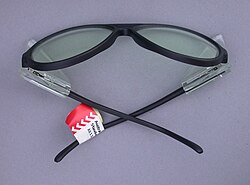
Safety glasses are engineered with break-proof plastic to shield the eyes from flying debris, hazardous chemicals, or biological splatters. They are mandatory in many professional settings, including construction, laboratories, and surgical environments. Specialized flash goggles are used in welding to protect against welding flash when a full helmet is impractical.
Sunglasses
Sunglasses protect the eyes from bright light and UV radiation. High-quality sunglasses utilize a UV-400 blocker to cover the dangerous light spectrum. Some lenses feature polarization, which removes horizontally polarized light to eliminate glare from surfaces like water. While beneficial for many, polarized lenses can make it difficult for pilots to gauge altitude or for users to see liquid-crystal displays (LCDs).

Mixed Double-Frame (Flip Glasses)
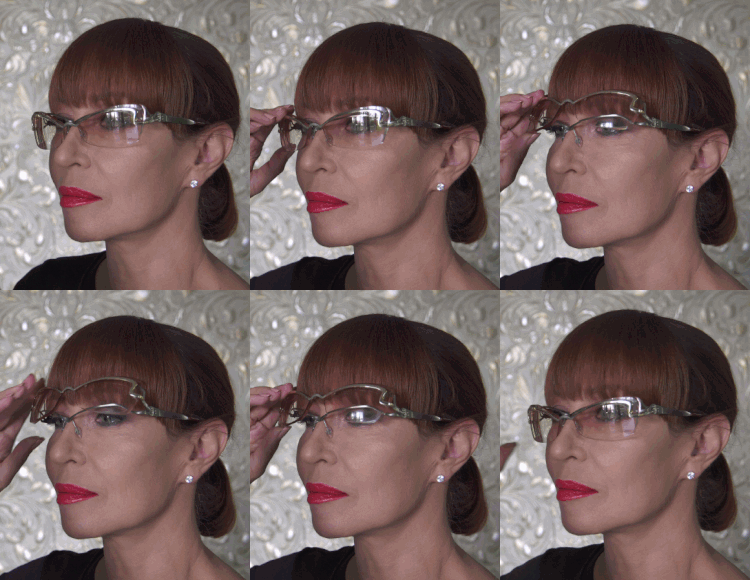
These glasses feature a fixed frame and a second, moving frame connected by a four-bar linkage. This allows the wearer to flip a set of lenses (such as sunglasses) up or down while keeping their primary corrective lenses in place, which is particularly useful for drivers entering tunnels.
Entertainment and Assistive Technology
3D Glasses
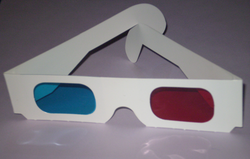
3D glasses create a three-dimensional illusion by filtering different visual information for each eye. Common types include:
- Anaglyph: Uses red and blue (or green) filters; often results in distorted colors.
- Polarized: Uses polarized filters to allow for full-color 3D.
- Active Shutter: Uses electronic shutters to alternate images between eyes.
Magnification and Recumbent Glasses
Bioptics involve small telescopes mounted on or within regular lenses to assist those with severe vision impairments. In contrast, recumbent (prism) glasses use a 90-degree refraction prism. Developed by Andrew McKie Reid in the 1930s, these allow bedbound patients to read or watch television while lying on their backs.
![McKie Reid recumbent glasses, on display at Thackray Museum of Medicine.[8]](/images/c8/68/c8685256c7610c6e5551b4d22f14e4b5d411b551c65e83fb7887d6130f825dc0.jpg)
Digital Eye Strain and Blue-Light Filtering
Yellow-tinted and blue-light filtering glasses have gained popularity to combat Computer Vision Syndrome (CVS), also known as digital eye strain. These glasses aim to reduce strain from LCD screens and fluorescent lighting.
However, medical consensus varies. The American Academy of Ophthalmology (AAO) and the College of Optometrists (UK) state that there is little scientific evidence that blue-blocking lenses improve visual performance or protect macular health. They suggest that eye strain is caused by long periods of continuous screen use rather than blue light itself, and recommend using prescription glasses specifically measured for computer distance (typically 20–26 inches) instead.
Summary of Eyewear Types
| Type | Primary Purpose | Key Feature |
|---|---|---|
| Corrective | Vision Correction | Refractive indices (Single, Bifocal, Progressive) |
| Safety | Eye Protection | Break-proof plastic and side shields |
| Sunglasses | Light/UV Protection | UV-400 blockers and polarization |
| 3D Glasses | Visual Illusion | Anaglyph or polarized filters |
| Recumbent | Viewing while lying down | 90° refraction prism |
| Bioptics | Magnification | Embedded mini-telescopes |
Frequently Asked Questions
What is the difference between bifocals and progressive lenses?
Bifocals have two distinct refractive indices with a visible line separating the distance and near-vision areas. Progressive lenses provide a continuous, seamless gradient of power without a visible line.
Do blue-light blocking glasses actually prevent eye disease?
No. According to the College of Optometrists (UK) and the AAO, there is no strong scientific evidence that blue-blocking lenses prevent macular degeneration or other eye diseases.
What is a UV-400 blocker?
A UV-400 blocker is a lens feature that protects the eyes by blocking nearly 100% of ultraviolet light rays with wavelengths up to 400 nanometers.
How do pinhole glasses work without lenses?
Pinhole glasses use a diffraction-limited system. By forcing light through small holes, they increase the depth of field, allowing the wearer to see more clearly without the need for refraction.
Why might polarized sunglasses be a problem for pilots?
Polarized lenses remove glare from horizontal surfaces. For pilots, this can be dangerous because it may remove reflections from water or structures that are essential for gauging altitude.