Gillette: A History of Innovation in Personal Grooming
For over a century, Gillette has been a dominant force in the global personal care market. From the invention of the disposable blade to the development of high-tech multi-blade systems, the brand has fundamentally changed how the world approaches shaving. Now owned by Procter & Gamble, Gillette continues to evolve its product line to meet modern grooming preferences.
Key Facts
- Founded: September 28, 1901.
- Current Owner: Procter & Gamble (acquired in 2005).
- Core Products: Safety razors, shaving supplies, and personal care products.
- Global Reach: Markets products worldwide.
- Famous Taglines: "The Best a Man Can Get" and "The Best Men Can Be".
The Evolution of the Safety Razor
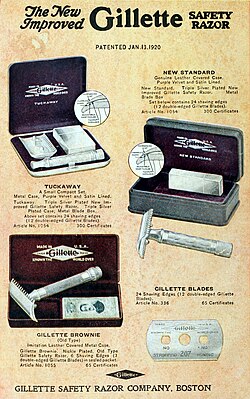
The journey of Gillette began with the introduction of the safety razor, a device designed to provide a safer and more convenient alternative to the traditional straight razor. In its early years, the company focused on double-edged safety razors, which allowed users to replace blades rather than sharpen a single piece of steel.
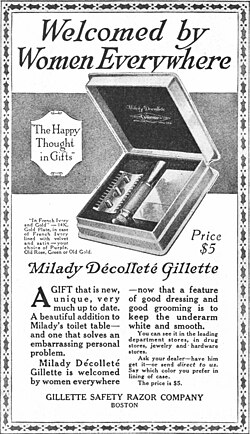
By the 1920s, the brand had expanded its reach, introducing models like the "Old Type" safety razor. The company also recognized the potential for a broader market, launching the Milady Décolleté Gillette, the first safety razor marketed exclusively for women.
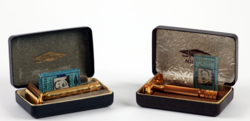
During the First World War, Gillette played a critical role in military logistics by producing the Khaki Set, a specialized safety razor set for the U.S. Army.
![The Khaki Set, the safety razor set produced by Gillette for the U.S. Army during the First World War[14]](/images/74/fe/74fe7d00ff89420c30aeb59b1be036e617f804e28af1b771eabcc39844ef3914.jpg)
Technological Milestones and Product Diversification
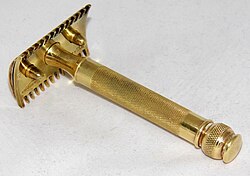
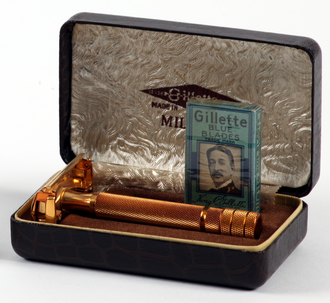
As the decades progressed, Gillette shifted from simple safety razors to more complex engineering. The 1930s saw the rise of the One-Piece Tech razor and the introduction of Blue Blades, marking a move toward more integrated designs.
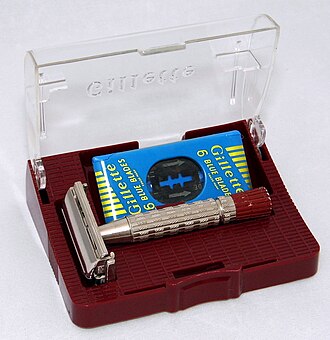
The mid-century era brought further refinements, such as the 1958 Super Speed razor, which utilized a blade dispenser for increased convenience.
From the 1960s through the 1980s, the company transitioned toward disposable razors, reducing the need for users to manually change blades. This era set the stage for the modern multi-blade systems we see today, including the Mach3, Fusion ProGlide, and the Sensor Excel.
Corporate Growth and Market Leadership
The latter part of the 20th century was marked by significant corporate activity. Gillette faced several takeover attempts, most notably from Revlon in the 1980s, and eventually formed a strategic relationship with investor Warren Buffett.
In 2005, the landscape changed permanently when Procter & Gamble (P&G) acquired The Gillette Company in a $54 billion stock deal. This acquisition integrated Gillette into one of the largest consumer goods portfolios in the world.

Modern Innovations
In recent years, Gillette has expanded beyond traditional blades. The brand has introduced high-end luxury items, such as a heated razor that reaches 122 degrees, and the Gillette Treo, designed for assisted shaving. To compete with subscription-based models like Dollar Shave Club, the company launched an on-demand ordering service in 2017.
| Attribute | Details |
|---|---|
| Introduction Date | September 28, 1901 |
| Primary Market | Worldwide |
| Parent Company | Procter & Gamble |
| Key Product Lines | Mach3, Fusion, Sensor, GilletteLabs |
| Sustainability Goal | Reduce virgin plastics by 50% by 2030 |
Frequently Asked Questions
Who currently owns Gillette?
Gillette is currently owned by the American consumer goods corporation Procter & Gamble, which acquired the company in 2005.
When was the first Gillette safety razor introduced?
The brand was introduced on September 28, 1901, revolutionizing the industry with the safety razor concept.
What is the significance of the Mach3 razor?
The Mach3 represented a major leap in shaving technology by introducing a three-blade system, supported by a massive investment in new production lines in the late 1990s.
Does Gillette offer products for women?
Yes, Gillette has marketed to women for over a century, beginning with the Milady Décolleté razor in the 1910s.
What are Gillette's current sustainability efforts?
Gillette has implemented a program to recycle old razors and has set a goal to reduce the use of virgin plastics in its products by 50% by the year 2030.