Ghazan Khan: The Ilkhan Who Transformed Iran and Islam
Mahmud Ghazan (1271–1304), known as Ghazan Khan, was the seventh ruler of the Ilkhanate, a division of the Mongol Empire centered in modern-day Iran. A direct descendant of Genghis Khan through the Hulaguid line, Ghazan is remembered as the most prominent of the Ilkhans. His reign marked a seismic shift in the region's history, most notably through his conversion to Islam, which transitioned the Mongol administration from a foreign occupying force to a localized Islamic sultanate.
Born into the Borjigin house, Ghazan was the son of Arghun and the grandson of Abaqa Khan. His early life was defined by the volatile politics of the Mongol court and the strategic management of the empire's frontiers.
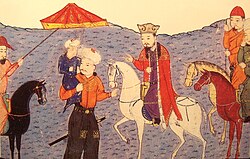
Key Facts
- Reign: October 4, 1295 – May 11, 1304.
- Dynasty: Hulaguid (House of Borjigin).
- Major Religious Shift: Converted from Nestorian Christianity to Sunni Islam in 1295.
- Key Achievement: Commissioned the Jami' al-Tawarikh (Compendium of Chronicles), one of the first universal histories of the world.
- Military Conflict: Led major invasions against the Mamluk Sultanate in Syria.
- Administrative Reform: Appointed the renowned historian Rashid-al-Din Hamadani as vizier.
Early Life and Rise to Power
Ghazan's political education began early. In 1284, following the overthrow of Tekuder, his father Arghun became Ilkhan, and the 11-year-old Ghazan was appointed viceroy of Khorasan. This appointment separated him from his father for the remainder of Arghun's life.
His tenure in Khorasan was fraught with conflict. In 1289, he faced a revolt led by Nawruz, an emir of the Oirat clan. While Ghazan's deputy, Tegene, was captured, the revolt was eventually suppressed by Arghun's reinforcements in 1290. For the next decade, Ghazan focused on defending the Ilkhanate's frontiers against the incursions of the Chagatai Khanate from Central Asia.
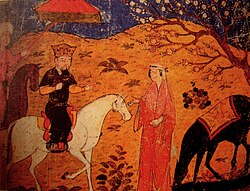
Ghazan's path to the throne culminated in 1295. After a series of defections by powerful emirs and the withdrawal of support from the vizier Taghachar, the reigning Ilkhan Baydu fled to Georgia. Ghazan's forces captured and executed Baydu on October 4, 1295, clearing the way for Ghazan's coronation on October 19.
The Conversion to Islam and Religious Policy
Upon taking the throne, Ghazan made the pivotal decision to convert to Sunni Islam, adopting the name Mahmud. This move was not merely personal but strategic, aligning the Mongol rulers with the majority population of their Iranian territories. During this transition, he met the influential scholar Imam Ibn Taymiyya.
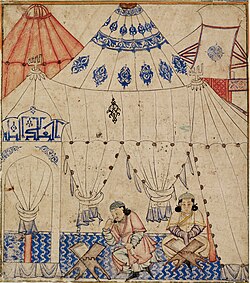
Despite his conversion, Ghazan maintained the traditional Mongol approach to religious pluralism. He showed tolerance toward Shias and the faiths of his Armenian and Georgian vassals. He notably protected Buddhist monks, allowing those who had feigned conversion to return to Tibet or Kashmir to practice their faith freely. He also re-established the Christian Patriarch Mar Yaballaha III in 1296 and exempted Christians from the jizya (the tax typically levied on non-Muslims).
Internal Purges and Administrative Reforms
The early years of Ghazan's reign were marked by a struggle to consolidate power. He conducted several purges of the nobility to eliminate rivals, including the execution of Baydu's loyalists and the suppression of the revolt of Baltu in Anatolia.
One of the most significant internal conflicts was the fall of Nawruz. Once a key ally, Nawruz was accused of treason and secret correspondence with the Mamluks. After a decisive battle near Nishapur, Nawruz was betrayed by the Malik of Herat and executed in August 1297.
To stabilize the state, Ghazan appointed Rashid-al-Din Hamadani, a Jewish convert to Islam, as his vizier. Rashid-al-Din served for 20 years and was commissioned to write the Jami' al-Tawarikh, a massive historical project covering world history from Adam onwards.
![Seal of Mahmud Ghazan, over the last two lines of his 1302 letter to Pope Boniface VIII. The seal was given to Ghazan by the sixth Great Khan (Emperor ChengZong of Yuan). It is in Chinese script: "王府定國理民之寶", which means "Seal certifying the authority of his Royal Highness to establish a country and govern its people". Overwritten on it vertically, are two lines in Mongolian using the old, Aramaic-based, Uyghur script. Vatican Archives.[32]](/images/c6/63/c66305833820764d9c54683ea9003dd3120da7a3c1d44e425db6e01e4c612d9f.jpg)
Military Campaigns and the Mamluk Wars
Ghazan sought to expand his influence into the Levant, leading to a series of conflicts with the Mamluk Sultanate. In October 1299, he marched into Syria, capturing Aleppo and forming an alliance with King Hethum II of Armenia, as well as elements of the Templars and Hospitallers.
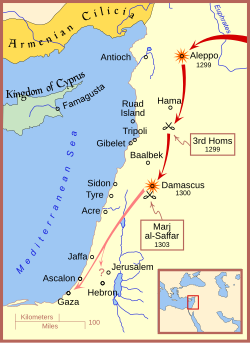
This coalition achieved a major victory at the Battle of Wadi al-Khazandar in December 1299, leading to the surrender of Damascus. However, the Mongols were forced to retreat in February 1300, primarily due to a lack of fodder for their horses.
Ghazan attempted to coordinate with European powers to establish a Frankish state in the Holy Land, writing to Pope Boniface VIII and King Edward I of England. He reiterated a promise to grant Jerusalem to the Franks in exchange for military aid. However, these diplomatic efforts did not yield the necessary reinforcements. The final major Mongol invasion of Syria ended in defeat at the Battle of Marj al-Saffar in April 1303.
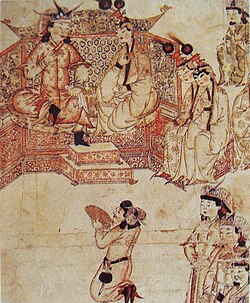
![Ghazan ordering the King of Armenia Hethum II to accompany Kutlushah on the 1303 attack on Damascus.[55]](/images/2a/0c/2a0ce4c8777e660506d39931c8841e9145dd4226edad05d20afd28ace8eb3375.jpg)
Legacy and Final Years
In his later years, Ghazan focused on the administration of his capital, Ujan, and explored Sufism, potentially being initiated into the order. He died on May 11, 1304, at the age of 32, and was buried in the Ghazan Mausoleum in Tabriz.
His legacy is defined by the synthesis of Mongol authority and Islamic governance. Through his reforms and religious tolerance, he helped integrate the Ilkhanate into the cultural and religious fabric of West Asia.
![Double silver dirham of Ghazan.[71]Obv: Arabic: لاإله إلا الله محمد رسول الله صلى الله عليه وسلم/ ضرب تبريز/ في سنة سبع ...ر, romanized: Lā ilāha illa llāha Muḥammadun rasūlu llāhi ṣalla llāhu ʽalayhi wa-sallam / ḍuriba Tabrīz / fī sanati sabʽin ..., lit. 'There is no God but Allah, Muhammad is His Prophet, Peace be upon him/ Minted in Tabriz in the year ...7' : ""Rev: Legend in Mongolian script (except for "Ghazan Mahmud" in Arabic): Tengri-yin Küchündür. Ghazan Mahmud. Ghasanu Deledkegülügsen: "By the strength of the Heaven/ Ghazan Mahmud/ Coin struck for Ghazan". Tabriz mint. 4.0 gr (0.26 g). Silver.](/images/ef/5a/ef5a653bbad7fbf074de9cf09946d8754f6bbc5538aa082a8373a88608cf2c32.jpg)
| Category | Details |
|---|---|
| Full Name | Mahmud Ghazan |
| Reign Period | 1295–1304 |
| Primary Religion | Sunni Islam (converted from Nestorian Christianity) |
| Key Ally/Official | Rashid-al-Din Hamadani (Vizier) |
| Major Victory | Battle of Wadi al-Khazandar (1299) |
| Major Defeat | Battle of Marj al-Saffar (1303) |
| Successor | Öljeitü |
Frequently Asked Questions
Why was Ghazan Khan's conversion to Islam significant?
His conversion marked a turning point for the Ilkhanate, shifting the dominant religion of the Mongol rulers in West Asia to Islam. This helped legitimize Mongol rule among the local Iranian and Muslim populations.
Who was Rashid-al-Din Hamadani?
He was a Jewish convert to Islam who served as Ghazan's vizier for two decades. He is most famous for authoring the Jami' al-Tawarikh, a comprehensive universal history of the world.
What was the outcome of the Mamluk-Ilkhanid War?
While Ghazan achieved a significant victory at Wadi al-Khazandar and briefly occupied Damascus, the Mongols were ultimately unable to maintain a permanent hold on Syria, ending with a defeat at the Battle of Marj al-Saffar in 1303.
How did Ghazan treat non-Muslims?
Ghazan continued the Mongol tradition of religious tolerance. He protected synagogues and churches, exempted Christians from the jizya tax, and allowed Buddhist monks to return to their homelands to practice their faith.
What was the role of Nawruz in Ghazan's rise?
Nawruz was an emir who initially revolted against Ghazan's father but later became a key supporter of Ghazan's bid for the throne. However, he was eventually executed for treason after suspected dealings with the Mamluks.