Germany Telephone Area Codes and Service Numbers
Navigating the telecommunications landscape in Germany requires an understanding of both regional area codes and specialized service numbers. From local city codes to premium-rate lines, the German numbering system is designed to route calls efficiently across various states and service providers.
Whether you are looking for a specific regional prefix or trying to determine the cost of a service call, this guide provides a detailed breakdown of the numbering allocations and their associated locations or costs.
Key Facts
- Service Numbers: Prefixes like 0137 and 0180 are used for specific services and often carry per-call or per-minute charges.
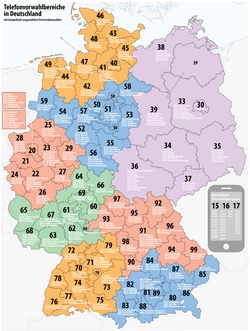
- Regional Mapping: Area codes are logically grouped by city and their surrounding areas (e.g., 331/0332 for Potsdam).
- Number Migrations: Some prefixes have evolved; for example, former toll-free numbers (130) and premium services (190) have transitioned to 800 and 900 respectively.
- Historical Changes: In February 1997, several area codes starting with 900 were changed to allow for the implementation of 0900 service numbers.
Service and Premium Rate Numbers
Germany utilizes specific prefixes for non-geographic services. These numbers often vary in price depending on the provider and the specific service offered.
Specialized Service Prefixes
- 12-series: Includes providers like Web.de (Karlsruhe) with rates between €0.13 and €1.86 per minute, and BBA Netkom in Hamburg.
- 137-series: These are typically charged per call or per minute, ranging from €0.14 to €1.00.
- 180-series: These numbers offer varying rates, such as 1801 at €0.039 per minute or 1804 at €0.20 per connection.
- 138: Used by T-VoteCall at a rate of €0.14 per minute.
Regional Area Code Allocations
Regional codes are assigned to specific cities and their surrounding districts. Below is a detailed look at how these are distributed across different zones.
Eastern and Northern Regions
The 300-series and 400-series cover a vast array of towns and cities. For instance, the 330-339 range covers areas around Oranienburg, Potsdam, and Neuruppin. In the north, the 400-series manages regions such as Kiel, Lübeck, and Flensburg.
Central and Southern Regions
Central Germany is served by a mix of codes, including those for Bad Salzdetfurth and Bad Pyrmont. The southern regions, including Stuttgart and Munich, utilize the 700 and 800 series. Notably, the 800-series includes areas like Bad Tölz and Bad Aibling.
The 900-Series Transition
To accommodate the 0900 service numbers, several regional codes were updated in 1997. Examples include the shift of 9002 to 09090 (Rain) and 9003 to 09080 (Harburg).
| Prefix/Code | Location or Service | Notes/Cost |
|---|---|---|
| 1371 | Service Number | €0.14 per call |
| 1801 | Service Number | €0.039 per minute |
| 331/0332 | Potsdam & surroundings | Regional |
| 431 | Kiel & surroundings | Regional |
| 70x/071 | Stuttgart & surroundings | Regional |
| 8041 | Bad Tölz | Regional |
Frequently Asked Questions
What happened to the 130 and 190 prefixes?
The 130 prefix, formerly used for toll-free numbers, and the 190 prefix, formerly used for premium-rate services, are now unassigned. They have been replaced by 800 and 900 respectively.
How much do 137-series calls typically cost?
Costs for 137-series numbers vary by the specific code, typically ranging from €0.14 per call or minute up to €1.00 per call.
Why were some 900-series area codes changed in 1997?
These changes were implemented in February 1997 specifically to clear the 0900 prefix for use as service numbers.
Which area codes cover the Potsdam region?
Potsdam and its surrounding areas are primarily covered by the 331 and 0332 prefixes.
Are there still unassigned codes in the 400-series?
Yes, several codes within the 400-series, particularly in the 430-439 range (such as 4301 and 4370), remain unassigned.