German Number Plates: Systems, Formats, and History
Vehicle registration in Germany is a highly structured system that provides immediate information about a vehicle's origin and status. From the distinct city codes to the color-coded safety stickers, German number plates are designed for efficiency, security, and clear identification across the federal states.
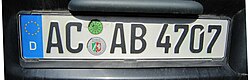
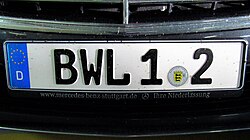
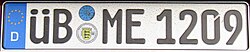
The current standard, known as the FE-style format, has been the primary system since 1994, though older DIN-style plates remain in use on some vehicles. These plates are typically 520 mm × 110 mm, though various specialized sizes exist for different vehicle types.
![Number plate in post-1994 format (FE-style)[a]](/images/ed/80/ed808b323ae8b07124e51a4ffce3643e17275e0cb86362e8c1652564557e2854.jpg)
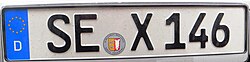
![Number plate in pre-1994 format (DIN-style), no longer issued but still in use[b]](/images/c6/dc/c6dc13780f0fcf113a79e050678c39974e08c0318bfc52bcf2021c281b2784c6.jpg)
Key Facts

- Standard Size: The common FE-style plate measures 520 mm × 110 mm.
- Area Codes: Plates begin with one to three letters representing the city or rural district (e.g., Z for Zwickau, TR for Trier, CUX for Cuxhaven).
- Safety Stickers: Color-coded stickers indicate the expiration date of the vehicle's safety test.
- Special Plates: Dedicated formats exist for electric vehicles, vintage cars, and government agencies.
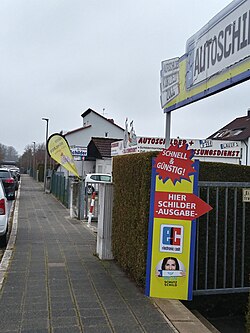
- Registration Seals: Every plate features a seal from the issuing authority, often displaying state or city arms.
Understanding the Plate Structure
![Small number plate (255×130)[e]](/images/60/48/604852c648a897544acf245727e35af045e3539a3c37c701c9ed6bdf93eeb0be.jpg)
Area Codes and Identification
The first section of a German plate identifies the registration district. These codes vary in length:
- 1-letter codes: Reserved for major cities (e.g., Z for Zwickau).
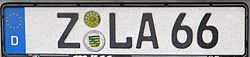
1-letter area code Z for Zwickau - 2-letter codes: Common for mid-sized cities and districts (e.g., TR for Trier).
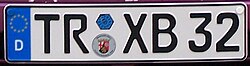
2-letter area code TR for Trier - 3-letter codes: Used for smaller districts or specific rural areas (e.g., CUX for Cuxhaven).
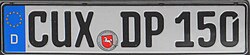
3-letter area code CUX for Cuxhaven
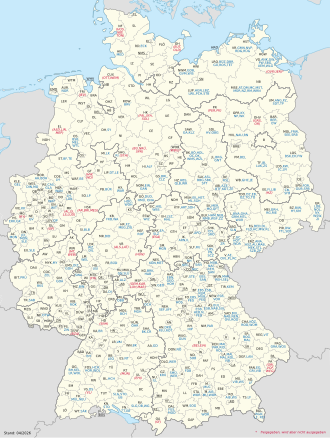
Character Combinations
Following the area code is a combination of letters and numbers. To avoid confusion, certain letters like B, F, G, I, O, and Q are often excluded from specific positions in certain districts. The number of possible combinations varies based on the format used, ranging from a few thousand to over six million per district.
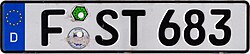
Specialized Plate Types
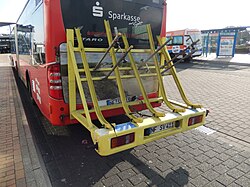
Government and Official Vehicles
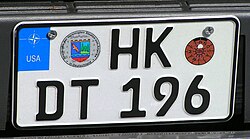
Germany uses specific codes for state and federal authorities. For example, the Bundeswehr (armed forces) and the Bundesfinanzverwaltung (customs) have distinct identifiers. Police vehicles in various states, such as Saxony, also utilize specific numbering schemes.
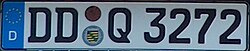

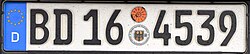
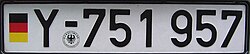
Vehicle-Specific Formats
Different vehicle types require different plate dimensions and markers:
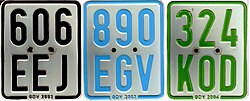
- Motorcycles: Plates issued until 2011 were 280×200 mm, while those issued since 2011 are 200×220 mm.
![Number plate for motorcycles, issued until 2011 (280×200)[c]](/images/0d/3a/0d3aea94c624297876aef778bc0a34aaee9e9d7eacad88a40f535a6ddcded9db.jpg)
Number plate for motorcycles, issued until 2011 (280×200)[c] ![Number plate for motorcycles, issued since 2011 (200×220)[d]](/images/03/46/03460415ee52589acb62fa6024fb785e8641acd1c7a0b7c798e0bb43ec35b259.jpg)
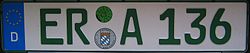
Number plate for motorcycles, issued since 2011 (200×220)[d] - Electric Vehicles: Plug-in electric vehicles are identified by an "E" suffix.
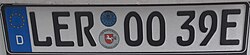
Plate for Plug-in electric vehicle - Vintage Cars: Collectors can use specific vintage plates or plates for a single historic vehicle.
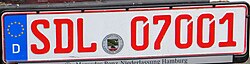
Plate for vintage car collector 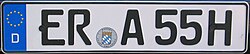
Plate for a specific vintage car - Temporary and Seasonal: Short-term plates (Kurzzeit-Kennzeichen) have a specific validity date, while seasonal plates are valid only during certain months.
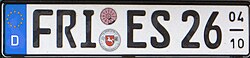
Seasonal number plate, here valid from 1 April to 31 October of each year 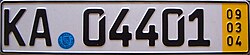
Temporary plate (Kurzzeit-Kennzeichen); this one was valid until 9 March 2004.
Other Specialized Plates
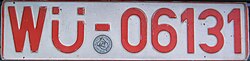
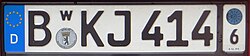
Other notable types include interchangeable plates (Wechselkennzeichen) for owners of multiple vehicles, red dealer plates, and tax-exempt vehicle plates.
Safety and Registration Markers
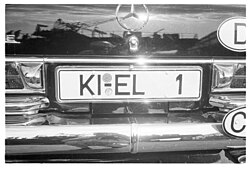
The Registration Seal
The registration seal is a critical security feature. Pre-1994 seals often featured city arms, while post-1994 seals typically use the state emblem. Tampering with these seals is a serious offense.
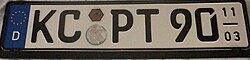
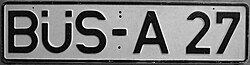
Safety Test Stickers
The safety test (TÜV) sticker is color-coded to allow authorities to quickly identify when a vehicle's inspection is due. The colors rotate every few years.
| Color (RAL) | Example Years |
|---|---|
| Copper brown (RAL 8004) | 1974, 1980, 1986, 1992, 1998, 2004, 2010, 2016, 2022, 2028, 2034 |
| Light pink (RAL 3015) | 1975, 1981, 1987, 1993, 1999, 2005, 2011, 2017, 2023, 2029, 2035 |
| Yellow-green (RAL 6018) | 1976, 1982, 1988, 1994, 2000, 2006, 2012, 2018, 2024, 2030, 2036 |
| Yellow-orange (RAL 2000) | 1979, 1983, 1989, 1995, 2001, 2007, 2013, 2019, 2025, 2031, 2037 |
| Sky blue (RAL 5015) | 1978, 1984, 1990, 1996, 2002, 2008, 2014, 2020, 2026, 2032, 2038 |
| Lemon yellow (RAL 1012) | 1977, 1985, 1991, 1997, 2003, 2009, 2015, 2021, 2027, 2033, 2039 |
![Old style safety test sticker, 1967[m]](/images/fa/9c/fa9c1ec8f638bd26ecefc82b809c2f11c74cecb15415819eb425551f2704b497.jpg)
Historical Evolution
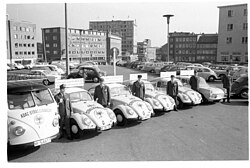
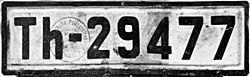
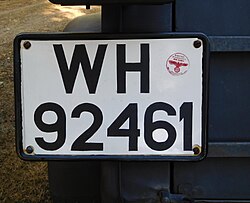
German plates have evolved through several political eras. Early systems date back to 1906, with distinct formats for the German Empire, the Weimar Republic, and the Third Reich. Following World War II, occupation zones had their own plates before the modern federal system was established.
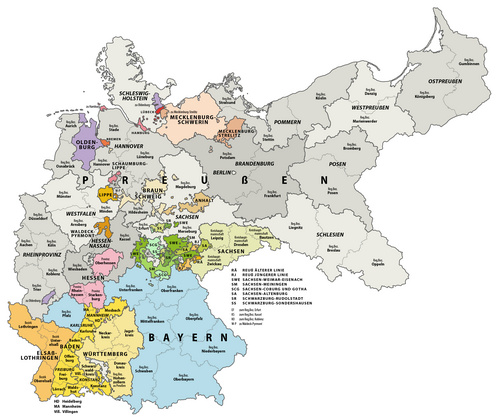
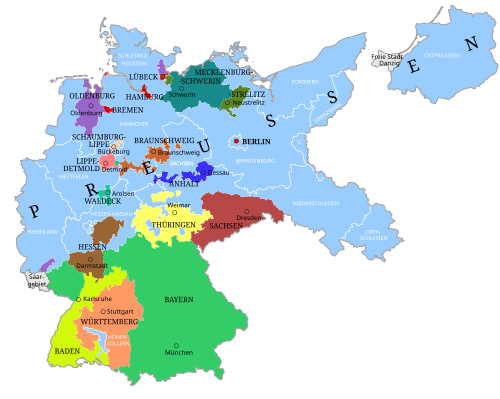
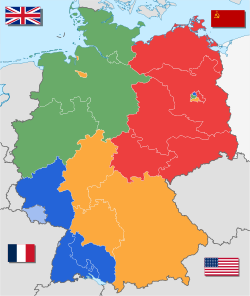
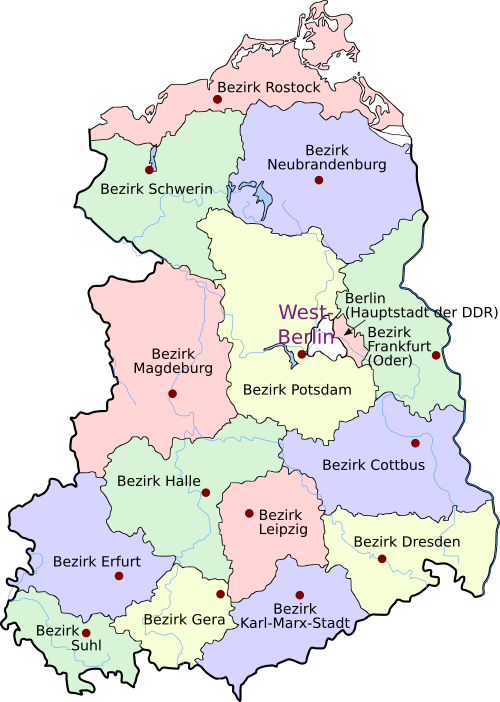
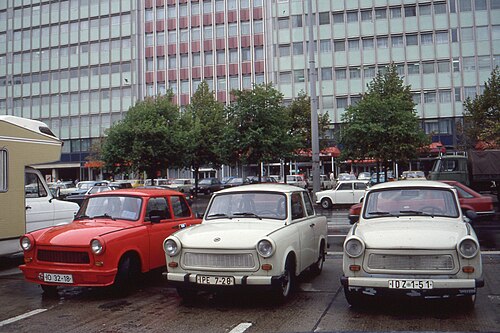
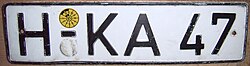
In East Germany (GDR), a different system was used until 1990, with specific codes for districts (Bezirke) and East Berlin. Following reunification, these were integrated into the federal system.
Frequently Asked Questions


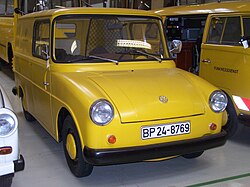
![Trabant registered in Stendal; pre-1994 typeface[x]](/images/95/77/9577d08f6c9812abb9db6869f2bfcf47828097d79bfeb5d47f743d3fbfb58c16.jpg)
![Car with maximum speed reduced to 25 km/h (16 mph), hence using an insurance plate[z]](/images/3c/03/3c034252c577bf84a041be3591f35d44f3b33f63ec3a671279c3d2cac07be7a6.jpg)
What is the difference between FE-style and DIN-style plates?
FE-style plates are the modern standard introduced in 1994, featuring a specific typeface and the EU blue strip. DIN-style plates are the older format; while no longer issued, they are still legally permitted on vehicles registered before the change.
How can I tell if a German plate is fake?
Fake plates often contain errors such as incorrect characters (like umlauts, which are not used on standard plates) or invalid leading digits (such as 0). A genuine plate must also have a valid registration seal from a recognized authority.
What does the "E" at the end of a plate signify?
The "E" suffix indicates that the vehicle is a plug-in electric vehicle or a hybrid with a significant electric range, often granting the owner specific parking or traffic privileges.
Are there banned letter combinations on German plates?
Yes, certain combinations are prohibited for historical or offensive reasons. For example, the combination "NS" is banned, although some instances have been issued accidentally in the past.
Why do some plates have different sizes?
Plate sizes are tailored to the vehicle. Motorcycles use smaller, more square plates, while some cars with limited space use "small number plates" (255×130 mm). Buses with bike carriers may use repeater plates to ensure visibility.