German National Library
The German National Library (Deutsche Nationalbibliothek, or DNB) serves as the central archival library and national bibliographic center for the Federal Republic of Germany. As one of the largest libraries globally, its primary mission is to collect, permanently archive, and comprehensively document all German and German-language publications. By maintaining a meticulous record of the nation's intellectual output, the DNB ensures that Germany's cultural and literary heritage remains accessible to the public.
Key Facts
- Total Collection: 43.7 million items as of 2021.
- Locations: Primary facilities in Leipzig and Frankfurt am Main.
- Established: Founded in 1912.
- Legal Mandate: Operates under the Law regarding the German National Library, with legal deposit requirements since 1935.
- Scope: Collects all publications in Germany, German-language works abroad, and foreign publications about Germany (known as Germanica).
Organizational Structure and Locations
The DNB distributes its duties between two main centers, each focusing on specific specialty areas to ensure efficient management of its massive inventory.
Leipzig Facility
The Leipzig site is home to the original building and houses the German Museum of Books and Writing. It also integrates the Deutsches Musikarchiv (German Music Archive), which moved from Berlin in 2010 to centralize all music-related archiving, including both printed and recorded materials.

Frankfurt am Main Facility
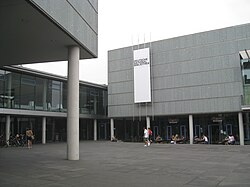
The Frankfurt branch provides modern infrastructure with a focus on accessibility and high-capacity storage. The building features over 300 workstations and extensive underground storage designed to accommodate growth through 2045.
Historical Evolution
The roots of a national library date back to the 1848 revolutions and the proposed Reichsbibliothek. However, the formal institution began in 1912 when the city of Leipzig, the Kingdom of Saxony, and the Association of German Booksellers agreed to establish a national library. Systematic collection began on January 1, 1913.
The library's history reflects Germany's political turbulence. During the Nazi era (1933–1945), libraries were subject to censorship and the acquisition of looted books from occupied territories. Following World War II, a second archive library was established in Frankfurt in 1946, leading to two separate national libraries serving the GDR and the FRG during the Cold War.
Upon German reunification on October 3, 1990, these two institutions merged into the Die Deutsche Bibliothek. In 2006, the "Law regarding the German National Library" officially renamed the institution to the Deutsche Nationalbibliothek and expanded its mandate to include the archiving of online publications.
Specialized Collections and Archives
German Exile Archive
The DNB maintains a critical record of German-speaking emigrants and exiles from 1933 to 1945. This is split between the Collection of Exile Literature in Leipzig and the German Exile Archive in Frankfurt. These collections include brochures, leaflets, and printed works produced abroad during the Nazi regime.
German Museum of Books and Writing
Located in Leipzig, the Deutsches Buch- und Schriftmuseum is the world's oldest museum of book culture. Founded in 1884, it holds over one million items and offers exhibitions and workshops to the general public.
Working Group for the Collection of German Imprints
Because the DNB only collects materials from 1913 onward, it collaborates with five other libraries through the Arbeitsgemeinschaft Sammlung Deutscher Drucke (AG SDD). Together, they coordinate a complete collection of German-language literature dating back to 1400.
Collection Summary
| Item Category | Quantity |
|---|---|
| Books | 17.3 million |
| Electronic Publications | 10.7 million |
| Journals | 8 million |
| Audio Records | 2.4 million |
| Total | 43.7 million |
Frequently Asked Questions
Who can access the German National Library?
Users must be at least 18 years old and present a valid passport or ID card. A valid residence permit for Leipzig or Frankfurt am Main is requested during the application process, and library use is subject to a charge.
What is "Germanica"?
Germanica refers to foreign-language publications about Germany that are published outside of the country, all of which are collected by the DNB.
How does the legal deposit system work?
Since 1935, the library has had a legal mandate requiring publishers to submit copies of their works. For music publishers, this has been a requirement since 1973, with copies deposited in both Leipzig and Frankfurt.
Why are some digitized exile collections not available online?
In 2012, the DNB removed some digitized exile collections from its website due to copyright concerns regarding "orphaned articles"—works where the individual authors could not be identified—as German law lacks a "fair use" clause.
Which libraries collaborate to cover German imprints before 1913?
The DNB works with the Bayerische Staatsbibliothek (1450–1600), Herzog August Bibliothek (1601–1700), Staats- und Universitätsbibliothek Göttingen (1701–1800), Universitätsbibliothek Johann Christian Senckenberg (1801–1870), and the Staatsbibliothek zu Berlin (1871–1912).