Georgy Poltavchenko: Tenure as Governor of Saint Petersburg
Georgy Poltavchenko served as the Governor of Saint Petersburg from August 31, 2011, to October 3, 2018. His leadership period was marked by significant infrastructure developments, urban reforms, and political maneuvers within the Russian administrative system.
Rise to Governorship
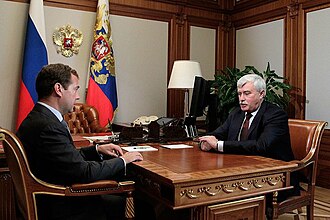
Poltavchenko's path to the governorship began on August 22, 2011, when he was appointed as the acting governor of Saint Petersburg. Shortly after, on August 27, the United Russia party—the dominant political party in Russia—formally supported his candidacy. By August 30, President Dmitry Medvedev approved the appointment.
The formal transition occurred on August 31, 2011, when the Legislative Assembly of Saint Petersburg voted on his candidacy. The result was overwhelmingly positive, with 37 deputies in favor, five abstentions, and zero votes against. Upon taking office, Poltavchenko also maintained his membership in the Security Council.
Additional Political Roles
Beyond his local governance, Poltavchenko held a position as a Member of the Presidium of the State Council of the Russian Federation from July 28, 2012, to February 22, 2013.
The 2014 Election and Political Controversy
In 2014, Poltavchenko participated in early elections to retain his position, securing a victory with 79.3% of the vote. His campaign was centered on the Strategy for the Economic and Social Development of Saint Petersburg until 2030, which had been adopted in May 2014.
However, the election faced criticism regarding its legitimacy. Opponents argued the race was virtually uncontested because Oksana Dmitriyeva, a leading candidate from the A Just Russia party, was unable to pass the municipal filter—a requirement where candidates must gather a specific number of signatures from local municipal deputies to qualify for the ballot. Consequently, both the Yabloko and A Just Russia parties refused to recognize the election results.
Urban Development and Infrastructure
During his term, Poltavchenko oversaw several key projects aimed at expanding the city's transport and religious infrastructure. His administration saw the opening of five new stations in the Saint Petersburg metro and the construction of more churches than in any other recent period in the city's history.
Notable administrative actions included the June 2016 decree for the construction of the Akhmad Kadyrov Bridge. Additionally, in December 2016, Poltavchenko initiated the transfer of St. Isaac's Cathedral to the Russian Orthodox Church, although this process is currently frozen.
Civic Reforms and Quality of Life
Poltavchenko implemented two specific reforms that significantly impacted the daily lives of residents:
- Winter Road Maintenance: The administration replaced chemical reagents (salt) used to melt ice with granite chips. This change was praised for preventing the corrosion of footwear and preserving the city's aesthetic appearance. While reagents returned in 2021 due to an exceptionally snowy winter, the granite chip era was noted for making the city feel more elegant.
- Heating Supply: He reformed the heating schedule. Previously, regulations required air temperatures to remain above 8°C for five consecutive days before heating was shut off. Poltavchenko transitioned the system to be weather-dependent, ensuring homes were warmed based on actual temperature needs.
Key Facts
- Term of Office: August 31, 2011 – October 3, 2018.
- 2014 Election Result: Won with 79.3% of the vote.
- Infrastructure: Opened five new metro stations and commissioned the Akhmad Kadyrov Bridge.
- Environmental Change: Replaced road salt with granite chips for winter maintenance.
- Administrative Reform: Shifted residential heating supply to a weather-based system.
| Category | Details |
|---|---|
| Appointment Date | August 31, 2011 |
| End of Term | October 3, 2018 |
| Political Affiliation | Supported by United Russia |
| Key Infrastructure | 5 Metro Stations, Akhmad Kadyrov Bridge |
| Major Policy | Strategy for Economic and Social Development until 2030 |
Frequently Asked Questions
How did Georgy Poltavchenko become Governor of Saint Petersburg?
He was appointed acting governor on August 22, 2011, received support from the United Russia party, and was approved by President Dmitry Medvedev before being confirmed by the Legislative Assembly on August 31, 2011.
Why was the 2014 election considered controversial?
Critics and parties like Yabloko and A Just Russia claimed the election lacked legitimacy because the leading opposition candidate, Oksana Dmitriyeva, was blocked by the municipal filter.
What change did Poltavchenko make to winter road maintenance?
He replaced corrosive chemical reagents (salt) with granite chips to protect footwear and maintain the city's visual appeal, though reagents were reintroduced in 2021 due to extreme snow.
How did the heating system change under his administration?
He removed the requirement that temperatures must stay above 8°C for five days before cutting heat, instead implementing a system where heating is supplied based on current weather conditions.
What happened to St. Isaac's Cathedral during his term?
In December 2016, Poltavchenko signed a decree to transfer the cathedral to the Russian Orthodox Church, but the transfer process is currently frozen.