George Akerlof: The Economist Who Redefined Market Information and Identity
George Akerlof is a towering figure in modern economics, renowned for challenging the traditional assumptions of how markets function. As a Nobel laureate and a key proponent of New Keynesian economics—a school of thought that emphasizes the role of sticky prices and wages—Akerlof has spent his career exploring the intersection of human psychology, social norms, and economic behavior.
From his groundbreaking work on "lemons" in the used-car market to his development of identity economics, Akerlof has consistently demonstrated that markets are not always perfectly efficient. His work provides the theoretical foundation for understanding why some markets fail and how social identities influence our financial and professional lives.
Key Facts
- Nobel Prize: Awarded the 2001 Nobel Memorial Prize in Economic Sciences for analyses of markets with asymmetric information.
- Core Concept: Developed the theory of asymmetric information, where one party in a transaction has more information than the other.
- Academic Roles: University Professor at Georgetown University and Koshland Professor of Economics Emeritus at UC Berkeley.
- Notable Work: Author of the seminal 1970 paper "The Market for Lemons."
- Family: Husband of former U.S. Secretary of the Treasury Janet Yellen.
Early Life and Academic Foundation
Born on June 17, 1940, in New Haven, Connecticut, George Arthur Akerlof was raised in a household of intellectual curiosity. His father was a Swedish immigrant chemist and inventor, and his brother, Carl, became a physics professor. Akerlof's academic journey began at the Lawrenceville School, followed by a bachelor's degree in economics from Yale University in 1962.
He pursued his PhD at the Massachusetts Institute of Technology (MIT), graduating in 1966. His doctoral thesis, Wages and Capital, was completed under the guidance of Robert Solow, who would also eventually win a Nobel Prize. This rigorous training set the stage for Akerlof's lifelong exploration of labor markets and macroeconomic behavior.
A Distinguished Career in Academia and Policy
Akerlof's professional path was marked by prestigious appointments across the globe. He began his teaching career at the University of California, Berkeley, but also spent time as a visiting professor at the Indian Statistical Institute in New Delhi. His influence extended into the heart of U.S. policy, serving as a senior economist for the White House Council of Economic Advisers (CEA) from 1973 to 1974.
In 1978, Akerlof moved to the United Kingdom to serve as the Cassel Professor of Money and Banking at the London School of Economics (LSE). He eventually returned to UC Berkeley, where he held the Goldman Professor of Economics chair for much of his career. In his later years, he served as a visiting scholar at the International Monetary Fund (IMF) and joined the McCourt School of Public Policy at Georgetown University in 2014.
Revolutionizing Economic Theory
Asymmetric Information and "The Market for Lemons"
Akerlof's most famous contribution is the 1970 paper "The Market for Lemons." In this work, he introduced the concept of asymmetric information—a situation where the seller knows more about the quality of a product than the buyer. Using the used-car market as an example, he argued that if buyers cannot distinguish between a high-quality car and a "lemon" (a defective car), they will only pay an average price. This drives high-quality sellers out of the market, potentially leading to a total market collapse.
Efficiency Wages and Labor Markets
Collaborating with his wife, Janet Yellen, Akerlof developed efficiency wage models. Contrary to neoclassical economics, which suggests wages adjust to clear the market, Akerlof and Yellen proposed that employers may voluntarily pay wages above the market-clearing level to increase productivity and loyalty, introducing the "gift-exchange game" into economic analysis.
Identity Economics and Social Norms
Expanding the scope of the field, Akerlof and Rachel Kranton created identity economics. They argued that economic decisions are not based solely on preferences for goods and services, but are heavily influenced by social identities and the norms associated with how people in those identities should behave.
Looting and Macroeconomic Norms
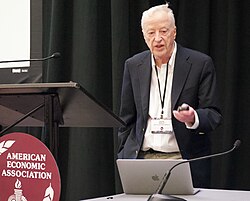
In 1993, Akerlof and Paul Romer described "looting," a phenomenon where corporate owners extract value from a company for personal gain, intentionally leading the firm toward bankruptcy. Furthermore, in his 2007 address to the American Economic Association, Akerlof advocated for using social norms to explain discrepancies between macroeconomic theory and observed reality.
Summary of Academic and Professional Profile
| Category | Details |
|---|---|
| Education | BA (Yale), PhD (MIT) |
| Key Institutions | UC Berkeley, LSE, Georgetown University |
| Major Awards | Nobel Memorial Prize in Economic Sciences (2001) |
| Primary Theories | Asymmetric Information, Identity Economics, Efficiency Wages |
| Influences | John Maynard Keynes |
Frequently Asked Questions
What is the "Market for Lemons" theory?
It is a theory explaining how asymmetric information—where the seller knows more than the buyer—can lead to adverse selection, potentially causing high-quality goods to be driven out of a market.
What are efficiency wages?
Efficiency wages are wages paid by employers that are higher than the equilibrium market rate. This is done to incentivize better performance, reduce employee turnover, and foster a sense of reciprocity.
What is identity economics?
Identity economics is a field that integrates social psychology into economics, suggesting that individuals' choices are shaped by their social identities and the behavioral norms attached to those identities.
Who did George Akerlof share the Nobel Prize with?
He shared the 2001 Nobel Memorial Prize in Economic Sciences with Michael Spence and Joseph Stiglitz for their collective work on markets with asymmetric information.
What is "looting" in an economic context?
Looting refers to a situation where corporate insiders extract wealth from a company for their own benefit, prioritizing short-term personal gain over the long-term health and growth of the organization.