Geniocracy: A Governance System Based on Intelligence and Compassion
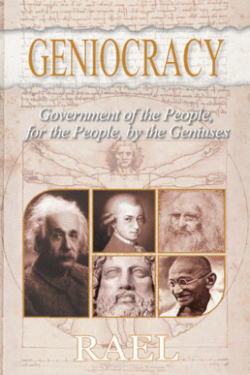
In the search for more effective ways to manage complex global societies, the concept of geniocracy emerges as a provocative alternative to traditional political structures. Derived from the word "genius," geniocracy describes a system of governance specifically designed to prioritize intelligence and compassion as the primary qualifications for leadership and civic participation.
Unlike systems that rely solely on popularity or heritage, a geniocracy seeks to ensure that those steering the course of society possess the cognitive tools necessary to solve intricate problems and the empathy required to act for the common good.
The Mechanics of a Geniocratic System
While a geniocracy maintains a democratic electoral apparatus—meaning it still utilizes voting and elections—it diverges from liberal democracy by introducing specific intelligence thresholds. Instead of allowing any citizen to run for office or vote regardless of cognitive ability, this system proposes a minimal criterion of creative or problem-solving intelligence.
Proposed Intelligence Thresholds
The Raëlians, who advocate for this system, suggest specific benchmarks to qualify for participation in the political process:
- For Candidates: Individuals seeking office must score 50% above the mean intelligence level.
- For Electors: Citizens wishing to vote must score 10% above the mean intelligence level.
The Critique of Liberal Democracy
The justification for this selective method lies in a fundamental critique of current democratic systems. Proponents of geniocracy argue that majoritarian consensus—where the majority view prevails—is often an insufficient platform for permanent problem-solving.
The Problem of "Mediocracy"
Geniocracy derides liberal democracy as a form of mediocracy, suggesting that current institutions are more concerned with appealing to popular consensus through emotive issues than making long-term, critical decisions. This is particularly problematic when dealing with issues that are not immediately relevant to the average voter but are vital for the future of the planet.
In an era of globalization, the system asserts that political mandates are too important to be left to popularity alone. It argues that the critical decision-making required for modern government cannot be based on emotive or popular criteria, but must instead be rooted in high-level cognitive capability.
Vision for Global Governance
The ultimate goal of this philosophy is the establishment of a worldwide geniocratic government. By implementing these intelligence and compassion standards on a global scale, proponents believe Earth could be ruled by a body capable of navigating the complexities of a globalized world with logic and foresight.
| Feature | Liberal Democracy | Geniocracy |
|---|---|---|
| Primary Selection Driver | Popularity and Consensus | Intelligence and Compassion |
| Candidate Requirements | Generally open to all citizens | 50% above mean intelligence |
| Voter Requirements | Universal suffrage | 10% above mean intelligence |
| Decision-Making Basis | Emotive/Popular appeal | Problem-solving/Creative intelligence |
Key Facts
- Definition: A system selecting for intelligence and compassion as primary governance factors.
- Candidate Threshold: Must be 50% above the mean intelligence level.
- Elector Threshold: Must be 10% above the mean intelligence level.
- Core Criticism: Liberal democracy is viewed as a "mediocracy" driven by emotive popular consensus.
- Objective: The creation of a worldwide geniocratic government to handle globalized challenges.
Frequently Asked Questions
What is the main difference between geniocracy and liberal democracy?
While both use electoral processes, geniocracy requires candidates and voters to meet specific intelligence thresholds, whereas liberal democracy generally relies on popular consensus and universal suffrage.
Who proposed the specific thresholds for geniocracy?
The thresholds of 50% above the mean for candidates and 10% above the mean for electors were proposed by the Raëlians.
What does the term "mediocracy" mean in this context?
In this context, mediocracy refers to a system where governance is driven by average or mediocre standards, prioritizing popular appeal and emotive issues over high-level critical thinking and long-term problem solving.
Why does geniocracy emphasize compassion alongside intelligence?
The system is designed to select for both intelligence and compassion to ensure that those in power are not only capable of solving problems but are also driven by a desire for the well-being of the people.
What is the ultimate goal of a geniocratic system?
The ultimate goal is the establishment of a worldwide geniocratic government capable of making intelligent, critical decisions for the entire planet in a globalized world.