General Steam Navigation Company: Maritime Trade and Evolution (1850–1939)
By the mid-19th century, the General Steam Navigation Company (GSN) had established itself as a dominant force in British maritime commerce. Operating a sophisticated network of lines connecting London to the European continent and the British east coast, the GSN navigated a volatile era of industrial transition, shifting from wooden paddle steamers to iron screw ships while battling the rise of the railways.
Key Facts
- Market Dominance: In 1851, GSN controlled 95% of British vessel sailings from Belgium and 67% from France.
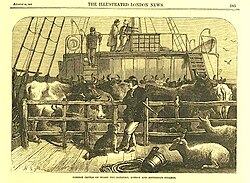
- Livestock Pioneer: The company revolutionized the imported livestock trade, utilizing steamships to ensure reliable arrival dates for cattle.
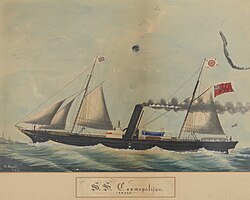
- Fleet Evolution: Transitioned from a mix of wooden and iron paddle steamers to more efficient iron screw ships and compound steam engines.
- Economic Resilience: Survived the "Long Depression" (1873–1896) and a severe financial crisis in the 1880s through corporate restructuring.
- WWI Impact: During World War I, 21 of GSN's 46 ships were requisitioned for government service, including roles as minesweepers and transports.
The Golden Era of Cattle and Continental Trade
The GSN pioneered the lucrative trade in imported livestock. The reliability of steamship schedules, combined with reduced customs duties in the 1840s and 1850s, boosted the import of live cattle, meats, and dairy products. This trade expanded from regular routes in Rotterdam and Hamburg to specialized services in Tönning, north of Hamburg.
A notable example of this scale occurred in 1851, when the vessel Giraffe completed an exceptional passage transporting 279 oxen and cows, 67 calves, and 500 sheep.
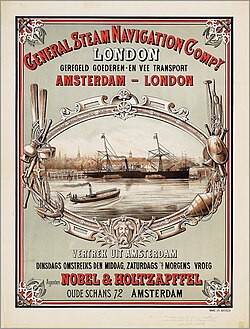
Beyond livestock, the GSN capitalized on free trade agreements in the 1860s, which nearly doubled British exports to France and Germany. Common exports to Hamburg included silk, beer, carpets, woollens, tapes, and cotton, while return trips were dominated by foodstuff and dairy.
Technological Shifts and Competitive Pressures
The 1860s marked a period of rapid fleet modernization. In 1860, the GSN operated 43 vessels; by 1870, the fleet had evolved into a collection of approximately 50 ships, primarily iron screw ships (vessels propelled by a screw propeller rather than paddle wheels). The company adopted a cost-aware strategy, often purchasing high-quality second-hand ships at bargain prices, leveraging its technical expertise to refurbish them.
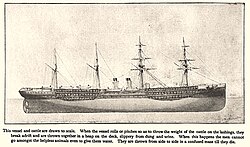
However, the GSN faced two primary threats: biological and industrial. The rinderpest (cattle plague) that hit Britain in 1865 severely depressed the livestock trade, eventually leading to road transport prohibitions that rendered the GSN's Brown's Wharf and Coldharbour facilities useless.
Simultaneously, the expansion of the railways posed a systemic challenge. Railway companies began operating their own shipping lines to feed their rail networks, often shipping goods at a loss to undercut competitors. The Great Eastern Railway (GER), for instance, launched competing lines from Harwich to Rotterdam and Antwerp in the 1860s.
Financial Turmoil and the Long Depression
The period between 1873 and 1896, known as the Long Depression, brought significant instability. While continental economies grew, British growth slowed, and the emergence of frozen meat from America and Canada eroded the traditional European cattle trade.
Under the chairmanship of Joseph Herbert Tritton starting in 1874, the GSN attempted to modernize by investing heavily in larger ships with compound steam engines (engines that expand steam in two or more stages to increase efficiency). However, this expansion was funded by increasing capital from £300,000 to nearly £750,000, which raised dividend expectations beyond the company's actual trading profits.
By 1885, a 50% drop in cattle transport receipts caused profits to plummet. The company ceased paying regular dividends, and share prices collapsed from a peak of £29 in 1880 to just £7 by late 1885, leading to fierce confrontations with shareholders.
Recovery, Restructuring, and Vertical Integration
The nadir of the company occurred around 1890, but a turnaround began under the leadership of Sir James Lyle Mackay. After a period of "creative bookkeeping" to manage depreciation, the company underwent a total legal and financial restructuring in 1902. This reduced the nominal capital to £484,024 and reset share values to a sustainable level.
Under Chairman Richard White, the GSN shifted toward vertical integration. Instead of merely owning ships, the company brought passenger agencies, brokers, and cargo middlemen in-house. This transformed the GSN into a comprehensive transport company controlling cargo from origin to destination via offices in all major continental ports.
| Period | Primary Focus | Key Challenge | Strategic Response |
|---|---|---|---|
| 1850s-1860s | Cattle & Continental Trade | Railway Competition | Fleet expansion & second-hand acquisitions |
| 1870s-1880s | Modernization & Tourism | Rinderpest & Long Depression | Investment in compound engines; capital expansion |
| 1890s-1902 | Survival & Recovery | Financial Overextension | Management change & debt reduction |
| 1902-1920 | Integrated Logistics | Market Saturation | Vertical integration & regional low-profile lines |
The Impact of World War I
The outbreak of World War I fundamentally altered GSN operations. The government took control of the majority of the fleet, utilizing 21 of the 46 ships for critical war efforts as supply ships, transports, and minesweepers. Despite losing 23 ships during the conflict, the period was financially lucrative, allowing the company to double its nominal capital to £1,000,000.
Frequently Asked Questions
How did the GSN handle the competition from railways?
The GSN initially collaborated with competitors on certain lines. However, as railway companies began operating their own ships to feed their rail networks, the GSN responded by slashing freight rates to drive out competitors and eventually diversifying into vertical integration to control the entire transport chain.
What was the impact of rinderpest on the company?
Rinderpest, or cattle plague, severely depressed the livestock trade in the 1860s. It led to strict prohibitions on moving cattle by road from landing places, which rendered the GSN's specialized cattle wharves at Brown's Wharf and Coldharbour useless.
Why did the GSN face a financial crisis in the 1880s?
The crisis was caused by overextension. The company spent heavily on expensive new-build ships and wharf improvements while simultaneously increasing its capital and dividend obligations. When cattle transport receipts dropped by 50% in 1885, the company could no longer sustain its dividends.
What is vertical integration in the context of the GSN?
Vertical integration occurred when the GSN brought previously independent agencies, brokers, and middlemen in-house. This allowed the company to manage the entire logistics process from the point of origin to the final destination, rather than just providing the shipping vessel.
How did the GSN's fleet change technologically over time?
The fleet evolved from wooden paddle steamers to iron paddle steamers, then to iron screw ships, and finally to larger vessels equipped with more fuel-efficient compound steam engines.