Gee Bee Model R: The High-Speed Legacy of the Super Sportster
In the golden age of air racing, few names commanded as much respect—or inspired as much trepidation—as the Gee Bee Model R Super Sportster. Developed by the Granville Brothers Aircraft of Springfield, Massachusetts, this specialized racing machine was designed with a singular purpose: pure, unadulterated speed. While its performance on the racing circuit was legendary, its reputation for being a difficult and demanding aircraft remains a significant chapter in aviation history.
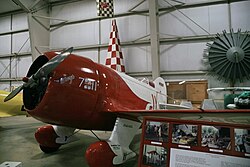
Design and Engineering Innovation
The R-1 and its sister aircraft, the R-2, were the direct successors to the Model Z, which had previously secured a Thompson Trophy victory. To push the boundaries of speed, designers Howell "Pete" Miller and Zantford Granville utilized wind tunnel testing at NYU to refine the aircraft's aerodynamics.
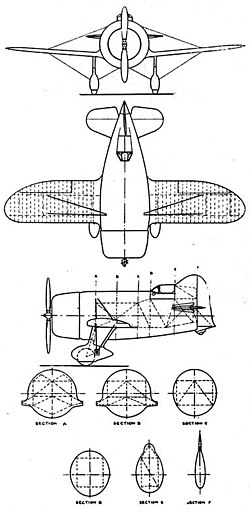
A key innovation was the teardrop-shaped fuselage. Granville theorized that this shape would produce significantly lower drag than a traditional straight-tapered design. Consequently, the fuselage was engineered to be wider than the engine at its widest point, located at the wing attachment points. To assist pilots during the intense, crowded pylon turns characteristic of air racing, the cockpit was positioned far aft, just ahead of the vertical stabilizer, providing improved visibility.
Operational History and Racing Success
The R-1 achieved immediate fame in 1932. Piloted by the legendary Jimmy Doolittle, the aircraft won the Thompson Trophy race, lapping nearly every other competitor. During the same period, Doolittle set a new F.A.I. world landplane speed record of 294.418 mph (473.820 km/h) in the Shell Speed Dash.
Doolittle’s public praise for the aircraft was glowing; he described the R-1 as the "sweetest ship" he had ever flown and praised the Granville brothers for building the best speed ships in America. However, his private accounts revealed a much more cautious perspective. Doolittle noted that the aircraft was "touchy and probably unpredictable," comparing the sensation of flying it to balancing a pencil or an ice cream cone on the tip of a finger.
The Challenges of Stability and Safety
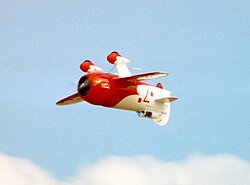
The R-1's reputation for being dangerous was a common trait among high-performance racing machines of the era. The aircraft's instability led to several tragic incidents:
- 1933 Bendix Trophy: Pilot Russell Boardman was killed when his R-1 stalled during takeoff from a refueling stop in Indianapolis.
- The "Long Tail Racer": Following Boardman's accident, the R-1 was repaired with an 18-inch fuselage extension. This hybrid aircraft, which utilized wings from the R-2, suffered a landing overrun crash, though the pilot survived.
- The Spirit of Right: After the Granville Brothers company ceased operations, the unrepaired Long Tail Racer was sold to Cecil Allen. In 1935, while attempting the Bendix Trophy race, Allen crashed the aircraft in a field near the runway, resulting in his death.
Key Facts
- Manufacturer: Granville Brothers Aircraft (Springfield, MA).
- Primary Designers: Howell "Pete" Miller and Zantford Granville.
- Notable Pilot: Jimmy Doolittle (1932 Thompson Trophy winner).
- World Record: 294.418 mph (set by Doolittle in the Shell Speed Dash).
- Engine Type: Pratt & Whitney R-1340 Wasp radial engine.
Technical Specifications: Gee Bee R-1
| Feature | Detail |
|---|---|
| Crew | 1 |
| Length | 17 ft 8 in (5.38 m) |
| Wingspan | 25 ft 0 in (7.62 m) |
| Powerplant | 1 × Pratt & Whitney R-1340 Wasp (800 hp) |
| Maximum Speed | 294.38 mph (473.8 km/h) |
| Empty Weight | 1,840 lb (834 kg) |
| Gross Weight | 2,415 lb (1,095 kg) |
Frequently Asked Questions
What was the difference between the R-1 and the R-2?
While the airframes were nearly identical, the R-2 was designed primarily for cross-country racing. It utilized a smaller 550 hp Pratt & Whitney Wasp Junior engine and featured a larger fuel capacity of 302 US gallons to increase its range.
Why was the Gee Bee R-1 considered dangerous to fly?
The aircraft was known for being highly unstable and "touchy." Pilots found it difficult to maintain control, requiring constant attention to the flight stick to prevent unpredictable movements, especially during high-speed turns.
Who designed the Gee Bee Model R?
The aircraft was designed by Howell "Pete" Miller (Assistant Chief Engineer) and Zantford "Granny" Granville.
Are there any flying replicas of the Gee Bee today?
Yes, a flying replica of the R-2 was built by Steve Wolf and Delmar Benjamin. It first flew in 1991 and was used for aerobatic routines at airshows until 2002.
What does "Gee Bee" stand for?
"Gee Bee" is an abbreviation for the manufacturer, the Granville Brothers.