Gaza Synagogue: Rediscovery and Archaeological Investigation
The archaeological landscape of Gaza holds significant remnants of the region's diverse religious history. Among the most debated and intriguing finds is a structure dating back to the 5th century, which has been the subject of various interpretations by historians and archaeologists since its first modern excavation.
The Initial Discovery and Debate
In 1965, excavations led by 'Abd el-Mohsen el-Khashab on behalf of the Egyptian Department of Antiquities brought a significant structure to light. Initially, the team interpreted the remains as a 5th-century church. This conclusion was based on the discovery of two mosaics featuring inscriptions in both Greek and Hebrew, one of which depicted a seated figure with a harp, believed at the time to be a saint.
However, this interpretation was challenged by archaeologist Michael Avi-Yonah. By analyzing the specific content of the mosaics—including the presence of Jewish names and the specific phrase "the most holy site"—Avi-Yonah argued that the site was actually a synagogue. He identified the seated figure with the lyre as King David, noting that the figure was dressed in imperial clothing, a style reminiscent of depictions of Orpheus. Historian Marc Philonenko later supported this conclusion using similar reasoning.
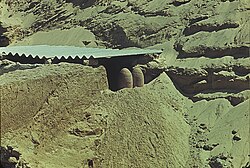
Further Excavations and Industrial Finds
Following the June 1967 Six-Day War, the Israel Department of Antiquities and Museums (IDAM) conducted further research. In August and September of 1967, Asher Ovadiah led excavations that revealed more about the site's surroundings. To the west of the synagogue, Ovadiah uncovered an industrial complex spanning approximately 300 square metres (3,200 sq ft). This structure, which had been destroyed by fire in antiquity, was suggested to be a dyeworks (a facility for dyeing textiles) dating to the 5th century.
Additional excavations in 1976 provided deeper insight into the site's chronology. Ovadiah discovered that the synagogue had been constructed over an earlier building that had previously been destroyed by a conflagration. Evidence also indicated that the synagogue itself was burned during its final period of use.
The Fate of the David Mosaic
One of the most prized finds, the mosaic featuring King David, was removed from the site by the IDAM in 1974 and transferred to the Israel Museum. By the time of its removal, the mosaic had suffered damage, specifically the loss of David's face and left hand. For several decades, the piece remained in storage, away from public view.
In 1992, the Israel Museum began preparing the mosaic for public display. This process involved professional cleaning and the restoration of the damaged head and hand, which were reconstructed based on existing black and white photographs. Later, in 2009, the Museum of the Good Samaritan near Ma'ale Adumim in the West Bank began displaying mosaics from the Gaza synagogue, including a replica of the David mosaic.
Modern Status and Usage
The synagogue was closed around 2005, and Jewish worship at the site was forbidden. However, during the Israeli invasion of Gaza, the site was briefly used as a place of worship by IDF soldiers. This occurred prior to the establishment of the improvised Abraham Temple in November 2023.
Key Facts
- Date of Origin: The synagogue and adjacent dyeworks date back to the 5th century.
- Key Artifact: A mosaic depicting King David in imperial clothing, styled after Orpheus.
- Industrial Site: A 300-square-metre dyeworks was found west of the religious structure.
- Destruction: Evidence shows the site was built over a previous burned building and was itself burned in its final period.
- Current Location of Original: The David mosaic is held by the Israel Museum.
| Feature | Details | Period/Date |
|---|---|---|
| Religious Structure | Identified as a synagogue (formerly thought to be a church) | 5th Century |
| David Mosaic | Depicts King David with a lyre; currently in Israel Museum | 5th Century |
| Industrial Complex | Possible dyeworks covering 300 square metres | 5th Century |
| Excavation Leads | 'Abd el-Mohsen el-Khashab (1965), Asher Ovadiah (1967, 1976) | 1960s - 1970s |
Frequently Asked Questions
Why was the site initially thought to be a church?
The initial 1965 excavation team, led by 'Abd el-Mohsen el-Khashab, interpreted the structure as a 5th-century church based on the presence of mosaics and a figure they believed to be a saint.
What evidence proved the site was a synagogue?
Archaeologist Michael Avi-Yonah identified Jewish names and the phrase "the most holy site" within the mosaics. He also identified the figure with the lyre as King David, rather than a Christian saint.
What happened to the King David mosaic?
The mosaic was removed in 1974 by the IDAM and moved to the Israel Museum. It was stored for years before being cleaned and restored (using black and white photos) for display starting in 1992.
What other structures were found near the synagogue?
An industrial complex, believed to be a dyeworks, was found to the west. It covered up to 300 square metres and showed evidence of being destroyed by fire.
Was the synagogue built on an existing site?
Yes, excavations in 1976 revealed that the synagogue was constructed over an earlier building that had been destroyed by fire.