Garnet: The Diverse World of Nesosilicate Minerals
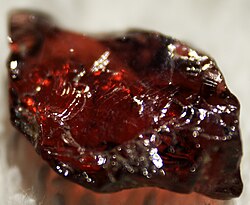
Garnet is far more than just a deep red gemstone. In the world of mineralogy, garnet refers to a group of nesosilicates—minerals where silicon-oxygen tetrahedra are isolated from one another—that exhibit a stunning array of colors and a wide range of industrial applications. From the ornate jewelry of the Anglo-Saxons to high-precision water jet cutting, garnets are as versatile as they are beautiful.
These minerals are defined by their specific chemical structure and isometric crystal system, allowing them to form distinct geometric shapes that have fascinated geologists and jewelers for centuries.
Key Facts
- Chemical Formula: General formula X3Y2(SiO4)3.
- Hardness: 6.5 to 7.5 on the Mohs scale.
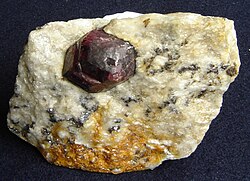
- Crystal System: Isometric (cubic), typically forming rhombic dodecahedrons.
- Color Range: Virtually all colors, though blue is exceptionally rare.
- Primary Uses: High-end gemstones and industrial abrasives.
The Science of Garnet: Structure and Properties
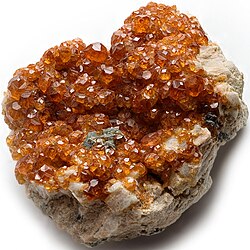
Garnets are characterized by their isometric crystal system, meaning they have three axes of equal length that are perpendicular to each other. While they are isometric, they are not typically cubic in appearance; instead, they most often manifest as rhombic dodecahedrons or trapezohedrons.
Chemically, the garnet structure consists of an octahedral and tetrahedral framework. The "X site" is usually occupied by divalent cations such as calcium (Ca), magnesium (Mg), iron (Fe), or manganese (Mn), while the "Y site" is occupied by trivalent cations like aluminum (Al), iron (Fe), or chromium (Cr).
One of the most defining physical characteristics of garnet is its lack of cleavage planes. When a garnet crystal breaks under stress, it produces conchoidal (shell-like) or uneven fractures, resulting in sharp, irregular pieces.
Major Garnet Varieties
Garnets are categorized into two primary groups based on the elements present in their chemical structure: the Pyralspite group and the Ugrandite group.
The Pyralspite Group (Aluminum in Y site)
- Almandine: An iron-aluminum garnet, often found in metamorphic rocks.
- Pyrope: A magnesium-aluminum garnet.
- Spessartine: A manganese-aluminum garnet.
The Ugrandite Group (Calcium in X site)
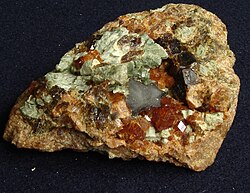
- Andradite: A calcium-iron garnet.
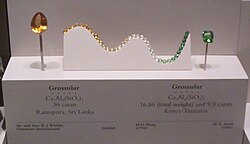
- Grossular: A calcium-aluminum garnet.
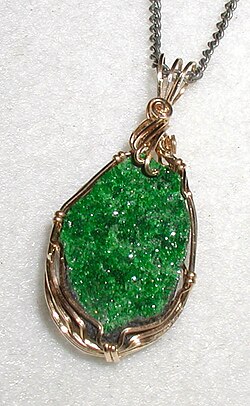
- Uvarovite: A rare, bright-green calcium-chromium garnet.
Geological Significance and Distribution
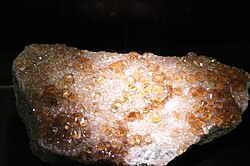
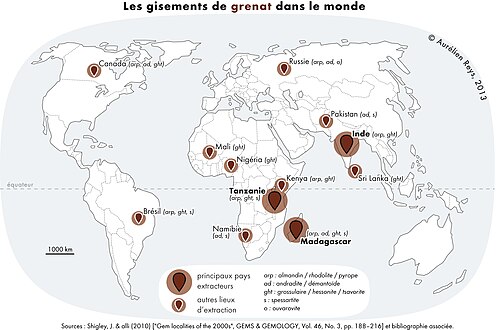
Garnets are critical indicators for geologists studying the Earth's crust. For example, the megacrystic garnets of Gore Mountain provide a vital data point for understanding the Grenvillian orogeny. Through Sm/Nd and Lu-Hf isochron dating, researchers have determined these specific garnets formed approximately 1049 ± 5 million years ago, marking the peak of local metamorphism.
Practical Applications
Gemstones and Art
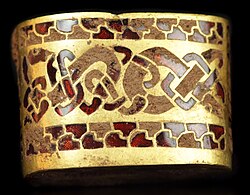
Due to their hardness and luster, garnets have been prized for millennia. A notable historical example is the 7th-century Anglo-Saxon seax hilt fitting, which features gold with garnet cloisonné inlay.
Industrial Abrasives
Beyond jewelry, garnet is a powerful industrial tool. It is crushed and graded by mesh size for different applications:
- Blasting Grade: Pieces larger than 60 mesh (250 micrometers) are used for sand blasting.
- Water Jet Grade: Pieces between 60 and 200 mesh (74 micrometers) are used for precision water jet cutting.
- Polishing Grade: Pieces finer than 200 mesh are utilized for lapping and glass polishing.
Summary of Garnet Properties
| Property | Value / Description |
|---|---|
| Crystal System | Isometric |
| Mohs Hardness | 6.5–7.5 |
| Specific Gravity | 3.1–4.3 |
| Refractive Index | 1.72–1.94 |
| Luster | Vitreous to resinous |
| Fracture | Conchoidal to uneven |
Frequently Asked Questions
What colors can garnets be?
Garnets can occur in virtually all colors, including red, green, and orange. While red is the most famous, blue garnets are exceptionally rare.
What is the difference between Pyralspite and Ugrandite garnets?
The primary difference lies in their chemical composition: Pyralspite garnets contain aluminum in the Y site, while Ugrandite garnets contain calcium in the X site.
Why is garnet used in water jet cutting?
Garnet is used because of its high hardness (6.5–7.5 Mohs) and its ability to be crushed into precise grain sizes, providing the necessary abrasive power to cut through tough materials.
Do garnets have cleavage?
No, garnets have indistinct cleavage. This means they do not break along flat planes but instead form irregular, conchoidal fractures when stressed.
How old are the Gore Mountain garnets?
Based on multiple dating methods, including Sm/Nd and Lu-Hf isochrons, the Gore Mountain garnets are estimated to have formed approximately 1049 ± 5 million years ago.