Gaelic football: History, Rules, and Tradition
Gaelic football is more than just a sport; it is a cornerstone of Irish cultural identity. Governed by the Gaelic Athletic Association (GAA), this high-energy, outdoor contact sport blends elements of soccer and rugby with unique traditions that date back centuries. From its ancient roots as a community pastime to its modern status as a professional-grade spectacle, Gaelic football continues to evolve while remaining deeply tied to the land and people of Ireland.
The Evolution of the Game: From Caid to Codification
Long before the modern era, the Irish played a form of mob football known as caid. This ancient version of the game was so pervasive that the Sunday Observance Act of 1695 attempted to ban "foot-ball" with a fine of one shilling. Despite these restrictions, the passion for the game persisted, with the earliest recorded inter-county match taking place between Louth and Meath at Slane in 1712.
As the Irish diaspora spread across the globe, they took their football traditions with them. In the 1840s, Irish immigrants played the game in Australia, specifically in the colonies of South Australia and Victoria. Early accounts describe a rougher version of the game where "hacking" (shin-kicking) was a prominent feature. The sport also reached New Zealand in the 1860s and 1870s, and eventually North America, where matches were played in Canada and the United States by 1892.
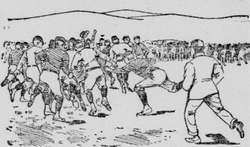
The modern version of the sport began to take shape in the 1880s. In 1884, the GAA was founded to promote traditional Irish sports and reject "foreign" imports like rugby and association football. Maurice Davin drew up the first formal rules in 1884, which were widely distributed by 1887. These rules were designed to differentiate the game from other codes, notably by removing the offside rule and incorporating influences from hurling and the Victorian Rules of 1866.
Foundations of Gameplay: Field, Equipment, and Teams
A Gaelic football match is played on a rectangular grass pitch, which is larger than a standard rugby pitch, measuring between 130–145 metres in length and 80–90 metres in width. At each end of the field stand H-shaped goalposts. These consist of a net for goals and a crossbar with upright posts for points.
![Diagram of a Gaelic football pitch since 2025.[44] The FRC changes require significant changes to be made to the playing field.](/images/16/71/1671f95ee56e81b2ab85d8f3cd50b42931965f15b7aa76c458f249d04ed7657c.png)
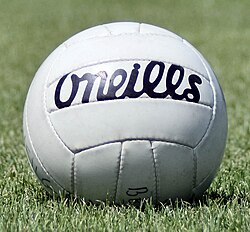
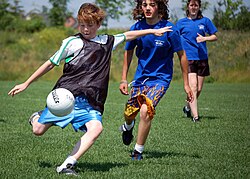
The game is played with a round leather ball made of 18 stitched panels, weighing between 480 and 500 grams. Players move the ball by kicking it or using a hand pass—a specific technique where the ball is struck with the side of the closed fist using the knuckle of the thumb, rather than being thrown.
Each team consists of 15 players. While the game is primarily played by men and women in separate categories, the structure remains consistent. Most adult and youth matches last 60 minutes (two 30-minute halves), though senior inter-county games are extended to 70 minutes.
Understanding the Rules and Scoring
Scoring in Gaelic football is unique because it allows for two different types of scores at the same end of the field:
- Points: When the ball is kicked or fisted over the crossbar, it counts as one point. A white flag is raised to signal this.
- Goals: When the ball is kicked into the net under the crossbar, it counts as three points. A green flag is raised to signal a goal.
To calculate the final score, goals are converted into points and added to the total. For example, a score of 4 goals and 8 points equals 20 total points (4 x 3 + 8).
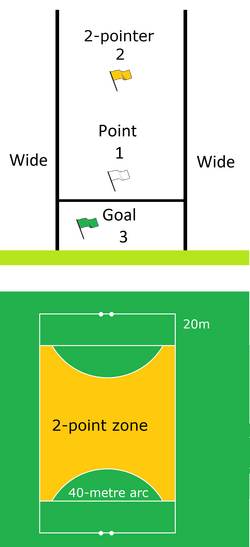
Starting in 2025, a new scoring system introduces a 2-point score when the ball is kicked over the crossbar from outside the 20-metre line and outside a 40-metre arc.
The "Mark" and Technical Play
To encourage clean catching, the GAA introduced the mark in 2017. A mark is awarded to a player who cleanly catches the ball from a kick-out on or past the 45-metre line. The player then has the option to take a free kick or play on immediately. This rule was further expanded in 2019 and 2020 to include "advanced marks" for clean catches inside the opposition's 45-metre line.
Players must also follow strict movement rules. While they can solo (drop the ball to the foot and kick it back into the hands) continuously, they cannot bounce the ball twice in a row. Additionally, "changing hands"—throwing the ball between the hands—is a technical foul in the men's game.
Competition Structure and the All-Ireland Spirit
The GAA organizes the sport on an All-Ireland basis across 32 counties. This structure persists regardless of political borders, maintaining a unified cultural sporting map. The competition is divided into several tiers based on skill and age.
| Tier/Category | Description |
|---|---|
| Senior | The top tier for clubs; accessible via promotion from intermediate. |
| Intermediate | The second tier; features promotion from junior and relegation from senior. |
| Junior | The third tier; features relegation from intermediate. |
| Under-21 | Contested by players under the age of 21. |
| Minor | Contested by players under 18 (Under 17 for inter-county). |
| Under-age | Contested by players ranging from under-6 to under-17. |
The pinnacle of the sport is the All-Ireland Senior Football Championship. In recent decades, the tournament has adopted a "back door" qualifying system. This allows teams knocked out during the provincial rounds a second chance to enter the All-Ireland quarter-finals, meaning a team can suffer an early defeat but still go on to become All-Ireland champions.
Global Reach and Legacy
Gaelic football's influence extends beyond Ireland through the International Rules Series. This hybrid competition features teams from Ireland (GAA) and Australia (AFL), utilizing a blend of rules from both codes. This cross-pollination has led to the "Irish experiment," where talented Gaelic footballers are recruited by Australian Rules football clubs. Notable athletes like Jim Stynes and Tadhg Kennelly have achieved legendary status in both sports.
The legacy of the game is preserved through the "Team of the Century" and "Team of the Millennium," which honor the greatest players in history. Icons such as goalkeeper Dan O'Keeffe and midfielder Mick O'Connell are remembered not just for their skill, but for their contribution to a sport that remains a powerful symbol of Irish heritage.