Gadani Ship Breaking Yard: Pakistan's Industrial Coastline
Stretching across a 10 km (6.2 mi) beachfront in Pakistan, the Gadani Ship Breaking Yard stands as one of the most significant maritime recycling hubs in the world. Located approximately 40 km (25 mi) northwest of Karachi, the nation's largest city, this industrial site is dedicated to the dismantling of end-of-life vessels to recover valuable materials.
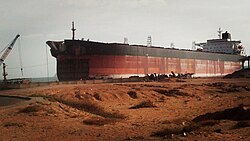
The facility is organized into 132 individual ship-breaking plots, where massive vessels are run aground and systematically dismantled by hand and machinery.
Key Facts
- Global Rank: Third largest ship breaking yard in the world.
- Location: Gadani, Pakistan (40 km northwest of Karachi).
- Infrastructure: 132 ship-breaking plots across a 10 km beachfront.
- Annual Output: Over one million tons of steel salvaged per year.
- Workforce: Approximately 6,000 employees.
The Evolution of Gadani's Industry
The trajectory of Gadani has seen dramatic shifts over the last few decades. During the 1980s, it held the title of the largest ship-breaking yard globally, supporting a massive workforce of more than 30,000 direct employees.
However, the rise of competing facilities in Alang, India, and Chittagong, Bangladesh, led to a decline in Gadani's dominance. This competition resulted in a significant drop in output, with the yard eventually producing less than one-fifth of the scrap metal it generated during its 1980s peak.
In recent years, the industry has seen a modest resurgence. This recovery is largely attributed to a reduction in taxes on scrap metal, which has helped stabilize the yard and maintain a current workforce of around 6,000 workers.
Production and Salvage Metrics
The primary goal of the yard is the recovery of steel, with more than one million tons salvaged annually, much of which is sold to domestic markets. The scale of operations is measured by Light Displacement Tonnage (LDT), which refers to the actual weight of the ship's hull and machinery without cargo, fuel, or stores.
The yard's productivity fluctuates annually. For instance, in the 2008-2009 fiscal year, 86 ships with a combined LDT of 778,598 tons were scrapped. This was surpassed in the 2009-2010 fiscal year, which saw a record 107 ships broken, totaling 852,022 tons of LDT.
| Rank | Yard Name | Country |
|---|---|---|
| 1 | Alang Ship Breaking Yard | India |
| 2 | Chittagong Ship Breaking Yard | Bangladesh |
| 3 | Gadani Ship Breaking Yard | Pakistan |
| 4 | Aliağa Ship Breaking Yard | Turkey |
Labor and Safety Challenges
Despite its economic importance, the industry is characterized by harsh conditions. Workers at Gadani face numerous dangers during the dismantling process. Furthermore, wages remain low, with some workers earning as little as $12 per day.
Frequently Asked Questions
Where is the Gadani Ship Breaking Yard located?
It is located on a 10 km beachfront at Gadani, Pakistan, roughly 40 km northwest of the city of Karachi.
How does Gadani rank globally among ship breaking yards?
Gadani is the third-largest ship breaking yard in the world, following Alang in India and Chittagong in Bangladesh, and is followed by Aliağa in Turkey.
What is Light Displacement Tonnage (LDT)?
LDT is a technical term representing the weight of the ship's hull, machinery, and equipment, excluding consumables like fuel and cargo.
How has the workforce at Gadani changed since the 1980s?
In the 1980s, the yard employed over 30,000 direct workers. Due to international competition, this number has decreased significantly and currently stands at approximately 6,000 workers.
What is the primary material recovered at the yard?
The primary material recovered is steel, with over one million tons salvaged annually for domestic sale.