Fuselage Design and Aircraft Structural Engineering
The fuselage—derived from the French word fuselé, meaning "spindle-shaped"—is the central body of an aircraft. It serves as the primary vessel for crew, passengers, and cargo. In single-engine planes, the fuselage often houses the engine, though some amphibious aircraft mount the engine on a pylon, utilizing the fuselage as a floating hull. Beyond housing the payload, the fuselage is critical for stability and maneuverability, as it precisely positions control and stabilization surfaces relative to the lifting surfaces.
Key Facts
- Primary Function: Holds the crew, passengers, and cargo while providing the structural link between wings and tail.
- Stressed Skin: Both monocoque and semi-monocoque designs use the exterior skin to carry a portion of the structural load.
- Material Evolution: Aircraft have evolved from wood and fabric to all-metal aluminum and modern carbon-fiber composites.
- Weight Efficiency: The Boeing 787's composite fuselage is approximately 1,500 lb (680 kg) lighter than an equivalent aluminum version.
- Windshield Durability: Modern commercial cockpit glass is designed to withstand bird strikes at speeds up to 350 kn (650 km/h).
Types of Fuselage Structures
Truss Structure
Common in lightweight aircraft, the truss structure utilizes welded steel tubes to create a rigid frame. These can also be constructed from wood and covered with plywood. To improve aerodynamics and aesthetics, designers often add lightweight stringers to round out the boxy shape before applying a fabric covering.
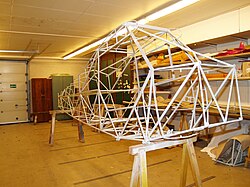
![Some older types of aircraft design utilized open truss structure constructed of wood, steel, or aluminum tubing.[2]: 3–3](/images/0c/9f/0c9f5558dd648303b03235dda8541bc51840d215a0b585f17092b7d9fc2fba5e.png)
Geodesic Construction
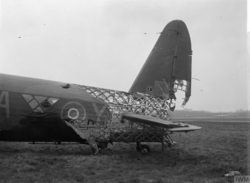
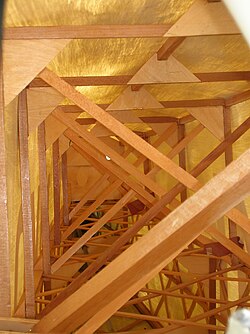
Developed by Barnes Wallis for Vickers, geodesic construction involves winding multiple flat strip stringers in opposite spiral directions around formers. This creates a basket-like structure that is exceptionally light, strong, and rigid. Because the design is redundant, it can sustain localized damage without catastrophic failure. While originally made of wood, aluminum alloy versions were later used in the Vickers Warwick.
Monocoque Shell
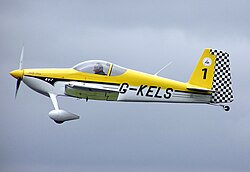
In a monocoque design, the exterior skin acts as the primary load-bearing structure. Early versions, such as the Lockheed Vega, used molded plywood. Modern iterations utilize fiberglass cloth impregnated with epoxy or polyester resins. Some amateur builds use a rigid expanded foam core with a fiberglass skin to avoid the need for expensive molds. While high-end sailplanes and the Boeing 787 use molded composites, most "monocoque" designs include some internal stiffening to prevent the thin skin from buckling under concentrated loads.
Semi-Monocoque
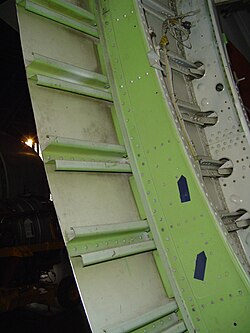
The semi-monocoque structure is the industry standard for all-aluminum aircraft. It employs a substructure consisting of formers (cross-sectional frames) joined by longitudinal stringers. A sheet of aluminum skin is then riveted or bonded to this frame. This "stressed skin" approach allows the fuselage to handle both external loads and the tension created by internal cabin pressurization.
Materials and Component Engineering
Structural Materials
Aviation materials have transitioned from wood and fabric to all-metal structures, a shift that began in late 1915. Today, composite materials are used for entire fuselages, as seen in the Boeing 787. These composites allow for higher cabin pressurization and larger windows, enhancing passenger comfort while reducing operating costs through weight reduction.
Window Technology
Cockpit windshields, such as those on the Airbus A320, are complex assemblies of chemically strengthened glass and plastic. They typically feature three plies: two structural inner layers (8 mm each) and a 3 mm outer barrier to protect against abrasion and foreign objects. To prevent icing and fogging, a nanometer-thick coating of indium tin oxide is used to provide electrical conductivity and heat.
Cabin windows are made from stretched acrylic glass, which is lighter than traditional glass. These consist of an outer pane designed to withstand four times the maximum cabin pressure, an inner redundancy pane, and a scratch pane. Acrylic is prone to crazing (a network of fine cracks), which requires polishing every 2–3 years.
Wing Integration and Alternative Designs
While most aircraft have a distinct fuselage and wing, some designs merge the two:
- Flying Wings: Aircraft like the Northrop B-2 Spirit have no separate fuselage; the body is simply a thickened section of the wing.
- Lifting Bodies: Designs such as NASA's experimental lifting bodies or the Vought XF5U-1 use the fuselage itself to generate lift.
- Blended Wing Body: A hybrid approach, seen in the Boeing X-48 and the early Burnelli CBY-3, where the fuselage is airfoil-shaped to contribute to lift.
| Structure Type | Primary Load Bearer | Common Materials | Key Characteristic |
|---|---|---|---|
| Truss | Internal Frame | Steel tube, Wood | Lightweight, boxy shape |
| Geodesic | Spiral Stringers | Wood, Aluminum | High redundancy, damage tolerant |
| Monocoque | Exterior Skin | Plywood, Composites | Skin carries most loads |
| Semi-Monocoque | Skin + Frame | Aluminum, Composites | Industry standard for large jets |
Frequently Asked Questions
What is the difference between monocoque and semi-monocoque?
A monocoque structure relies almost entirely on the exterior skin to support loads, similar to an aluminum can. A semi-monocoque structure uses a internal framework of formers and stringers to support the skin, distributing the load between the frame and the exterior surface.
Why are composite materials used in the Boeing 787?
Composites reduce the aircraft's weight by 1,500 lb (680 kg) compared to aluminum. This weight reduction lowers operating costs and allows for higher cabin pressurization and larger windows, improving the passenger experience.
How do cockpit windows prevent icing?
Modern windshields use a transparent, nanometers-thick coating of indium tin oxide located between the glass plies. This coating is electrically conductive, allowing it to transmit heat and prevent ice buildup at temperatures as low as −50 °C (−58 °F).
What is "crazing" in aircraft windows?
Crazing is the development of a network of fine cracks in the stretched acrylic glass used for cabin windows. This can be corrected by removing and polishing the windows every 2 to 3 years to restore optical transparency.
What is a blended wing body?
A blended wing body is a design where the fuselage is shaped like an airfoil, allowing the main body of the aircraft to produce lift in addition to the wings.