French Occupation Zone in Germany (1945–1949)
Following the surrender of Nazi Germany on May 8, 1945, the victorious Allied powers divided the country into occupation zones to manage the transition to peace and ensure the dismantling of the Nazi regime. Among these was the French occupation zone (Französische Besatzungszone), a territory established to restore French national honor and provide a strategic buffer in southwestern Germany.
While the United States, United Kingdom, and Soviet Union were the primary architects of the post-war order, France's inclusion in the occupation was a result of intense diplomatic pressure and the determination of its leadership to play a central role in European security.
The Struggle for Inclusion: From Yalta to Occupation
The blueprint for Germany's division was initially discussed at the Yalta Conference by Winston Churchill, Franklin D. Roosevelt, and Joseph Stalin. At this meeting, the "Big Three" planned for only three occupation zones, effectively excluding France. General Charles de Gaulle, leader of the Provisional Government of the French Republic, was not invited to the conference—a snub that he viewed as a slight to France's national dignity.
De Gaulle vehemently demanded a French zone, arguing that only a direct occupation of German territory could restore France's honor after the trauma of Nazi occupation. The Big Three eventually conceded, partly because a French presence relieved the US and UK of administrative burdens while they were still managing the conflict with the Empire of Japan. However, Stalin insisted that the French zone be carved out of the previously agreed-upon American and British sectors.
Geography and Administration
For logistical efficiency, France occupied regions bordering its own territory in southwestern Germany. To facilitate this, the British ceded the Palatinate, the Saarland, and territories on the left bank of the Rhine up to Remagen. The Americans ceded land south of Baden-Baden, the Lindau region on Lake Constance, and parts of Hesse and Württemberg (which became Württemberg-Hohenzollern).
The French forces officially took possession of these areas on July 26, 1945. The zone also included Büsingen am Hochrhein, a German exclave separated by Swiss territory. To prevent the exclave from becoming a sanctuary for Nazi war criminals, France and Switzerland agreed that French soldiers could cross Swiss land to maintain order in the town.
Territorial Organization
The French administration established three distinct German states within their zone:
- Rheinland Pfalz (Rhineland-Palatinate) in the northwest.
- South Baden in the southwest.
- Württemberg-Hohenzollern in the southeast.
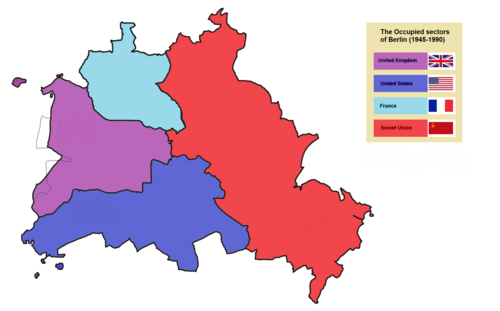
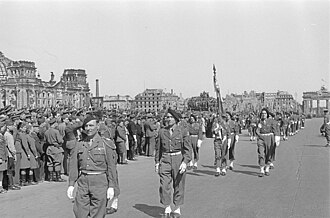
Additionally, the Saar Protectorate was initially part of the zone but was separated on February 16, 1946, with customs controls established by December of that year. In Berlin, the districts of Reinickendorf and Wedding were assigned to French administration starting February 9, 1945.
Governance and Political Transition
The zone was headquartered in Baden-Baden. Military leadership began with Jean de Lattre de Tassigny, who represented France during the signing of the German Instrument of Surrender, before the command passed to Marie-Pierre Kœnig. Diplomatic relations were managed by André François-Poncet, who served as high commissioner and later as ambassador until 1955.
Political life began to normalize with the first Landtag (state parliament) elections on May 18, 1947. This led to the formation of various coalition governments involving the CDU, SPD, FDP, and KPD, marking the early steps toward the democratic governance of the Federal Republic of Germany.
Key Facts
- Duration: 1945 to 1949.
- Capital: Baden-Baden.
- Total Population: Approximately 5 million (excluding the Saar Protectorate).
- Key Leaders: Jean de Lattre de Tassigny and Marie-Pierre Kœnig (Military Governors).
- Successor State: West Germany (Federal Republic of Germany).
- Key Territories: Rheinland Pfalz, South Baden, and Württemberg-Hohenzollern.
| Category | Details |
|---|---|
| Timeframe | 1945–1949 |
| Administrative Center | Baden-Baden |
| Population Distribution | Rheinland Pfalz (2.7M), South Baden (1.2M), Württemberg-Hohenzollern (1.05M) |
| Key Dates | May 8, 1945 (Surrender); May 23, 1949 (FRG established) |
| Military Command | French Forces in Germany |
Frequently Asked Questions
Why was France initially excluded from the occupation zones?
France was not invited to the Yalta Conference where the initial three-zone division was planned by the United States, United Kingdom, and Soviet Union.
How did France obtain its occupation zone?
General Charles de Gaulle demanded a zone to restore French national honor. The other Allies agreed to relieve their own administrative burdens, and the French zone was created from land ceded by the American and British zones.
What happened to the Saar Protectorate?
While initially part of the French zone, the Saar Protectorate was separated on February 16, 1946, and established its own customs controls by the end of that year.
Which German states were created within the French zone?
The French established Rheinland Pfalz, South Baden, and Württemberg-Hohenzollern. Later, South Baden and Württemberg-Hohenzollern merged with Württemberg-Baden (from the American zone) to form Baden-Württemberg.
Who were the primary military governors of the zone?
The zone was first commanded by Jean de Lattre de Tassigny and subsequently by Marie-Pierre Kœnig.