Free Syrian Army
The Free Syrian Army (FSA) emerged in 2011 as a primary armed opposition force during the Syrian Civil War. Founded by defectors from the Syrian Arab Army, the organization sought to challenge the government of Bashar al-Assad. Over more than a decade, the FSA evolved from a centralized command of defecting officers into a decentralized network of brigades, eventually integrating into larger coalitions or transitioning into the Syrian National Army.
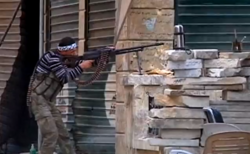
Initially, the FSA functioned as a "big tent" organization, encompassing a wide array of political positions and regional militias. Its early operations were characterized by checkpoint raids, ambushes on army convoys, and urban fighting in cities like Homs and Aleppo.
Key Facts
![Areas of conflict and displacement (light purple), refugee camps (yellow triangles), displaced in host homes (green houses), FSA held territory (red), June 2012.[253][254]](/images/3b/3f/3b3f096f684814cbeb59d147baed2238187530881480bc013e1fc42fe3954967.jpg)
- Founded: July 29, 2011, by Riad al-Asaad and other defecting officers.
- Peak Strength: Reached approximately 87,000 fighters by May 2013.
- Core Composition: Originally formed by Syrian Arab Army defectors and later joined by civilian volunteers.
- Key Alliances: Aligned with the Syrian National Coalition (2013–2017).
- Evolution: Transitioned from a central organization (2011–2015) to a decentralized identity (2015–2025).
Formation and Early Operations (2011–2012)
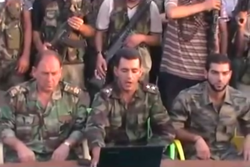
The FSA was established in July 2011 by seven officers who defected from the Syrian Arab Army. The early phase of the conflict saw a surge in defections, as soldiers refused to fire on civilian protesters and instead turned their weapons against the regime. These defectors organized into local battalions, conducting high-profile attacks on intelligence complexes in Damascus and Idlib, as well as the Homs airbase.
By 2012, the FSA reached the height of its influence. The organization expanded rapidly, with troop numbers growing from 25,000 in late 2011 to 75,000 by mid-2012. During this period, the FSA focused on guerrilla warfare and the capture of strategic territory, particularly in the northern and southern regions of the country.
![Areas of conflict and displacement (light purple), refugee camps (red triangles), displaced in host homes (green houses), FSA held territory (red), June 2012.[253][254]](/images/35/f8/35f8faf4d3432cb22fcfdd9ab4999f5a69919f998e341899873563185d564acd.jpg)
Command Structure and Regional Leadership
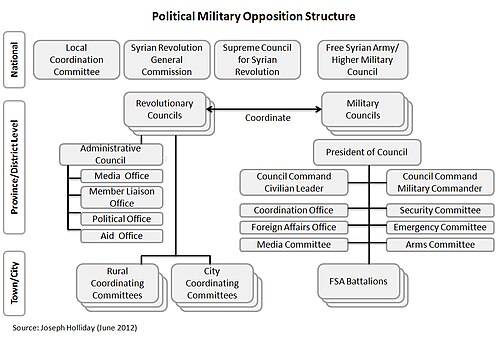
To manage the growing number of fighters, the FSA established a provincial command structure. Notable leaders included Colonel Abdel Jabbar al-Oqaidi in Aleppo and Colonel Khaled al-Haboush in Damascus. The organization also saw the rise of prominent brigades, such as the Farouq Brigades in Homs and the Al-Tawhid Brigade in Aleppo.
Evolution and Decline (2013–2015)
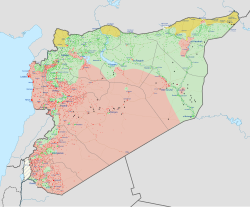
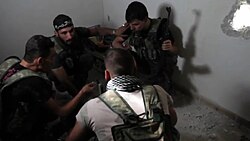
Starting in 2013, the landscape of the Syrian opposition shifted. The rise of Islamist factions began to erode the FSA's influence, as some fighters defected to more radical groups. By 2014, the emergence of the Islamic State of Iraq and the Levant (ISIL) created a new front, forcing many FSA units to fight both the Syrian government and ISIL simultaneously.
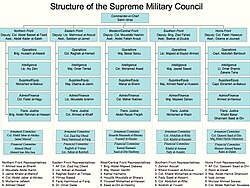
The intervention of Russia in 2015 further complicated the conflict. While the FSA continued to operate, the organization became increasingly decentralized. The Supreme Military Council (SMC), which served as the military wing of the Syrian National Coalition, struggled to maintain a unified command over the various independent brigades.
Later Years and the Syrian National Army (2016–2025)
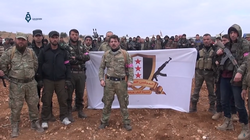
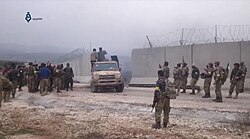
From 2016 onward, the FSA's role shifted toward Turkish-led operations against ISIL and the Syrian Democratic Forces (SDF). Many remaining FSA units were integrated into the Syrian National Army (SNA), which focused on controlling territories in northern Syria.
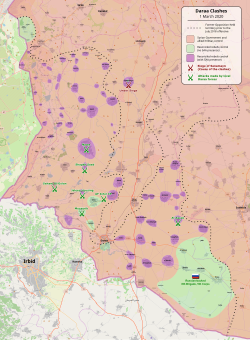
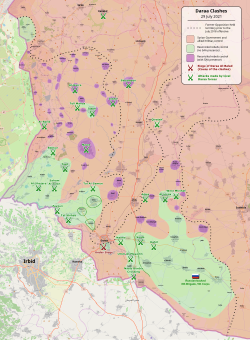
Despite the centralization into the SNA, the "FSA" identity continued to be used ad hoc by various groups. In southern Syria, particularly in Daraa, FSA-aligned fighters continued to clash with government troops well into 2021. By 2025, the organization had largely transitioned from a central command to a fragmented series of local forces.
Equipment and International Support
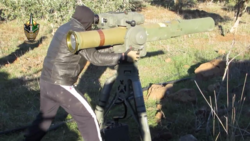
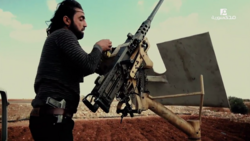
The FSA received varying levels of support from international actors, including the United States, Turkey, Qatar, and Saudi Arabia. This support included financial aid and weaponry, most notably the American-made BGM-71 TOW anti-tank missiles and M2 Browning heavy machine guns.
Summary of FSA Leadership and Growth
| Period | Primary Leader/Body | Estimated Size | Status |
|---|---|---|---|
| Late 2011 | Riad al-Asaad | 25,000 | Formation |
| Mid-2012 | Riad al-Asaad | 75,000 | Rapid Expansion |
| May 2013 | Salim Idris (SMC) | 87,000 | Peak Strength |
| December 2015 | Various (Decentralized) | 35,000 | Decline/Fragmentation |
Frequently Asked Questions
Who founded the Free Syrian Army?
The Free Syrian Army was founded on July 29, 2011, by Riad al-Asaad and a group of defecting officers from the Syrian Arab Army who sought to protect civilians and overthrow the government.
What was the role of the Supreme Military Council?
The Supreme Military Council (SMC) was established between 2012 and 2015 to serve as the centralized military leadership and the military wing of the Syrian National Coalition.
How did the FSA differ from the Syrian National Army?
The FSA began as a loose coalition of defectors and militias. The Syrian National Army (SNA) is a more structured force, largely backed by Turkey, that absorbed many former FSA units in northern Syria.
What weapons did the FSA use?
While they used captured Syrian government equipment, the FSA also received international arms, including US-made BGM-71 TOW anti-tank missiles and M2 Browning heavy machine guns.
Did the FSA fight other groups besides the Syrian government?
Yes. While their primary enemy was the Syrian government, FSA units also engaged in combat against ISIL and, in some instances, clashed with the Syrian Democratic Forces (SDF).