Franz Miklosich and the Evolution of Slavic Philology
Franz Miklosich was a towering figure in 19th-century linguistics whose scholarly rigor transformed the study of Slavic languages. Though his academic journey began in the realm of law, his intellectual curiosity led him toward philology—the study of language in oral and written historical sources—where he would eventually leave an indelible mark on European academia.
Academic Transition and Early Career
Miklosich initially served as a professor of philosophy at the University of Graz. In 1838, he transitioned to the University of Vienna to pursue a doctor of law decree. However, during this period, he encountered the works of Jernej Kopitar, a prominent Slovenian philologist and linguist. This influence proved pivotal; Miklosich abandoned his legal studies to dedicate his life to the scientific analysis of Slavic languages.
In 1844, he secured a position at the Imperial Library of Vienna, a post he held until 1862. That same year, he published a critical review of Franz Bopp's Comparative Grammar. This work caught the attention of Vienna's academic elite and served as the catalyst for a prolific series of publications that demonstrated his immense erudition and triggered a revolutionary shift in how Slavic languages were studied.
Leadership and Academic Influence
Miklosich's expertise led to his appointment in 1849 to the newly established chair of Slavic philology at the University of Vienna, a position he maintained until 1886. His influence extended far beyond the classroom into the highest levels of institutional governance and international scholarship.
He was a distinguished member of the Academy of Vienna, serving as the secretary of its historical and philosophical section. His leadership roles included serving as the Dean of the Faculty of Philosophy for three terms between 1850 and 1865, and as Rector during the 1853/1854 academic year. Additionally, he was a member of the council of public instruction, a member of the upper house, and a correspondent of the French Academy of Inscriptions and Humanities.
Broad Linguistic Research and the Romani Study
While primarily known for his work with Slavic languages, Miklosich's research was expansive, encompassing Romanian, Aromanian, Albanian, Greek, and Romani. One of his most significant contributions occurred between 1872 and 1880 with the publication of Über die Mundarten und Wanderungen der Zigeuner Europas.
This comprehensive survey of Romani dialects provided an historical-comparative grammar, a lexicon, and an analysis of migration routes and origins. Through his research, Miklosich identified a substantial Greek element common to Romani dialects, leading him to designate a "Greek-speaking area" as the European homeland of the Gypsies.
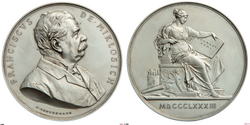
In recognition of his lifelong contributions to science, the Austrian Academy of Sciences commissioned a special medal for him in 1883 to celebrate his 70th birthday.
Key Facts
- Primary Field: Slavic philology and comparative linguistics.
- Key Appointment: Held the first chair of Slavic philology at the University of Vienna (1849–1886).
- Major Work: Authored a definitive survey on Romani dialects and migrations (1872–1880).
- Academic Reach: Researched Slavic, Romanian, Aromanian, Albanian, Greek, and Romani languages.
- Institutional Roles: Served as Rector of the University of Vienna (1853/1854) and Dean of the Faculty of Philosophy.
| Year/Period | Achievement/Role | Institution/Context |
|---|---|---|
| 1838 | Doctor of Law decree | University of Vienna |
| 1844 | Librarian | Imperial Library of Vienna |
| 1849–1886 | Professor of Slavic Philology | University of Vienna |
| 1853–1854 | Rector | University of Vienna |
| 1872–1880 | Published Romani dialect survey | Comparative Linguistics |
| 1883 | Awarded commemorative medal | Austrian Academy of Sciences |
Frequently Asked Questions
What was Franz Miklosich's original field of study?
Miklosich originally studied law and received a doctor of law decree from the University of Vienna in 1838 before switching his focus to linguistics.
Who influenced Miklosich to study Slavic languages?
He was heavily influenced by the works of Jernej Kopitar, a Slovenian philologist and linguist, during his time as a student.
What was the significance of his work on Romani dialects?
Between 1872 and 1880, he published a detailed survey that included a lexicon and comparative grammar, identifying a Greek-speaking area as the European homeland of the Gypsies based on linguistic evidence.
Which languages did Miklosich study besides Slavic languages?
His extensive writings also covered Romanian, Aromanian, Albanian, Greek, and Romani.
What academic positions did he hold at the University of Vienna?
He held the chair of Slavic philology, served three terms as Dean of the Faculty of Philosophy, and served as Rector for the 1853/1854 term.