Frank Knox: The Legacy of a Versatile Destroyer
The Frank Knox was more than just a vessel; it was a testament to mid-century naval engineering and adaptability. Built in Bath, Maine, and named in honor of the Secretary of the Navy, this destroyer served through some of the most pivotal conflicts of the 20th century, evolving from a World War II combatant into a specialized radar picket and eventually a cornerstone of the Greek Navy.
World War II and Early Service
Commissioned in December 1944, the Frank Knox entered the western Pacific war zone in mid-June 1945. As part of Task Force 38, the ship participated in the final carrier air raids targeting the Japanese home islands. During the Battle of Okinawa, she served as a radar picket destroyer—a specialized role providing early warnings of incoming enemy air raids to protect the main fleet.
The ship witnessed the conclusion of the war firsthand, present in Tokyo Bay on September 2, 1945, for the formal Japanese surrender. After remaining in the Far East until February 1946, the vessel continued regional deployments throughout the late 1940s. In March 1949, her role was formalized through a reclassification as a radar picket destroyer, designated as DDR-742.
The Korean War and Cold War Era
With the outbreak of the Korean War in July 1950, the Frank Knox returned to the Pacific. Her combat tour, which extended into 1951, was marked by diverse missions including the support of the Inchon invasion, patrolling the Taiwan Straits, and shelling enemy targets on shore. She completed two additional cruises during the conflict in 1952 and 1953.
Throughout the remainder of the 1950s, the ship remained a staple of the Seventh Fleet, deploying regularly to the WestPac (Western Pacific) region. To keep the vessel viable in a changing technological landscape, she underwent the FRAM II program (Fleet Rehabilitation and Modernization) between 1960 and 1961. This modernization provided the ship with updated radars and advanced equipment to meet contemporary naval threats.
Vietnam Conflict and the Pratas Reef Incident
After being based in the Far East from 1961 to 1964, the Frank Knox deployed again in June 1965 to support operations off the coast of Vietnam, where she conducted coastal patrols and provided naval gunfire support.
On July 18, 1965, while underway in the South China Sea via Tsoying Naval Base, Taiwan, the ship ran aground on Pratas Reef. The resulting salvage effort was grueling and difficult. Despite sustaining severe damage and being an older vessel, the ship's command and control capabilities were deemed valuable enough to justify extensive repairs, which were completed at Yokosuka, Japan, over the following year.
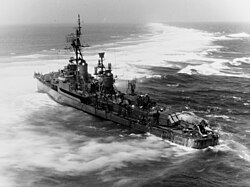
Returning to active duty in November 1966, the ship resumed annual Seventh Fleet cruises and continued its involvement in Vietnam combat missions. In early 1969, she was redesignated as DD-742. Following her final deployment in November 1970, she was decommissioned in January 1971.
Greek Naval Service as Themistoklis
The ship's journey did not end with its U.S. decommissioning. Shortly after, it was transferred to the Greek Navy and renamed Themistoklis (D210), after the Athenian statesman who convinced Athens to build a navy to defeat the Persians. The vessel served Greece for two more decades before being placed out of commission in the early 1990s.
The ship's final chapter occurred on September 12, 2001, when it was used as a torpedo target and sunk by the Greek submarine Nireus (S-111).
Key Facts
- Original Name: USS Frank Knox (DDR-742 / DD-742)
- Greek Name: Themistoklis (D210)
- Commissioned: December 1944
- Major Conflicts: World War II, Korean War, Vietnam War
- Modernization: FRAM II program (1960–1961)
- Final Fate: Sunk as a torpedo target on September 12, 2001
| Period | Designation | Primary Role/Event |
|---|---|---|
| 1944–1945 | USS Frank Knox | WWII / Task Force 38 / Battle of Okinawa |
| 1949 | DDR-742 | Reclassified as Radar Picket Destroyer |
| 1950–1953 | DDR-742 | Korean War / Inchon Invasion support |
| 1960–1961 | DDR-742 | FRAM II Modernization |
| 1965 | DDR-742 | Aground on Pratas Reef |
| 1971–1990s | Themistoklis (D210) | Greek Navy Service |
Frequently Asked Questions
What was the role of a radar picket destroyer?
A radar picket destroyer, such as the Frank Knox during the Battle of Okinawa, was positioned away from the main fleet to provide early warning of incoming enemy air raids, acting as a defensive screen.
What was the FRAM II program?
The FRAM II (Fleet Rehabilitation and Modernization) program was a mid-life upgrade conducted between 1960 and 1961 that provided the Frank Knox with updated radars and new equipment to extend its operational utility.
How did the ship survive the Pratas Reef incident?
Although the ship was badly damaged after running aground in 1965, its command and control capabilities were considered essential enough to justify a year of extensive repairs in Yokosuka, Japan.
Why was the ship renamed Themistoklis in Greek service?
The ship was named after Themistocles, the Athenian statesman who persuaded Athens to build a powerful navy, which subsequently led the city to victory over the Persians.
How did the ship finally meet its end?
After being decommissioned by the Greek Navy in the early 1990s, the vessel was used as a torpedo target and sunk by the Greek submarine Nireus (S-111) on September 12, 2001.