Francisco Tárrega: The Father of Modern Classical Guitar
Francisco de Asís Tárrega y Eixea was a visionary Spanish composer and guitarist of the late Romantic period whose influence fundamentally reshaped the classical guitar. Known for his technical mastery and lyrical compositions, Tárrega elevated the guitar from a simple accompaniment instrument to a respected solo recital instrument, laying the groundwork for the 20th-century classical guitar tradition.
His legacy survives not only through his students and technical innovations but also through timeless pieces such as Capricho Árabe, Recuerdos de la Alhambra, and the Gran Vals—the latter of which gained unexpected global fame as the basis for the iconic Nokia ringtone.
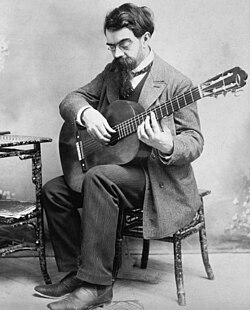
Key Facts
- Born: November 21, 1852, in Villarreal, Spain.
- Died: December 15, 1909, in Barcelona, Spain.
- Key Works: Recuerdos de la Alhambra, Capricho Árabe, and Lágrima.
- Major Influence: Integrated Romantic classical styles with Spanish folk elements.
- Technical Legacy: Pioneered the use of cut fingernails to achieve a specific tonal quality.
- Education: Studied at the Madrid Royal Conservatory under Emilio Arrieta.
Early Life and Musical Beginnings
Born in Villarreal, Tárrega's early exposure to music came from his father, who played flamenco and various other styles. As a child, nicknamed "Quiquet," Francisco would experiment with his father's guitar while his father worked as a watchman.
A childhood accident involving an irrigation channel left Tárrega with eye injuries. Fearing total blindness, his father moved the family to Castellón de la Plana so Francisco could study music, ensuring he could earn a living regardless of his sight. His first teachers, Eugeni Ruiz and Manuel González, were both blind.
Tárrega's talent was recognized early by concert guitarist Julián Arcas, who encouraged him to study in Barcelona. Despite his father's insistence that he also learn the piano—which was more prestigious in Europe at the time—Tárrega's passion for the guitar remained dominant. His youth was marked by a rebellious spirit, including multiple attempts to run away to pursue a musical career in coffee houses and restaurants.
Professional Development and the Influence of Torres
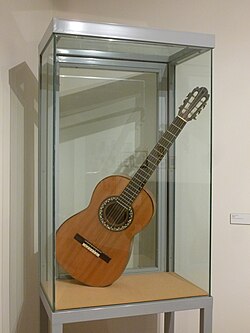
In 1874, Tárrega entered the Madrid Royal Conservatory with the support of Antonio Canesa. It was during this period that he acquired a guitar made by Antonio de Torres, a master luthier. The superior sonic qualities of the Torres guitar profoundly influenced Tárrega's playing style and his belief in the instrument's potential for complex composition.
At the conservatory, Tárrega studied composition under Emilio Arrieta, who guided him to abandon the piano and focus exclusively on the guitar. By the late 1870s, Tárrega had established himself as a performer and teacher, instructing notable pupils such as Emilio Pujol, Miguel Llobet, and Daniel Fortea.
Travels, Inspiration, and Personal Life
Tárrega's career took him across Europe, including performances in Lyon and Paris, and a visit to London. It was during a period of homesickness in England that he composed Lágrima (teardrop), capturing his sadness in music.
In 1882, he married María José Rizo. The couple eventually settled in Barcelona in 1885, where Tárrega became part of a vibrant artistic circle that included Isaac Albéniz, Enrique Granados, and Pau Casals. He also found a significant patron in Concepción Gómez de Jacoby, whose support allowed him to travel to Granada. This visit inspired one of his most famous works, Recuerdos de la Alhambra, originally titled "A Granada" in 1899.
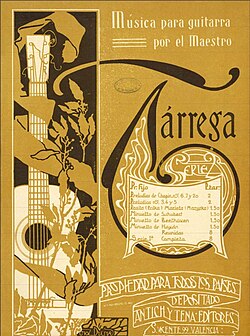
In his later years, Tárrega continued to innovate. During a visit to Algiers in 1900, he was inspired by an Arabian drum rhythm to compose Danza Mora. Around 1902, he began cutting his fingernails, creating a distinct sound that became a hallmark of his school of playing.
Musical Style and Lasting Influence
Tárrega's style was a sophisticated blend of 19th-century European Romanticism and Spanish folk elements. Unlike previous generations of Spanish guitarists, his work displayed a deeper familiarity with contemporary classical genres. He was often called the "Sarasate of the guitar" due to his virtuosity, though he personally preferred intimate settings over large concert stages.
Beyond his original compositions, Tárrega was a prolific transcriber. He adapted works by Beethoven, Chopin, and Mendelssohn for the guitar, as well as pieces by his friend Isaac Albéniz. While he published only 19 original works during his lifetime, he composed approximately 80 original pieces and 120 transcriptions.

Tárrega's health declined in 1906 after he suffered paralysis on his right side. Despite this, he continued to compose, finishing his final work, Oremus, on December 2, 1909, just thirteen days before his death.
Summary of Tárrega's Legacy
| Category | Details |
|---|---|
| Primary Genre | Romantic / Spanish Classical |
| Notable Compositions | Recuerdos de la Alhambra, Capricho Árabe, Gran Vals, Lágrima |
| Key Technical Shift | Transition to cut fingernails for specific tone |
| Instrument Influence | Promoted the use of Antonio de Torres guitars |
| Total Works | Approx. 80 original pieces and 120 transcriptions |
Frequently Asked Questions
What is Tárrega's most famous piece?
While he has several masterpieces, Recuerdos de la Alhambra is perhaps his most famous, known for its use of the tremolo technique to evoke the atmosphere of Granada.
How is Tárrega connected to the Nokia ringtone?
An excerpt from Tárrega's composition Gran Vals was used as the default ringtone for Nokia phones, appearing in various instrumentations over the years.
Why is Tárrega considered the father of modern classical guitar?
He is credited with laying the foundations for the 20th-century classical guitar by introducing sophisticated Romantic compositions, refining technical approaches, and establishing the guitar as a legitimate solo recital instrument.
Which guitars did Tárrega use?
Tárrega used several instruments, most notably those made by Antonio de Torres (including models FE 17, SE 49, and SE 114) and an Enrique Garcia guitar (n°74) which he later gifted to Alfred Cottin.
What was Tárrega's relationship with the piano?
Tárrega was a proficient piano player and was encouraged by his father to study it for professional stability. This keyboard knowledge allowed him to create high-quality transcriptions of piano works by composers like Chopin and Beethoven for the guitar.