Fractions: A Comprehensive Guide to Parts of a Whole
Derived from the Latin word fractus, meaning "broken," a fraction represents a part of a whole or a specific number of equal parts. In everyday language, we use fractions to describe quantities such as one-half, eight-fifths, or three-quarters. Whether you are slicing a cake or calculating probabilities, fractions are fundamental tools for expressing precise values.
A simple fraction consists of two main components: an integer numerator (the top number) and a non-zero integer denominator (the bottom number). The numerator tells you how many parts you have, while the denominator indicates how many equal parts make up a single whole unit. For instance, in the fraction 3/4, the 3 indicates three parts, and the 4 indicates that four parts constitute a whole.
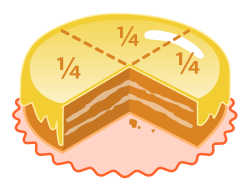
Key Facts
- Numerator: The number of equal parts being considered.
- Denominator: The total number of equal parts that make up a whole.
- Reciprocal: Every fraction (except zero) has a reciprocal, found by flipping the numerator and denominator.
- Equivalent Fractions: Fractions that represent the same value, such as 1/2 and 2/4.
- Decimal Relation: Fractions can be expressed as decimals by dividing the numerator by the denominator.
Mathematical Representations and Vocabulary
Fractions serve multiple mathematical purposes, acting as representations for both ratios and division. For example, the fraction 3/4 can represent the ratio 3:4 or the division operation 3 ÷ 4.
Reading Fractions Aloud
In English, denominators are typically expressed using ordinal numbers (e.g., one-fifth, two-fifths). There are several common exceptions:
- The denominator 2 is read as half or halves.
- The denominator 4 can be read as quarter or fourth.
- The denominator 100 is often read as percent.
For complex or large denominators, it is common to use cardinal numbers by saying the numerator "over" the denominator (e.g., "one over one hundred seventeen").
Negative Fractions
Negative fractions represent the opposite of positive values. Due to the rules of signed numbers, the position of the negative sign does not change the value: −1/2, -1/2, and 1/−2 all represent negative one-half. Conversely, a negative divided by a negative results in a positive, meaning −1/−2 is equal to positive 1/2.

Common Forms of Fractions
Fractions appear in various formats depending on the mathematical context:
- Simple/Vulgar Fractions: Standard fractions consisting of a numerator and denominator.
- Mixed Numbers: A combination of a whole number and a fraction (e.g., 2 1/4).
- Decimal Fractions: Fractions where the denominator is an integer power of ten, expressed using a decimal separator (e.g., 0.75).
- Percentages: A specific type of fraction where the implied denominator is always 100 (e.g., 51% = 51/100).
- Permille: A notation representing parts per thousand (e.g., 75 ppm = 75/1,000,000).
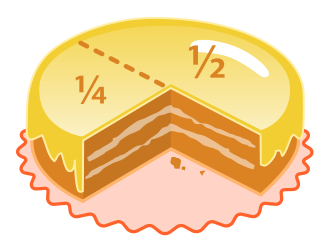
Arithmetic Operations
Equivalent Fractions and Simplifying
You can create an equivalent fraction by multiplying both the numerator and the denominator by the same non-zero number. This works because you are essentially multiplying the fraction by 1. To simplify or reduce a fraction, you divide both parts by their greatest common divisor.
Addition and Subtraction
To add or subtract fractions, they must have a common denominator. If they do not, you must convert them into comparable quantities. For example, to add quarters to thirds, both must be converted into twelfths.
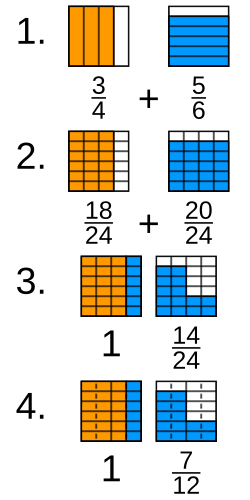
Multiplication and Division
Multiplication is straightforward: multiply the numerators together and the denominators together. When multiplying mixed numbers, it is often easiest to convert them into improper fractions first. For division, the process involves the relationship between the numbers, often involving the reciprocal.
Summary of Fraction Types
| Type | Example | Implied Denominator |
|---|---|---|
| Simple Fraction | 3/4 | 4 |
| Decimal Fraction | 0.75 | 100 (10²) |
| Percentage | 51% | 100 |
| Permille | 75 ppt | 1,000 |
Frequently Asked Questions
What is the difference between a numerator and a denominator?
The numerator is the top number that indicates how many parts are being counted, while the denominator is the bottom number that indicates the total number of equal parts in a whole.
How do I convert a fraction to a decimal?
To convert a fraction to a decimal, perform long division by dividing the numerator by the denominator. For example, 1 divided by 4 equals 0.25.
What is a reciprocal?
A reciprocal is what you get when you flip a fraction. For example, the reciprocal of 17 (which is 17/1) is 1/17.
Can a fraction have a negative denominator?
Yes, but mathematically, a fraction with a negative denominator is equivalent to a fraction with a negative numerator. For example, 1/−2 is the same as −1/2.
What are equivalent fractions?
Equivalent fractions are different fractions that represent the same value or proportion, such as 1/2 and 2/4 or 50/100.