Forest Hills Churches: The History of St. Andrew's and Upham Memorial
The architectural and spiritual landscape of the Forest Hills neighborhood in Jamaica Plain reflects the shifting demographics and social currents of Boston over the last century. From the dominance of Irish Catholic parishes to the rise of diverse community institutions, the stories of St. Andrew's and Upham Memorial Church provide a window into the area's evolution.
The Legacy of St. Andrew the Apostle Parish
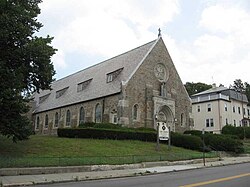
Established by the Archdiocese of Boston in 1918, St. Andrew the Apostle Church was positioned at the corner of Walk Hill and Wachusett Streets. For much of the 20th century, the parish served as the heart of the community, to the point where "Forest Hills" and "St. Andrew's Parish" were virtually synonymous.
The parish expanded significantly over the decades. In 1942, St. Andrew the Apostle School opened, supported by a convent that housed the Sisters of the Congregation of Saint Joseph and, later, the Sisters of Charity. The complex also included a rectory for priests and a dedicated community hall located across the street.
By the late 1940s, the neighborhood was predominantly Irish Catholic, though it also hosted Italian, French, Polish, Portuguese, and Scottish Catholic residents. This demographic concentration created a distinct social divide during the 1970s busing crisis. While violence erupted in other Boston neighborhoods, the impact in Jamaica Plain was less visible; many White families utilized parochial schools, while the local public schools—the Parkman and the Seaver—served a mostly Black and Latino student population.
Decline and Transition
Toward the end of the century, the parish faced a sharp decline driven by urban flight—the movement of residents away from an increasingly heterogeneous urban area—and a loss of trust in the archdiocese. The Catholic Church sex scandal hit the parish particularly hard, as John J. Geoghan, a notorious molester who ran the altar boy program from 1974 to 1980, had served there. One of his most prominent accusers, Patrick McSorley, was a member of this parish.
St. Andrew's Church closed in 2000, and the school followed in 2005, with remaining students transitioning to Sacred Heart School in Roslindale. In 2008, the entire campus—including the church, school, rectory, and convent—was purchased by the Bethel African Methodist Episcopal (AME) Church. This transition breathed new life into the buildings; Bethel AME leased the school facilities to the MATCH Charter School for its middle school and the Young Achievers Pilot School for arts space.
Upham Memorial Church
While St. Andrew's represented the Catholic experience, Upham Memorial Church served the Methodist community. Completed in 1901 at the corner of Wachusett and Patten Streets, the church was designed by James G. Hutchinson in the Tudor Revival style, characterized by its wooden construction, half-timbering, and a corner tower. An additional wing was added to the structure in 1925.
As the neighborhood became more heavily Catholic following World War II, attendance at Upham Memorial dropped, leading to its closure in 1969. The building remained vacant until 1977, when it was acquired by the Knights of Columbus. During their ownership, aluminum siding was installed, which obscured the original architectural details of the Tudor design.
The building later served as part of The Young Achievers School, a city-wide pilot school. Following the school's relocation to Mattapan, the former church building was converted into residential condominiums.
Key Facts
- St. Andrew's Founding: Built in 1918 by the Archdiocese of Boston.
- Demographic Shift: Predominantly Irish Catholic through the mid-20th century.
- Bethel AME Acquisition: Purchased the St. Andrew's campus in 2008.
- Upham Memorial Style: A Tudor Revival wooden church completed in 1901.
- Upham's Fate: Closed in 1969 and eventually converted into condominiums.
| Feature | St. Andrew the Apostle | Upham Memorial Church |
|---|---|---|
| Denomination | Catholic | Methodist |
| Year Completed | 1918 | 1901 |
| Closure Year | 2000 (Church) / 2005 (School) | 1969 |
| Current Use | Bethel AME Church / Charter Schools | Condominiums |
Frequently Asked Questions
What happened to the St. Andrew's school students after 2005?
Students who had not yet graduated from St. Andrew's School were given the option to attend Sacred Heart School in Roslindale.
Who currently owns the former St. Andrew's campus?
The campus was purchased in 2008 by the Bethel African Methodist Episcopal (AME) Church.
What architectural style was used for Upham Memorial Church?
Upham Memorial Church was designed by James G. Hutchinson in the Tudor Revival style, featuring half-timbering and a corner tower.
Why did attendance decline at St. Andrew's Parish?
The decline was caused by a combination of urban flight as the area became more ethnically diverse and widespread dissatisfaction with the archdiocese following the Catholic Church sex scandal.
What was the role of the Knights of Columbus at Upham Memorial?
The Knights of Columbus acquired the building in 1977 and added aluminum siding, which covered many of the original architectural details.